
 English
 Français
  Deutsch
 Italiano
 Turkish
 Greek
Greek Serbian
Gjergj Fishta: The Homer of Albanian Letters and His Enduring Legacy




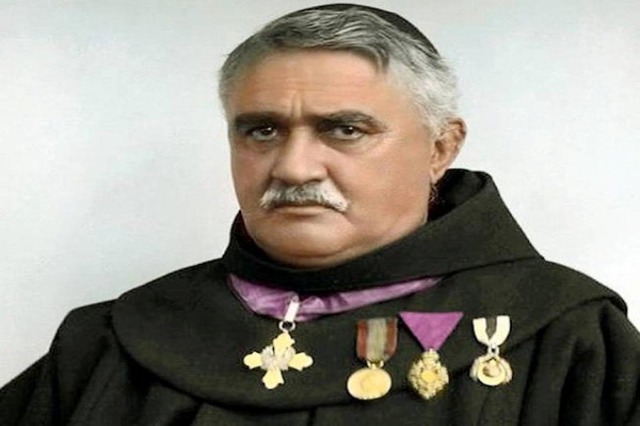
On October 23, 1871, Gjergj Fishta, hailed as the “Homer of Albanian letters,” was born. His epic poem Lahuta e Malcis, to which he dedicated 40 years of work, immortalized his figure as a literary creator. Parallels have been drawn between his masterpiece and the Iliad of the ancient Greek author, with Fishta’s work also displaying affinities with Dante and Goethe, especially in its blending of mythology with reality, philosophical thought, and dramatic intensity.
Fishta received his early education at the Franciscan seminary in Shkodra and pursued further studies in Bosnia in the fields of philosophy and theology. He was the first Albanian director of the Franciscan School, where he ensured that the Albanian language was introduced as a medium of instruction. As a representative of the “Bashkimi” society, he participated in the Congress of Manastir and, as chairman, led the activities of the Alphabet Commission.
In 1913, Fishta founded the literary-cultural journal Hylli i Dritës. During World War I, alongside Luigj Gurakuqi, he co-founded the Literary Commission, which aimed to develop a national literary language. In 1920, he was appointed General Secretary of the Albanian delegation at the Paris Peace Conference, and that same year, he was elected as a deputy representing Shkodra. He also took part in the June Revolution of 1924.
For his contributions to education, literature, and religion, Fishta was awarded the “Foenix” decoration in 1931 and became a member of the Italian Academy in 1939.
Father Gjergj Fishta passed away in his hometown of Shkodra on December 30, 1940.
/a.c/
Të ngjashme
Latest News


Most read







 RTI
RTI