
 English
 Français
 Deutsch
 Italiano
 Turkish
 Greek
 Serbian
Gjirokastra Bazaar




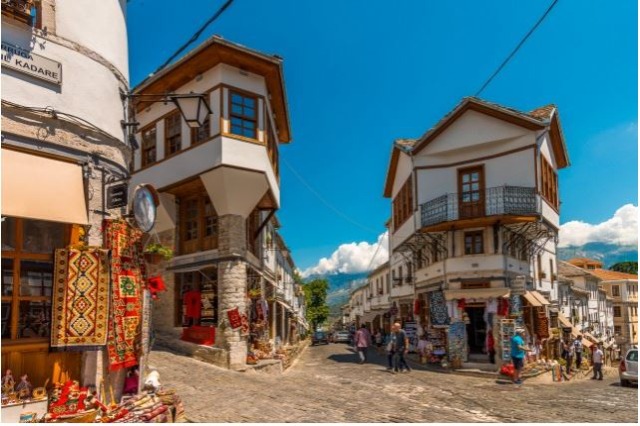
The amazing architectural, historical, commercial and cultural ensemble is the buzzword of local residents and those who come to Gjirokastra. All the roads that connect the old and new quarters of the city meet in the small square, Qafa e Pazarit. This strategic point is the center of the bazaar and the historic city.
The castle, the Angonat complex, the Obelisk, the hexagon and the mosaic on the cobblestones are the views that can be seen from this point. About 100 shops are located on both sides of the 5 roads that branch off from the Qafa e Pazarit. Traders, craftsmen, artisans, bars, restaurants, hostels can be found on both sides of the roads. They preserve the main feature of this ensemble and prove the purpose of creation, the exercise of the skills of the time, the exchange of goods and consequently the exchange of cultures, traditions and customs between the areas in the south of Albania.
The revitalization of the area, the restoration of facades, walls, roofs, windows, shutters, lighting, has given a positive boost to trade, crafts, handicrafts, hotels, and inns left in oblivion for decades. The bazaar is now one of the tourist attractions and the center of tourist businesses, one of the most unique in the region.
The bazaar was built at the end of the 18th century and the beginning of the 19th century. Like the whole city, the architecture belongs to the Ottoman style. One of the traditions passed down through the generations is that of determining the dimensions of these roads. Fortunately, they still exist today in the same shape and size. Engineers determined the width of the road by exchanging two loaded horses. The steep streets did not favor the passage of carts, so until recently goods were transported by animals.
Even though hundreds of years have passed since the construction, the people of Gjirokastrites still call it the new bazaar. The reason is the existence of the first bazaar of the city, the old one in the neighborhood that bears the same name today. Restorative interventions in recent years have revealed interesting data. The beginnings of this bazaar stand on the ruins of another. Many new buildings stand on the foundations of old buildings that most likely coincide with another legend. The burning of the bazaar and its rebuilding in
the same place.
Sections of cobblestones about 1.5 meters below the current level of the road and underground spaces or catacombs were recently discovered. These findings point to another level of the bazaar and shed light on the historical stratification of the stone city.
This ensemble is a living proof of the special relationship of the residents, who together with stone and wood have carved here precious values of spiritual, material and cultural heritage.
/Klara Ruci/
Të ngjashme












Most read










 RTI