
 English
 Français
  Deutsch
 Italiano
 Turkish
 Greek
Greek Serbian
Gjon Buzuku who printed the first book of Albanian literature in 1555




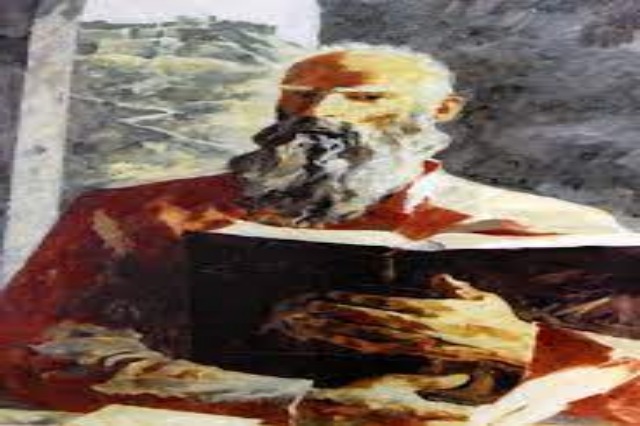
Gjon Buzuku occupies a fundamental place in the Albanian literature with the book ‘Meshari’ /The Mass/. It was a church liturgical book known as Meshari /The Mass/, according to the liturgical character it contains.
Gjon Buzuku is considered as the first known author of Albanian literature to date. Works in the Albanian language during the first centuries of the Ottoman conquest are few. The oldest of them that has reached our days is Gjon Buzuku’s “Meshari” /The Mass/ (1555).
But who was the author, where was he from, where did he work, on what basis was he able to write and publish his book, these are questions that still have not found a complete answer.
The little we know about the author’s life, about the difficulty he encountered, about the work, the purpose and about the time when he wrote or published his work, we learn only from the afterword of the book. Gjon Buzuku was a Catholic priest, a simple parishioner, who apparently worked in Northern Albania, not far from where he published his work, probably in the territory of Ulqin and Tivar. As he tells us, he began the work on March 20, 1554 to finish it on January 5, 1555, the time he worked on the Albanian version, or on its publication, is not clear.
The book, as it stands today, is 188 pages long, with the first 16 pages missing and several more in between. So, having neither the cover nor the first page, we do not know its real title nor we know the place of publication. Hard to it is a misfortune or a blessing. Perhaps, if it had the cover or even the first page, the book could have disappeared, because it seems to have been on the list of those books that were banned by the Roman Catholic Church. So all its copies have disappeared from circulation and only this mutilated one remained. This is probably the reason that today it is found only in a hidden and forgotten copy that has escaped the eye of the inquisition.
The copy that is found has apparently been used a lot.
In addition to the torn pages, on many pages on the side there are notes and names of priests who, apparently, had it in their hands.
The content of the book is religious and mainly with parts of the liturgy, parts that are read and recited only by clerics in church services.
It is a translation of a book in Latin. The language of the work is in the dialect of Northern and Western Albania.
The content of the work testifies to the use of Albanian in religious services. We are at the time when the movement to break away from the Catholic Church of Rome, the movement known as Protestantism, had broken out in Europe. One of the main demands of this movement was that church services be held in the mother tongue. Even Buzuku, it seems, walks this path, even though it is against the orders of the Vatican. From what he says in the afterword, it seems that Buzuku did not enter this path by chance.
In the circumstances created in Albania by the Ottoman conquest, the Catholic Church of Rome was forced to make concessions, while on the other hand it was a way to preserve the Albanian being, by carrying church services in mother tongue. Buzuku understood this and used it, motivated not only by religious but also patriotic goals.
All considered, it is evident with the work of Buzuku, we have a continuation of the Albanian culture and in the difficult conditions of the Ottoman conquest, a culture that was enriched later with the works of Budi, Bardhi, Bogdani and othersin the Albanian language.
From its publication until 1740, Meshari was a lost work, an unknown work, for almost two centuries. In 1740, it was discovered in the Library of Propaganda Fides near Rome by the Gjakova author, Gjon Kazazi. This discovery caused a great stir, because it is the first book printed in the Albanian language. After that, the matter remained silent again for more than a century until 1900, when Arbëresh, Pal Skiroi rediscovered it, no longer in the Propagada Fides Library, but in the Vatican Library, in Rome, where it is still found today. In 1932 the book was photocopied in three copies, one of which is in the Albanian National Library. In 1968 a scientific edition of Buzuku’s work came out, accompanied with a wider study of the language and the merits of the author.
The language of the work is based on the speech of Northeast Albania, but the effort to raise it above the dialect from which it started is noticeable. In Buzuku’s work we sometimes also find parts of a narrative prose, of a prose with literary values, which stands out for the mastery of the use of words, and the certainty of more or less stable linguistic constructions. The sacrifice of Buzuku is very important for the history of the printed Albanian language. By comparing the language of Buzuku with today’s Albanian, we can see different developments that Albanian has had since the 16th century until today, almost for five centuries.
To the much beloved Our World,
I am not surprised if I have committed any error. This being the very first effort and too difficult to operate in our tongue, ‘cause they that were printing had a great fatigue and hard it would be that they did not make any mistake….
-A Fragment in English from Gjon Buzuku’s ‘Meshari’ /The Mass/-
/a.p./
Të ngjashme
Latest News




Most read









 RTI
RTI