
 English
 Français
 Deutsch
 Italiano
 Turkish
 Greek
 Serbian
Grand Park of Tirana: A Green Oasis of History, Culture, and Recreation




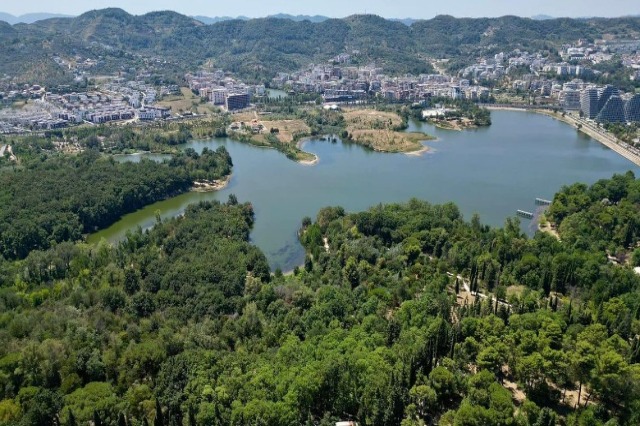
The Grand Park of Tirana, also known as the Park on the Artificial Lake, is a 289-hectare public park located in the southern part of Tirana, Albania. Managed by the Agency of Parks and Recreation of the Municipality of Tirana, it is one of the city’s most cherished green spaces.
The park features an artificial lake, as well as several notable landmarks, including the Saint Procopius Church, the Presidential Palace, and memorials dedicated to various prominent Albanian figures. Despite the growing development of buildings surrounding the park, it remains a peaceful retreat for many locals. Early-morning jogs and strolls have become daily routines for residents. At the southern end of the park, you’ll find the Zoo and the Botanical Garden, which houses numerous plants and flowers native to Albania.
The Botanical Garden spans 14.5 hectares and is home to nearly 120 species of trees, shrubs, and flowers. The artificial lake covers 55 hectares, while the entire park occupies 230 hectares.
Built between 1955 and 1956 according to a Bulgarian design, the park was originally known as the Gogo Stable, situated in a green area. It stretches from the southern end of Dëshmorët e Kombit Boulevard, after the University of Tirana, and lies south of Skanderbeg Square. The park was once called the ‘Park of Saint Procopius,’ named after the nearby Saint Procopius Church. Inside the park, visitors can find memorials commemorating 45 British and Australian soldiers who fell during World War II, as well as a memorial for hundreds of German soldiers who died in the same conflict.
The park also houses the Royal Palace, which sits near Elbasan Street. Originally constructed by Zog of Albania, the palace briefly served as the Royal residence for Italian King Victor Emmanuel III during his only visit to Albania in May 1941. Today, the palace is the official residence of the President of Albania.

The park was once the site of a monument dedicated to Sadijé Toptani, the mother of King Zog. The monument was destroyed by the communist regime in the 1950s and now survives only in photographs. A wall was later built to demarcate the park’s boundaries.
Known as the “Lung of the City” due to its lush plant diversity, the Grand Park also includes a botanical garden, a zoo, and a swimming pool complex. An amphitheater within the park hosts various cultural events, especially during the summer months. The artificial lake, which was constructed using local waters in 1955 with the help of volunteer labor, serves as a popular spot for fishing and swimming.
Additionally, the park is the final resting place of the Frashëri brothers—Abdyl, Naim, and Sami Frashëri. In 1998, the remains of Faik Konitza, Albania’s former Minister to Washington and publisher of Albania magazine, were moved from the United States and interred at the park.
In 2020, Albania unveiled a Holocaust memorial at the park’s entrance, near Mother Teresa Square, to honor both the victims of the Holocaust and the Albanians who risked their lives to protect Jews during World War II. The inscription on the memorial, written in English, Hebrew, and Albanian, reads: “Albanians, Christians and Muslims endangered their lives to protect and save the Jews.”
The Grand Park of Tirana offers a tranquil environment for relaxation, exercise, and cultural activities. It serves as a symbol of sustainable urban planning and underscores the importance of preserving green spaces to improve the quality of life in cities.
Të ngjashme
Latest News










Most read










 RTI