
 English
 Français
 Deutsch
 Italiano
 Turkish
 Greek
 Serbian
History of”black gold”discovery in Albania




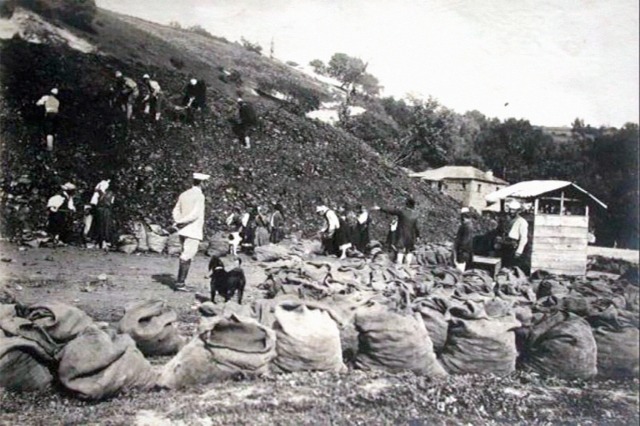
Industrial development, especially in the 20th century, made oil return to the primary source of energy. In this way, oil research begins in many countries of the world, and as a result, the first studies commenced even in Albania.
For the first time, signals for the presence of oil in Albania were given by a Frenchman in 1868. The geologist Henri Coquard did a study where he signaled that in the area around the bitumen mine in Selenica, Vlora, where natural bitumen had been extracted for centuries, the presence of gas and oil.Then, in 1905, the Italian geologist Alessandro Martelli made a detailed study of the Selenica mine, while in the years 1910-1912 he published various studies on the assets in the surroundings of Vlora.
In 1913, a team of 7 Italian professors visited Albania to study its natural potential. Two of them make a study of the Albanian soil in the area between Durres, Elbasan and Vlora and signal for the first time the presence of oil in the area of Berat.
The outbreak of the First World War brought the Italian, Austro-Hungarian and French armies to Albania. Part of the military troops were well-known geologists of the respective countries, whose mission was clear.
In this way, the Italian army that administered Vlora as soon as it came to the Albanian territory found an interesting phenomenon in the area of Sherishta in Vlora; “the water sources took heavy oil with them in their flow!”.
In this way, the Italian Navy brings to Albania a commission of oil technicians and geologists who carry out a geological and tectonic study between Vjosa and the bay of Vlora, coming to the conclusion of choosing a point where the first excavation or exploration for extraction would be carried out of ‘black gold’.
In early 1918, the team headed by geologist Leo Maddalena and oil drilling engineer Odoardo Amoretti installed a construction site in the Drashovica field in Vlora, which was selected as the most suitable spot.
The results of the oil drilling were very interesting as no deeper digging than 200 meters was needed to reach the oil source.
Daily production was 3 thousand liters per day. This was considered as a result of great importance because the study confirmed that Albania had oil resources that could meet the high demand that the railways and the Italian industry itself had for oil.
The discovery was attempted to be kept secret and was not published until 1924, but in the meantime word had circulated internationally igniting what could be considered the ‘Albanian black gold fever’.
But the War of Vlora in 1920 would bring about the departure of the Italians and consequently an interruption of the process of oil extraction and further research.
The Italians themselves, in the articles published in 1942, would cast doubts that Britain had influenced their violent departure, but they did not have a fact to prove this claim.
In this way, the discovery of oil had turned Albania into the center of the interests of the states with the most developed industry, which did not immediately hesitate to start discussions with the first Albanian government that came after the war.
In this way, Albania turned into a place of ‘pilgrimage’ for many representatives of the most famous international oil companies and many geologists.
/Klara Ruci/
Të ngjashme











Most read










 RTI