
 English
 Français
  Deutsch
 Italiano
 Turkish
 Greek
Greek Serbian
Ismail Kadare, the towering figure of Albanian letters, passes away at 88





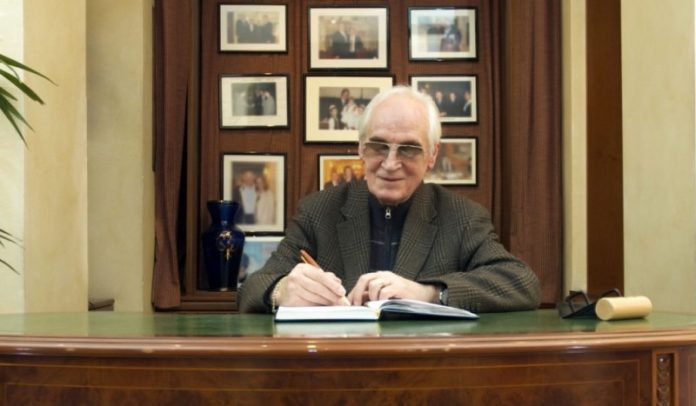
Ismail Kadare, the giant of Albanian literature and author of many works and poems translated into numerous languages worldwide, passed away in the early hours of the morning at the age of 88.
Ismail Kadare was born in Gjirokastër on January 28, 1936, and throughout his career, he was an academic, politician, and one of the greatest contemporary writers.
Kadare was known for his prose but also contributed to drama, poetry, and translations. He started writing at a young age, initially gaining recognition for his poetry and later becoming the foremost Albanian prose writer.
To date, his works have been translated into about 45 different languages, making him the primary representative of Albanian literature worldwide.
Kadare was nominated multiple times for the Nobel Prize in Literature.
He studied in Moscow but had to abandon his studies due to the severing of relations between Albania and the Soviet Union. Upon returning to his homeland, he began working as a journalist and pursued his literary career, also serving as the editor of the foreign literature section of the literary magazine “Drita.”
His works even escaped the censorship of the communist regime, such as his famous work “The Palace of Dreams.” Kadare received numerous international awards, including the “Cino del Duca” award, the “Man Booker” International Prize, the Prince of Asturias Award for Literature, the “Jerusalem Prize,” the “Nonino Prize” in 2018, the “Boccaccio Prize,” and the “Lerici Pea Prize” in Italy. French President Macron awarded him the title “Commander of the Legion of Honor,” describing him as a “wonderful author of Balkan history.”

Ismail Kadare’s Career
In the 1950s and early 1960s, Kadare became known for his poetry and prose. After returning from Moscow, he was advised to keep his work “The City without Advertisements” hidden. He published an excerpt as a novella titled “Days of Coffee Shops” in 1962 in “The Voice of Youth.” The publication was banned as a decadent work. In 1963, he published the novel “The General of the Dead Army,” about an Italian general and a priest who come to Albania to retrieve the remains of Italian soldiers who died in World War II. His subsequent novel, “The Monster,” was published in the magazine “Nëntori” but was banned.
In 1967, Kadare was part of a delegation of the Writers’ Union sent to China, along with several other delegations. At that time, the Cultural Revolution in China was at its peak. His experiences in communist China would later be reflected in his works.
In early 1970, the French publishing house Albin Michel published the French translation of “The General of the Dead Army.” It gained extraordinary recognition in France and was translated into nearly 20 languages within three years. He wrote and published the novels “The Castle” (1970) and “Chronicle in Stone” (1971), which were both published in France shortly after. During these years, he also edited the only foreign-language magazine of the Writers’ Union, “Les Lettres Albanaises.” After his success in France, he was appointed as a deputy and, two years later, became a member of the Albanian Party of Labor.
After publishing two novels with historical themes, Kadare faced criticism again for avoiding “current” themes, so he decided to write a novel about Albania’s split with other communist countries in the winter of 1960-1961. The novel was titled “The Great Winter” and, upon its release in early 1973, was revised and republished in 1977 under the altered title “The Great Winter” and was also translated into French.
In early October 1975, Kadare submitted the poem “The Red Pashas” for publication. In 1978, he published his first collection of novellas, “Twilight of the Gods of the Steppe,” “The Three-Arched Bridge,” “The Niche of Shame,” and “The Celebration Commission” in a single volume.
His next novel, “Moonless Night,” published in early 1985, was banned. The day after the dictator’s death, on April 10, members of the Writers’ Union, the Political Bureau, and the Central Committee of the Communist Party hastily organized a meeting to condemn his latest novel. Another novel, “Agamemnon’s Daughter,” which openly expressed anti-communist views, was written in 1985 and, along with other anti-communist works, was secretly smuggled out of the country through his French publisher and friend Claude Durand, with instructions to publish them in case Kadare suffered an “accident” in Albania. To inform the West about the situation in Albania, he provided detailed information about Albania’s prisons and internment camps to his French publisher, which were later published in the newspaper L’Express in Paris.

In 1986, Kadare published the novel “The Wedding Procession Turned to Ice,” which depicted the violence and terror used by Serbs against Albanians in Kosovo. The novel was inspired by the 1981 demonstrations by Albanians in Kosovo. In 1988, he became a member of the French Institute.
In late 1990, Kadare moved to France, where he could freely pursue his profession. His exile in Paris was fruitful and allowed for further success, both in Albanian and French.
Ismail Kadare’s literature after 1990 retained the essential characteristics of his earlier work: ethnographic spirit and the portrayal of Albanian identity, while adding the author’s freedom to address themes that could not previously be freely explored.
Ismail Kadare’s profile as an author is marked by his profound influence on both Albanian and world literature. A towering figure, Kadare’s works transcend the boundaries of language and culture, earning him international acclaim and numerous prestigious awards. His literary journey reflects a commitment to exploring and depicting the intricacies of Albanian identity, history, and the human condition. Despite facing political censorship and personal risk, Kadare’s writings remained a powerful voice against oppression and a testament to artistic resilience. His legacy as a storyteller and cultural ambassador solidifies his status as one of the most significant literary figures of the 20th and 21st centuries, ensuring his place in the global literary canon for generations to come.
/k.s/
Të ngjashme
Latest News





Most read









 RTI
RTI