
 English
 Français
 Deutsch
 Italiano
 Turkish
 Greek
 Serbian
Ismail Kadare’s Passing: Macron Pays Tribute to a Champion of Free Speech Resistance, Denouncing Dictatorship Repression




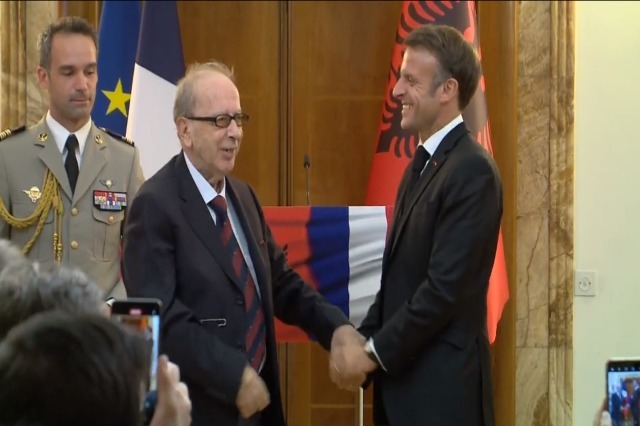
The French Presidency has extended condolences following the passing of writer Ismail Kadare, lauding him as a symbol of the European spirit whose courageous words often endangered his life and career.
In a statement, the Presidency highlighted Kadare’s prolific career in a country under dictatorship, where his novels became a beacon of resistance against censorship.
President Macron emphasized Kadare’s vocal opposition to intellectual repression during Tirana’s regime, noting how his works inspired and empowered the people by challenging authoritarianism.
France honored Kadare with prestigious awards, including the “Cross of the Legion of Honor” and “Officer of the Legion of Honor.”
Ismail Kadare, a master of words and a towering figure in Albanian literature, passed away at the age of 88 on July 1. The government has declared a two-day national mourning period on July 2 and 3 in his honor.
“Today, we mourn the loss of a writer whose life, works, and persona enriched dialogue, embodied the resilience of the European spirit, and found solace in France, a sanctuary for his creativity. Ismail Kadare, the Franco-Albanian writer, departed from us this Monday. He was one of those rare individuals for whom writing was a constant struggle; where every word fought its way out of silence, each line risking the addition of minutes to his life, and every novel standing as a potential epitaph for his career. He lived and created as a free man in a place that was not: post-war Soviet Albania under Enver Hoxha’s iron grip.
The world of literature opened up new horizons for the young Kadare. From reading Cervantes, Homer, and Gogol, he forged his intellectual resistance. His resilience became evident when he defied the indoctrination of literature professors both at the University of Tirana and at Moscow’s Gorky Institute, the bastion of official literature. Instead of aligning with the ‘elite corps of socialist realism,’ he joined the ranks of freedom fighters. His monumental work, ‘The General of the Dead Army,’ published in 1963, was allowed to pass because its theme was disquieting, its narrative challenging communist norms: the exhumation of soldiers from World War II in front of a priest and an Italian soldier under Albanian rule, a rain that persists. Conversely, ‘The Monster’ in 1965 and ‘The Winter of Great Solitude’ in 1973 labeled him a pariah as they denounced Tirana’s intellectual suppression at that time. Accused twice of inciting rebellion, he was banished to extensive rural work, a period he documented.
After ‘The Palace of Dreams’ in 1981, he was labeled an ‘enemy of the people.’ His publications were banned, prompting him to seek political asylum. Thus, he turned to France, the first country to translate his books and where his passion for writing blossomed beyond borders. With his publisher Claude Durand, head of Éditions Fayard, he orchestrated a grand escape to France in 1990, another strike against dictatorship: in Tirana, his departure incited the first student protests in over forty years.
From the heart of France to the revitalized capital of democratic Albania, he divided his life between words and the world, people, and places. From his walks through rediscovered Tirana, to the table at Café Rostand where he daily placed his notebook and pen, he crafted timeless texts, at the intersection of myths and worlds, from the imagination of the Pyramid of Cheops to Tirana, nestled between Luxembourg’s gates, Cornwall’s shores, and Troy’s walls. They perpetually remind us of Europe’s common heritage, and its history as a shared narrative.
The President of the [French] Republic honors a free spirit, who played a pivotal role in the great awakening of a people that dismantled the iron curtain, and who revered France as a haven for his creativity. He extends heartfelt condolences to his loved ones, readers, and the Albanian people,” the statement from Elysee Palace concludes.
/a.p./
Të ngjashme



Most read










 RTI