
 English
 Français
  Deutsch
 Italiano
 Turkish
 Greek
Greek Serbian
Jeronim De Rada, the catalyst of national awareness




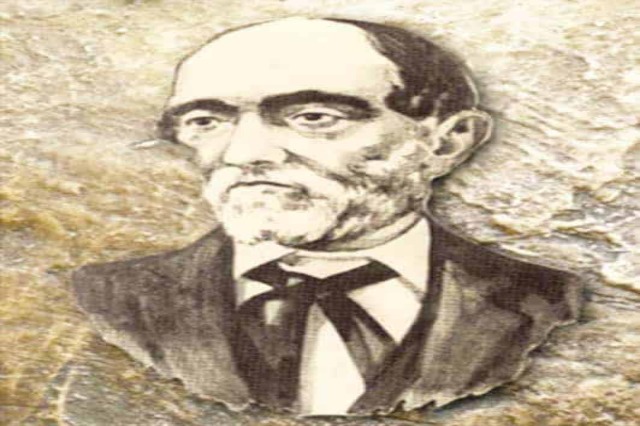
Jeronim De Rada is a well-known poet and author/publicist. He was born in Macchia of Calabria, Italy, and completed his first lessons at the college of St. Adrian of St. Mitër Korona. In 1834 he went to study Law in Naples, where he actively participated in the political and cultural movement of the time. In 1848 he published the first Albanian newspaper “L’Albanese d’Italia”, in which he expressed his views on the events of the time. After the failure of the revolution in the Italian states in 1848, he closed the newspaper and, disappointed, retired to his native village until the beginning of the 1860s. Starting from 1861, a new phase began in De Rada’s life. He appeared as one of the most vocal figures of Albanian National Renaissance. After the treatise Principles of Aesthetics (Principii di estetica, 1861) he published the works the antiquity of the Albanian nation (“Antichità della nazione albanase”, 1864) and the Rhapsody of an Albanian poem (“Rapsodie d’un poema albanese”, 1866), which played a important role for the propaganda of the Albanian national issue. He entered into correspondence with Albanian patriots and with European cultural personalities, lovers of Albania, and followed the events in Albania with lively interest. In 1878, he supported the Albanian League of Prizren and raised his voice against the land mutilation of Albania. He gave valuable help to the national issue with the magazine “Fjamur i Arbrit” /Flag of Albania/, which he published in 1883-1885. In “Political Testament” (1902) he expressed his optimism in the future of Albania and his dissatisfaction with the imperialist policy of Italy towards the homeland of the ancestors.
He developed a fruitful activity in the field of language studies, by paying special attention to the issues of the origin of the Albanians and the Albanian language, protecting their antiquity. De Rada is one of the first Albanian researchers of the grammatical structure of Albanian language. In the two grammatical works he composed (1870, 1894), he pointed out aspects not previously emphasized by Albanian scholars and Albanianologists and unstudied or unknown linguistic phenomena. In his linguistic works, interesting information is given about Arbëresh dialects. He made continuous efforts for a common alphabet of Albanian to provide a system as complete and suitable for Albanian with the Latin characters, supplemented with diacritical marks. The organization of two Albanian language congresses should be mentioned, the first (1895) in Corigliano Calabro, the second (1897) in Ungra (Lungro) (Arbërese language congresses) are part of De Rada’s linguistic activity. He dedicatedly taught Albanian at the Arbëresh College of Saint Mitër Korona for ten years until he passed away on February 28, 1903.
The poetic activity of De Rada was quite extensive. He published early, but the writing that brought him fame as a poet with outstanding talent is the lyrical-epic poem Songs of Milosao (1836), the first work of our literature of great artistic value. The story of the unfortunate love between two young people from the aristocratic circles of Albania in the 15th century is also at the center of the poem Serafina Topia, on which the poet worked in the years 1839-1843. Dissatisfied with his work, De Rada took up this subject again in the poem A Mirror of Human Life (1898), expanding it and treating in it a more current problem for the time, the war against the Ottoman conqueror. De Rada’s most important work is ‘Skenderbeu i Pafan’ /Unlucky Skanderbeg/, which he held in his hands for a long time (1837-1896). Many of the songs and poems he had published emerged into this work. The national pathos that had inspired De Rada’s work was expressed more fully and clearly in this work. The poem gives a broad picture of Albania in the 15-th century, the glorious deeds of the people, and their ardent love for a free and independent life, the amazing vigor they displayed in the face of the fierce attacks of their enemies. At the center of the work is the conflict between the Albanians and the Ottomans, given through scenes of fierce and furious battles are presented, which are distinguished by the pronounced historical color and expressive details. The national hero appears in the work as an outstanding statesman and rare bravery, who knew with his wisdom and heroism to raise his people in an unparalleled liberation war. In the characters of other characters, the heroism and bravery of Albanians is embodied. This work is De Rada’s masterpiece, in which the main features of his talent were clearly seen, as a master of broad historical pictures and skillful description of the inner world of heroes, thoughts and deepest feelings and the most secret of man. As a poet, especially in the ‘Songs of Milosao’, De Rada was also highly regarded by European literary circles.
De Rada played a major role in the history of Albanian literature. He is the first to write works with a national spirit. His figure rises as the purest and most powerful figure of literature and the Arbëresh world. His influence on contemporary Arbëresh writers was great. The poetic tradition written by him continues to live renewed even in today’s Arbëresh literature.
/a.p./
Të ngjashme
Latest News





Most read








 RTI
RTI