
 English
 Français
  Deutsch
 Italiano
 Turkish
 Greek
Greek Serbian
Johann Georg von Hahn, Austrian Diplomat, Founder of Albanology




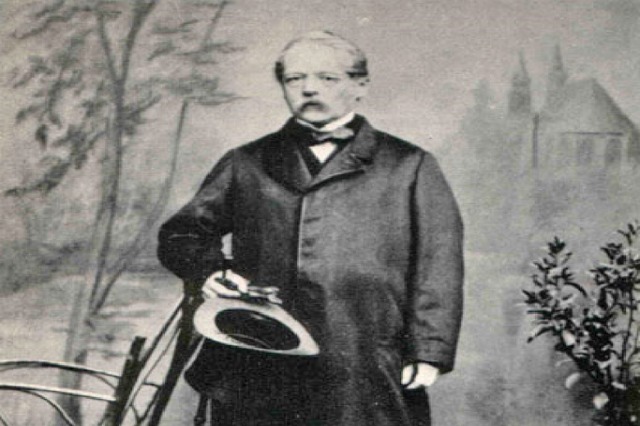
Today, the National Historical Museum commemorated the most renowned Albanologist of the 19th century, the Austrian diplomat Johann von Hahn, on his birthday July 11, 1811.
Von Hahn worked at the Austrian consulate in Ioannina, where he came into contact with Albanians and even learned the Albanian language. He made three trips to Albania, gathering data on Albanian history, philology, and folklore. He was highly interested in the spiritual world and history of the Albanians and the Arbëreshë of Greece.
Hahn searched through Albania for material for his major three-volume work, “Albanesische Studien” (Albanian Studies), published in 1854. In it, he argued for the first time, from a multidisciplinary perspective (historical, linguistic, ethnographic, etc.), the autochthony of the Albanians, their Illyrian origin, and the derivation of the Albanian language from Illyrian, demonstrating Albanian as a language of the Indo-European family.
His thesis was utilized by the ideologists of the Albanian National Renaissance for the national consciousness of the people and for arguing the historical right to autonomy and an independent state that would include all territories inhabited by Albanians.
In addition to “Albanian Studies,” he became known for his scholarly works “Journey through the regions of the Drin and Vardar,” “Journey from Belgrade to Thessaloniki,” and others.
Hahn was the first Albanologist to scientifically observe and confirm that Albanian motifs in songs, ethnology, culture, art, and lexicon were older than those of other Balkan peoples.
Professor Eqrem Çabej regarded Hahn as the founder of Albanology in the true scientific sense of the word.
/k.s/
Të ngjashme


Latest News





Most read









 RTI
RTI