
 English
 Français
 Deutsch
 Italiano
 Turkish
 Greek
 Serbian
Kruja town




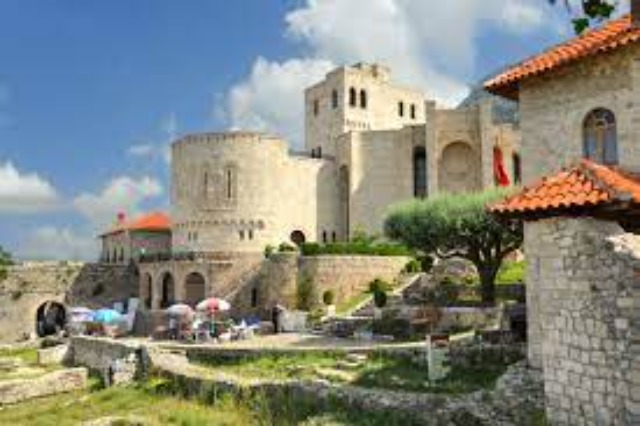
Kruja is a city in Albania just north of Tirana. Krujë itself is a small city situated approximately 31 kilometers (20 miles) north of the capital city of Tirana and is a place rich in history. While the region has been populated since the 3rd century B.C, it was also home to the eponymous Alban tribe as well as Gjergj Skanderbeg, the national hero of Albania. Kruja has a long list of attractions to offer tourists from the ancient castle nestled in the craggy rocks, two museums, stunning views, a nearby national park, sacred temples, natural springs, the ancient city ruins of Albanopolis, and the old bazaar.
Kruje is small enough to get around on foot very easily. It is built on a mountainside, with the one-street bazaar the central attraction, and the renovated castle just above and to the south.
Kruje Castle is located at the top of a craggy mountain 680 meters (2,230 feet) above sea level. From the castle there is a broad view that spans from Mount Tomori in the south to Ulcinj in the north with views of the Adriatic coast throughout.The castle features an arched tunnel as its entrance and once inside you can find castle remnants, the watch tower, two museums, restaurants, and homes that are still occupied to this day
Skanderbeg Museum inside Kruja Castle. This museum was opened November 1, 1982 and also resides within the Krujë castle walls. The museum is centered around an epic man of the 15th century who held off the invasion of the Ottoman Empire for 25 years. The museum recognizes the lasting strength and subsequent loss of the army of Skanderbeg. The national museum engenders the character of a memorial and opens to a stunning sculptural fresco representing our hero Skanderbeg amongst his cohorts. The museum holds artifacts, writings, and accounts of Skanderbeg’s life and death, while additional displays continue to be added as discoveries are made.
Kruja Ethnographic Museum Also located within the Krujë Castle walls is the ethnographic museum, found in what was the home of the Toptani family. This house, built in a style known as Çadak, was characteristic of the Krujë area at the time and dates back to the year 1764. The Toptanis were noble rulers of the area up until their move to Tirana. The house was declared a museum in 1959 and was restored by professor Emin Riza. The home allows you to experience daily life in this time period and is complete with interactive cultural displays and original furnishings.
Dollma Bektashi Tekke The Dollmës shrine can be found within the Krujë castle walls. The shrine was a place for spiritual retreat and character reformation for the Tekke faith. In front of the shrine’s doors, on the sacred grounds, is a large olive tree planted on the day of Skanderbeg’s wedding.
Medieval HamamThe hamam, or steam bath, is another legacy of medieval life in Kruja. The hamam was built at the end of the 15th century and is located on the southwestern edge of Kruja Castle near the Dollmes Temple. The building consists of four areas: the changing room, the middle room which has remnants of a tank, and two separate bathing areas with water supplied by the well of the square. In the middle of the main room is the kettle where water was heated. This hamam was used by the city’s elite. In 1963, it was proclaimed a first degree cultural monument.
The church in the Castle of KrujaThis church dates to the 15th century. It is built over the ruins of an older church from which is saved a part of its frescos. It is called the Church of Skanderbeg and its existence was found in the 80’s (20th century) during excavations.
Kruja Castle Watch Tower:The watch tower is located inside the Krujë castle walls and is one of the few remaining towers found within. It stretches an additional 16 meters (53 feet) above the castle walls and once provided a complete view of the horizon allowing the monitoring of enemy movements in three directions while staying protected to the east by Mount Krujë. The bell found inside the tower announced the death of Skanderbeg, the Albanian national hero, and can now be seen in the Skanderbeg Museum which can also found within the castle walls.
The Tower Houses of KrujaThey are Krutan Buildings qualified as tower-houses because besides living, they have served also for protection against any possible aggressor. Such houses can be found in the old neighborhoods of Kruja .
Faith Mosque It is located near the Skanderbeg Museum and is thought to have similarity with the Mosque which is located in the Castle of Preza. It dates in the end of the 15th century.
Old Bazaar The Old Bazaar of Kruja dates to the 17th century and is known by the locals as Derexhiku. It was built approximately 400 years ago and had about 200 shops starting from neat Kruja City Hall to the entrance gates of Kruja Castle. The first shops are thought to have started next to the castle entrance and over the years the shops expanded towards what is now the center of town. The shops line the street on both sides creating roads of roof-covered storefronts whose sloping roofs create an arcade along its length. The main crafts and trades in these shops have been leather working, silk, kitchen utensils, furniture, tailoring, pottery, carpentry, cafes, wood carving, butchers, barbers, shoemakers, blacksmiths, and wool workers. In the Old Bazaar today you can find objects and handmade items from traditional artisans as well as antiques collected from Kruja and the surrounding areas.
Merat Beut Mosque: The Mosque, found in the Old Bazaar, was built in 1533 during the Ottoman invasion. This mosque is unique architecturally and matches in harmony with the Old Bazaar. It is also considered a cultural monument. During the Communist times, the mosque was closed and it’s minaret reopened once again in 1991 and is visited by locals and foreign tourists alike.
Cave of Sari Salltëku The cave of Sari Salltëku is located at the top of Mount Krujë and is considered sacred within the Bektashi faith. Skanderbeg Monument In the center of town is a monument for the national hero, Gjergj Kastrioti Skanderbeg. The statue was erected on November 28, 1959. It was officially declared to be a national cultural monument in 1963. The statue depicts Skanderbeg charging into war atop his stallion with sword drawn.
Albanopolis is an Illyrain city and the capital city of the Albans, an Illyrian tribe which used to live in the zone. It is located in the village of Zgerdhesh, 5km away from Fushe-Kruja. It is thought that Albanopoli is the city from which Albania and the Albanians inherited this name.
Qafë-Shtamë National Park The park was established as a national park in 1996 and is located 25 kilometers (15.5 miles) northeast of Kruja. The bottled drinking water of the same name is found here and is famous because it was historically delivered daily to the royal family in Tirana due to its curative properties. Its location is 1,100m above sea level nestled in the mountains. The park is comprised largely of black pine forest and is famous for its curative water, special atmosphere, fresh air, natural beauty and the unique landscape that it offers. Here at the park you will be able to enjoy popular outdoor activities such as hiking, camping, picnics, yoga, etc. Accessing the park is easiest by car.
Hurdha e Kecit (The pond of the nanny-goat) This toponym is present in the territory of Kruja where there are springs and waterfalls. The Pond of Nanny-goat is located in the village of Noje, 6km in the east of Kruja, in one of the ramification of the Dro River. It is a waterfall with a length of 15-20m and with a scenic view.
Lake of Bovilla lies in between two mountain ranges with opportunities for walking, hiking, mountain biking, and climbing on the rocks. From any view of the Lakeside Mountains you can enjoy the beautiful view of the landscape.
Cave of Bovilla: It is located in the southern part of the Gami Mountain, in the gorge of Bovilla, which divides Kruja from the Tirana district. This cave is not exposed for visitors. Based on researchers this cave is the continuation of the Cave of Pellumbasit of the Dajti Mountain. It is thought to have been inhabited around the 12th and 11th century B.C.E. A distinction of this settlement is the presence of prehistorical pictures which show scenes from that time.
Abdyl Aga Bridge: The Abdyl Aga Bridge is situated between Mount Krujë and Mount Kurçajt in the southernmost part of Krujë and spans the Black River. It is believed to have been built in the early 1800’s and is constructed entirely of limestone. The bridge is part of a medieval road that once led through this region and provided a safe crossing for the caravans that passed through.
Kurçajt Bridge is located to the south of the Krujë region in the village of Kurçaj. It stretches over the Black River and served as an integral part of an old caravan trail connecting Krujë with Tirana. It was constructed in the late 1700’s and is made from staggered stones raised gradually by concrete portions. The bridge was made with a unique asymmetric shape that reaches up to the opposite side like a staircase.
Weeping Gorge: Located 2 kilometers (1.2 miles) from the north of Krujë, along the road that leads to Qafë-Shtama national park is a memorial for martyrs of the Ottoman invasion. The memorial hangs at the edge of a massive gorge overlooking an expansive valley. Historical evidence shows that below these stones are the remains of 90 girls that chose to be thrown into the abyss rather than succumb to the Ottomans on June 16th, 1478.
Black River Canyon: Located between Kruja Mountain and Gamnit Mountain, the Black River Canyon offers a walking and hiking trail with views of waterfalls, rivers, and old ottoman bridges. Within the canyon are the Abdyl Agës Bridge, Black Gorge, Bridge of Kurcajt, and Medieval Steps. This area is thought to have been an important passageway around the 15th century and traces are readily seen in the area today.
Të ngjashme










Most read










 RTI