
 English
 Français
  Deutsch
 Italiano
 Turkish
 Greek
Greek Serbian
Kurti proposes to Stoltenberg the opening of a Kosovo diplomatic office in NATO




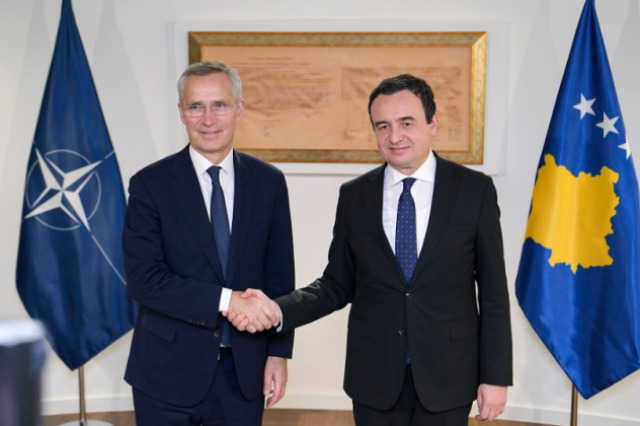
Today, the Prime Minister of the Republic of Kosovo, Albin Kurti, met with NATO Secretary General Jens Stoltenberg. The discussion mainly focused on the historic role of NATO in Kosovo, the continuous contributions of the KFOR mission to the country’s security and peace, recent developments within Kosovo, and the importance of inter-institutional cooperation and coordination.
Prime Minister Kurti, accompanied by the First Deputy Prime Minister, Besnik Bislimi, the Minister of Internal Affairs, Xhelal Sveçla, and the Minister for Communities and Returns, Nenad Rashiq, initially conveyed the people’s and the Government of Kosovo’s thanks and appreciation to NATO for its valuable contribution in Kosovo.
He briefed Secretary Stoltenberg on governance matters, highlighting the significant investments made in defense, education, health, and agriculture.
Discussing the security situation, especially concerning the ongoing threat posed by Serbia, Prime Minister Kurti emphasized the presence of 48 Serbian forward operational bases along the border with Kosovo, alongside the anti-aircraft system positioned in close proximity to this border.
On this occasion, the Prime Minister listed Serbia’s military systems, including the modernized ‘FK-3’ and ‘Pancir S1’ missile systems, along with the ‘Neva M1T’ and ‘Kub M2 (SM)’ missile systems from the 250th Army Brigade of Serbia.
He highlighted that the FK-3 system is a Chinese missile system, making Serbia the first country in Europe, as of 2022, to operate Chinese weaponry, which also includes CH-92 combat drones.
In addition, he mentioned that the Armed Forces of Serbia have established a dedicated unit for drone surveillance, operating within the 63rd Parachute Brigade of the Serbian army.
“Prime Minister Kurti proposed Secretary General Stoltenberg to pursue close cooperation with NATO in ensuring peace and security.
He noted that while the previous year saw criminal groups erecting barricades to challenge law and order (in July and December 2022), this year witnessed violent attacks targeting local and international law enforcement institutions, such as those on May 26 and 29, followed by the kidnapping of Kosovo policemen on June 14. These events culminated in the aggression of September 24, which violated state sovereignty, territorial integrity, and national security.
During the meeting, Prime Minister Kurti shared findings from the investigation process conducted by local security institutions concerning the terrorist and paramilitary attack on September 24 in Banjska, resulting in the tragic loss of National Police Sergeant Afrim Bunjaku. He also addressed the kidnapping of three Kosovo policemen on June 14 within Kosovo’s territory, asserting the direct involvement of the state of Serbia. “These incidents underscored the urgent need to bolster security along the Kosovo-Serbia border, urging NATO to expedite conclusions from its independent investigations into these criminal acts,” emphasized Kurti.
Moreover, discussions encompassed Kosovo-Serbia relations, the ongoing dialogue mediated by the European Union, and the recent October 26 meeting with European leaders in Brussels. Prime Minister Kurti highlighted “the Government of the Republic of Kosovo’s stance against the European-American plan for full and unconditional implementation of the Basic Agreement, emphasizing the importance of Kosovo’s NATO Partnership for Peace Program membership.” Additionally, he proposed the establishment of a diplomatic office of Kosovo within NATO.
Secretary Stoltenberg expressed appreciation for the coordination between security institutions and KFOR. He also acknowledged and thanked the Government and the Republic of Kosovo for their support to Ukraine in the face of Russian military aggression. He described the September 24 attack in Banjska as terrible and unacceptable.
/m.ll/
Të ngjashme

Latest News






 RTI
RTI