
 English
 Français
  Deutsch
 Italiano
 Turkish
 Greek
Greek Serbian
Lord Byron, the British romantic poet in love with Albanians




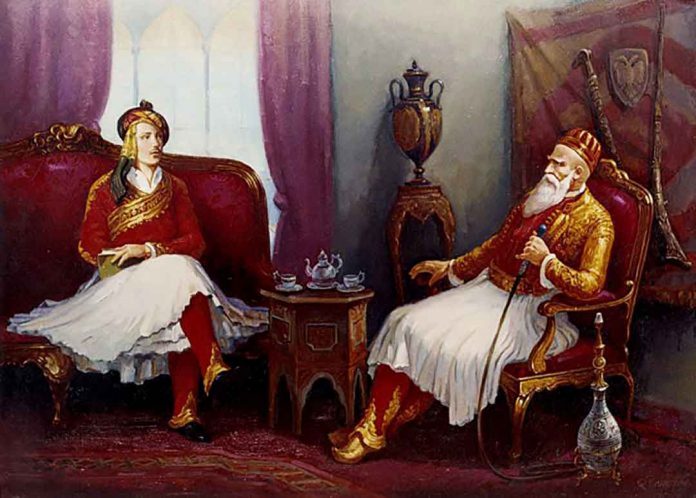
TIRANA, January 22 – George Gordon Byron was born on January 22, 1788. He became a leading figure of the Romantic Movement. Britain considers him one of its greatest poets.
Byron came from a noble family. Meanwhile, he traveled widely across Europe. His journeys took him to Albanian lands for a significant period. He also explored other regions of the continent.
The poem “Childe Harold’s Pilgrimage” revealed his early impressions of Albania. At the same time, his letters to his mother reflected admiration for the country. John Cam Hobhouse, his companion, kept diary notes that showed Byron’s view of Ali Pasha of Tepelena.
He described Albania as a land of rare natural beauty. In addition, he considered Albanians handsome, brave, and proud. Their traditional white fustanella [Albanian kilt] caught his attention. Byron noted that Ali Pasha was fierce but not cruel. He also described him as a vizier who remained independent. Some accounts compared Ali Pasha to Alexander the Great and Skanderbeg.
Byron’s Romantic education influenced his vision of the country. As a poet, he painted Albania as mysterious and admirable. His curiosity also shaped how he recorded local culture.
During his visit to southern Albania, he acquired a traditional Albanian costume. Later, in 1813, painter Thomas Phillips created the portrait “Portrait of a Nobleman in the dress of an Albanian”. The work exhibited at the Royal Academy. Today, it resides at the British Embassy in Athens.
Byron expressed his admiration in letters as well. On November 12, 1809, he told his mother that he loved Albanians. He recalled staying in Albanian barracks for two or three days at a time. The soldiers impressed him with their friendliness. He also praised their honesty. According to Byron, their hospitality exceeded what he experienced in Gibraltar, Malta, Spain, France, Sicily, and England.
In 1823, Byron traveled to Greece. There, he inspired the Greek independence movement. However, he fell ill with fever before he could see the country’s liberation. He died in Mesolongi on April 19, 1824, at age 36.
/a.p./
Të ngjashme
Latest News



Most read








 RTI
RTI