
 English
 Français
  Deutsch
 Italiano
 Turkish
 Greek
Greek Serbian
Luigj Gurakuqi, the compiler of the Declaration of Independence text




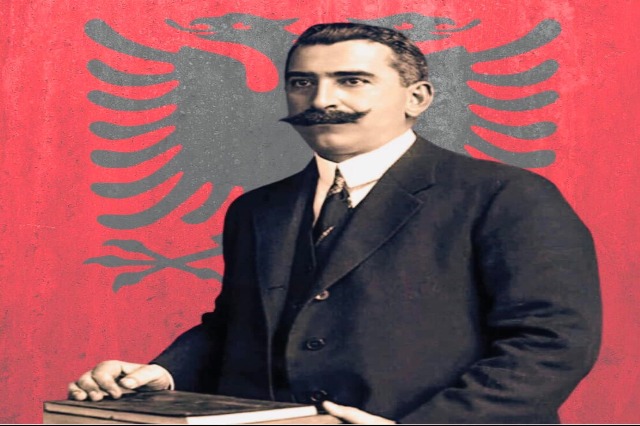
Luigj Gurakuqi was one of the main personalities of Albanian patriotic and democratic Movement. Completely devoted to the cause of the Homeland, his activity is connected with the most important events of the time he lived in. He was born in Shkodër on February 19, 1879. He had his first lessons and part of high school in his hometown, then went to Italy. There he graduated from the Arbëresh College of Shën Mitër Korona, in Calabria, where he was a student of Jeronim De Rada. Then he continued his higher studies in biological sciences, in Naples. Since he was a student, he made a name for himself in the Albanian press as a poet and publicist under the nicknames Cakin Shkodra and Lekë Gruda.
In 1908, he returned to Albania and quickly became one of the main leaders of the national movement. There were no important events of the time, Gurakuqi did not had his hand on. He participated in the Congress of Manastir 1908, which decided about the alphabet of Albanian. He was the first director of the Elbasan High Pedagogical School and one of the leaders of the uprisings in the North during the years 1911-1912. He was Ismail Qemali’s right hand in all that great work for the declaration of Independence. In 1916, he was one of the founders of the Literary Commission in Shkodër. In 1912, he developed a dense activity for the organization of the general uprising. He participated in the meeting of Bucharest and the Declaration of Independence in Vlora, 1912. He was the closest collaborator of I. Qemali, the father of Independence. He was elected Minister of Education and established compulsory primary education for boys and girls, in the Provisional Government of Vlora, created in December 1912.
During the WWI, with the invasion of Shkodra by the Montenegrin army, Luigj Gurakuqi was exiled to Podgorica. While, during the Austro-Hungarian occupation, taking advantage of the position of the General Director for Education and of the favorable political conjuncture, he opened many Albanian schools. He was one of the founders of the Literary Commission in 1916, where he proved to be a good master of the Albanian language, proposing, among other things, a string of new terms words that entered its fund. He participated in the Durrës Congress in 1918, where he was elected Minister of Education in the provisional government and a member of its delegation to the Paris Peace Conference. In 1921-1924, he was a MP of Shkodër in the National Council where, as one of the leaders of the democratic opposition, he fought for the democratization of the country’s life, for the relief of the farmer’s condition from severe oppression, for economic and cultural development and for the protection of independence. He actively participated in the Democratic-Bourgeois Revolution of June 1924, being one of the inspirers and its main leaders. In the government headed by Fan S. Noli (1924), he was appointed Minister of Finance. He stood out for his high sense of responsibility and for his determination and efforts to create and strengthen the Albanian democratic state. With weapons in hand, with programmatic articles and with his fiery speeches, Luigj Gurakuqi fought not only for a free and independent Albania, but also for a modern state, which through democratic reforms would eradicate backwardness and change rapidly, to regain the time lost during the centuries of captivity.
In the years 1921-1923, Gurakuqi as the MP of Shkodër was constantly in opposition with Zog and all the other feudal lords. Fellow fighter of Fan Noli, Gurakuqi was among the most active leaders of the Democratic-Bourgeois Revolution of June 1924.
After the counter-revolution, he immigrated to Italy, and on March 2, 1925, he was treacherously murdered in Bari, Italy by people appointed by Zog.
Noli praised the figure of this outstanding son of Albania in a popular poem. After WWII, his remains were brought to homeland. He was honored with the high title “Hero of the People” and “Teacher of the People”.
Gurakuqi’s poetic creativity covers the years 1898-1907. After that, the broad political creativity did not allow him to take any more poetry.
For the first time his poems were collected in one volume in 1941.
Even as a publicist, L. Gurakuqi made an outstanding name, dealing with the most important issues of the time. He published in the magazine “Albania”, in “Kalendari Kombtar” /National Calendar/, in the newspapers “Drita” /The Light/, “Liberty of Albania”, “La Nacione Albanianese” ?The Albanian Nation/. As a prominent stylist, he has left models of journalistic prose in both dialects.
Gurakuqi gave valuable help to Albanian literature and culture as a poet, publicist, orator, and poetic metrics.
/a.p./
Të ngjashme
Latest News
Most read




 RTI
RTI