
 English
 Français
 Deutsch
 Italiano
 Turkish
 Greek
 Serbian
“Marubi”National Photography Museum




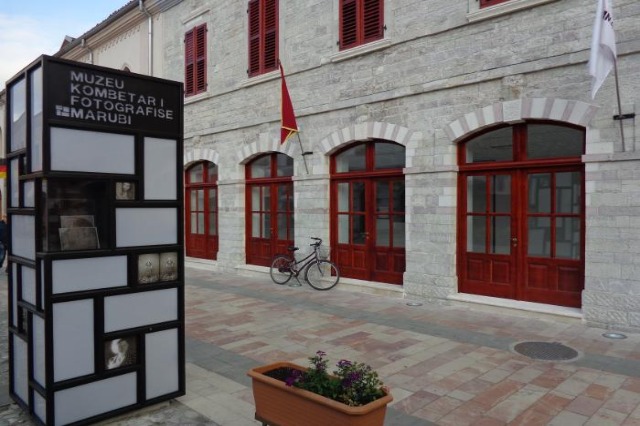
The art of photography in our country began in Shkodra in the 1850s and is associated with the name of Pietro Marubi (1834 – 1903), who came from Piacenza, Italy as a political refugee to Shkodër, where he settled permanently, establishing the “Marubi” photographic studio in the city center, the first of its kind in Albania. His over forty years of work as a photographer left significant traces with historical and artistic value, which are exhibited in the National Photography Museum “Marubi”.
This museum gathers the treasure of the Marubi dynasty, photos taken from the establishment of the studio in 1856 until 1989. The archive of the Photographic Library is very rich and contains about 500 thousand photographs, all from negatives and roll films of various sizes. The Marubi family documented important periods of Albania’s history through their photographs, such as during the Ottoman Empire, the Zog I monarchy, and the communist regime.

Pietro Marubi, the founder of the Marubi archive, was born in Piacenza, Italy, in 1834, and due to historical circumstances, he resettled in Shkodra, where he dedicated himself to his passion for the art of photography.
Currently, the museum collection of the National Photography Museum “Marubi” also preserves museum objects such as cameras, lenses, various flashes, studio curtains, chairs, and other studio items used by the Marubi family representatives. Important documents related to the activities of the photo library have been also preserved.
The National Photographic Library “Marubi” is one of the oldest institutions of Albanian culture, especially in Albanian photography, leaving significant marks in the history of Albania with its photographs. This photo library is one of the oldest cultural institutions in Albania, with a 158-year history.
Among the earliest photographs are those by Hamiz Kazazi (1858) and Leonardo de Martino (1859).
The apprentice of the Italian master, Mati Kodheli also modestly contributed in the “Marubi” studio. From 1885, Kel Kodheli (1870 – 1940), Mati’s brother, also worked in this studio. With the master’s death, he inherited the studio and began independent work, later adopting the surname “Marubi” in honor and gratitude to his generous teacher.
The third generation of the “Marubi” dynasty, after Kel’s death, is represented by his son, Gega, who continued to enrich this valuable treasure, working with the same dedication and professionalism until the end of his life.
In 1970, the renowned photographer Gegë Marubi donated this photo library to the Albanian state, the result of a hundred-year uninterrupted work, merging art and the memory of Shkodër and our nation, which contains around 200,000 glass plates and celluloid negatives.
In support of Geg’s noble gesture, the Albanian state was simultaneously given four other archives of negatives with outstanding value, by distinguished Shkodra photographers, almost doubling the number of negatives in this photo-library. It is worth noting that each of these photographers had created their own profile as an artist photographer.
The collections of over 400,000 negatives, besides covering a long chronological period, also have a geographical extension beyond the borders of the city and district of Shkodra. Besides thousands of Shkodra citizens, numerous local and national historical events, daily chronicles of the city, well-known public figures, and personalities from various fields of political, economic, social, and cultural life are captured there.
A considerable number of negatives are dedicated to accredited Consuls in Shkodra and foreign political and military personalities from foreign states, as well as thousands of soldiers and officers from Turkey, Italy, Austria-Hungary, France, Britain, Montenegro, etc., especially from the periods of World War I and World War II. The communist period of fifty years is also rich and historically significant for the historical memory of Shkodra and the nation.
Among the special museum objects are the materials and objects used by the Marubi’s dynasty and other photographers in their studios.
In recent years, there has been extensive and diverse activity aimed at promoting the values of this photo library. Periodic photo exhibitions have been opened within the country, such as in Shkodra, Kruja, etc., as well as abroad, in Italy (Rimini, Florence, Venice), in Montenegro, which have been received with great interest. At the same time, several albums on various themes have been published so far by the institution itself or in collaboration with foreign institutions.
/k.s/
Të ngjashme




Latest News










Most read










 RTI