
 English
 Français
 Deutsch
 Italiano
 Turkish
 Greek
 Serbian
Mete: The Berlin process, a good opportunity for the economic integration of the Western Balkans




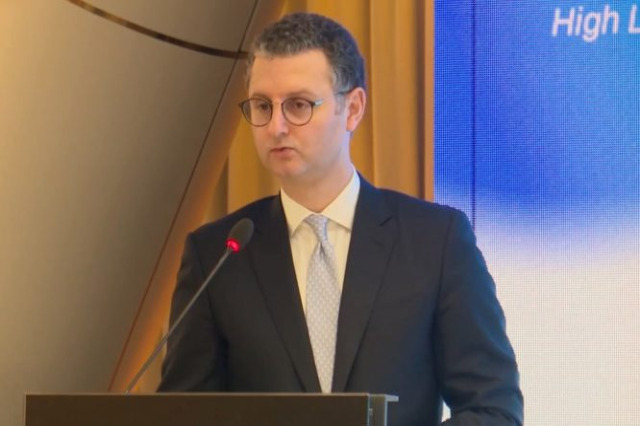
Today, the Minister of Finance and Economy, Ervin Mete, stated that the Albanian government has taken concrete measures within the framework of the commitments made through the Berlin Process.
In his speech during the proceedings of the two-day conference on Trade Facilitation organized by the General Directorate of Customs, Mete stated that the Berlin Process is a good opportunity to achieve the common goals of economic integration and the development of the Balkan region.
Minister Mete prioritizes the harmonization of customs procedures with those of the European common market.
He declared that the progress achieved at the political level, such as the removal of customs tariffs between the European Union and Balkan countries, as well as the implementation of free trade agreements, Stabilization-Association, and CEFTA among regional countries, is now being complemented by a series of technical measures. These measures include the removal of non-tariff barriers, the establishment of common ‘One Stop Shop’ control points, mutual recognition of Authorized Economic Operators, and the implementation of an integrated transit system.
In this regard, Mete emphasized that the Ministry of Finance and Economy has endorsed the concept of the second phase of the World Bank’s project for Trade and Transport Facilitation. He explained that this proposal entails the implementation of a series of measures, along with other initiatives like blue lanes and green lanes.
“For example, the ‘One Stop Shop’ between Albania and Kosovo, Montenegro, and, starting from July 2023, with North Macedonia, serve as concrete models demonstrating how time has been halved, and costs have been reduced for economic operators between the countries in the region. Therefore, this conference provides an excellent opportunity to encourage customs authorities in the Western Balkans to seek similar agreements with their neighboring EU member states,” he emphasized.
The minister highlighted that the common European market, with over 450 million consumers, offers an opportunity for Western Balkan businesses. A remarkable 85% of them believe that their products, goods, and services can not only thrive but also compete with what the 27 EU countries currently offer.
On the other hand, Mete highlighted that digitalized services have considerably reduced physical interactions with the customs administration. Currently, 34 services are available electronically through the e-Albania government portal, with ongoing efforts to implement an additional 21 services.
The sustainable simplification and modernization of business services were also evident in the World Bank report, serving as an indicator of the impact of the modernization of the Albanian Customs Administration on customs procedures. The report revealed that in the Port of Durrës, the average time for goods clearance has decreased by 26%, in border customs offices by 20%, and in internal customs offices by a substantial 74%,” declared the minister.
Furthermore, Mete stated that digitization is empowering businesses to expand their reach and accelerate commerce.
“Today, all economies are grappling with the challenges brought about by digital transformations, striving to leverage them for cost reduction and increased productivity. Crossing borders for trade is significantly easier now,” said Mete.
He added that companies, especially medium and small ones, are employing digital and innovative tools to overcome growth barriers, adapting to new models that enable complex transactions, and exploring alternative financing options.
The latest United Nations report on Digitization and Trade Facilitation primarily evaluated Albania in two critical areas: ‘paperless trade’ and cross-border trade. The report positioned Albania favorably, attributing it a deserved ranking for the measures taken and their implementation, ranging from 40% to 60%. Mete emphasized that the adoption of international standards, the harmonization of legal and technical frameworks through closer inter-governmental cooperation, and the promotion of ‘paperless’ cross-border collaboration are vital for fostering greater interaction between national systems.
/m.ll/
Të ngjashme



Latest News









Most read










 RTI