
 English
 Français
  Deutsch
 Italiano
 Turkish
 Greek
Greek Serbian
Mexhiti to RTSH 24: No Repeal of Albanian Language Law, Addressing Constitutional Gaps




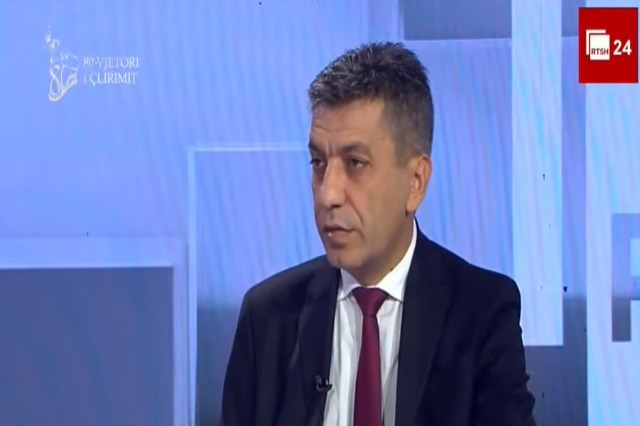
North Macedonia’s First Deputy Prime Minister, Izet Mexhiti, clarified concerns regarding the Albanian language law, emphasizing that the issue lies in addressing constitutional inconsistencies in two specific provisions rather than repealing the law itself.
In an interview with RTSH 24, Mexhiti explained that the Albanian language law, passed by the previous government, was incomplete and contained gaps. He noted that the same government had referred the law to the Venice Commission, which identified constitutional incompatibilities in two key provisions: the use of the Albanian language in judicial processes and its inclusion on police and military uniforms.
“These issues stem from shortcomings left by the previous administration,” Mexhiti stated. He further explained that the Constitutional Court’s current deliberations focus solely on these two provisions, not on repealing the law in its entirety. “Our aim is to find a solution that aligns with the Constitution, ensuring the law fully serves its purpose,” he added.
Mexhiti criticized the prior government for introducing a law that failed to secure the rights of Albanians in North Macedonia, despite their significant presence, making up 24–30% of the population.
“The law was implemented halfway, falling short of the standards seen in Kosova for the Serbian language, which represents only 2–3% of the population there. It’s essential that we establish a legal framework that guarantees the linguistic rights of Albanians,” Mexhiti emphasized.
He also highlighted the progress made under the current government in empowering the Albanian community. “In just four months, we’ve taken bold steps to strengthen Albanian representation. A pivotal part of the Ohrid Agreement is decentralization, and we’ve allocated €1 billion toward its realization. This includes €35.5 million for the new Mother Teresa University campus in Skopje,” Mexhiti noted.
He stressed that Albanians in North Macedonia must be viewed as stakeholders, not merely numbers to sustain governance. “Albanians hold key positions, including the Speaker of Parliament and six ministries in the government. Decentralization empowers Albanians, and collaboration with the Albanian government remains a priority,” Mexhiti concluded.
/a.p./
Të ngjashme



Latest News





Most read









 RTI
RTI