
 English
 Français
 Deutsch
 Italiano
 Turkish
 Greek
 Serbian
Minister Ibrahimaj leads investment council meeting, focuses on digitalization and EU alignment




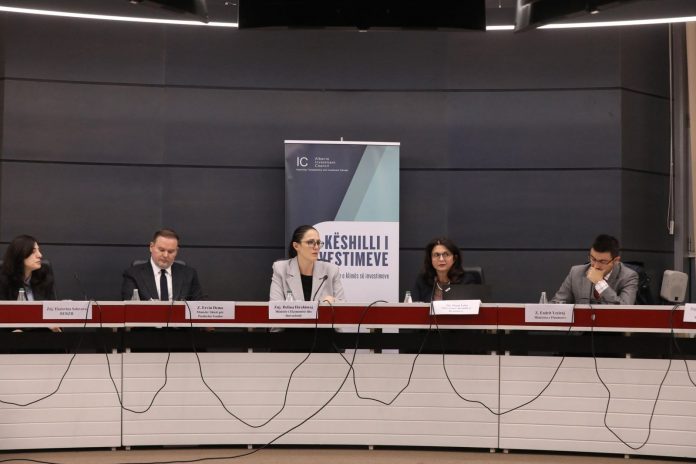
Minister of Economy and Innovation, Delina Ibrahimaj, chaired the latest Investment Council meeting. During the meeting, she highlighted business expectations regarding digital local services.
Additionally, the meeting presented findings from the 2015–2025 investment climate survey. It focused on tax administration interactions, EU single market challenges, and the Council’s 2026 work plan recommendations.
Minister Ibrahimaj reaffirmed MEI’s commitment to its tasks. Specifically, she emphasized aligning legislation with EU standards in economic and business support. She said, “These criteria and standards must be met by Albanian businesses. Although this is a major challenge, it also brings opportunities.”
She stressed the need to unify and modernize local services. Moreover, she called for high transparency, measurable indicators, and strong coordination between central and local authorities. Furthermore, she emphasized improving the fiscal environment and strengthening business confidence.
For 2026, Ibrahimaj outlined key priorities. First, digitalizing local services. Second, strengthening tax administration. Third, supporting SMEs in the European transition. Finally, adopting the Council’s recommendations as the basis for next year’s work.
The Ministry presented initiatives to formalize processes and provide systematic information. In addition, reforms will increase transparency, reduce business costs, and create a modern, competitive investment climate aligned with EU standards.
State Minister for Local Government, Ervin Demo, attended the meeting. He noted that digitalizing municipal services will improve services for businesses and citizens. However, he added that the process will take time.
Representatives from central and local institutions, as well as domestic and foreign businesses, also participated.
Digitalization of Local Services
Analysis involving 166 businesses and municipalities showed that access to digital local services remains fragmented. Moreover, local services are not fully aligned with central services. In addition, municipalities face limited technical capacity and lack clear performance indicators.
Businesses support digitalization and integration. However, they seek simplified and standardized services, reduced physical contact, inclusive consultation, and more transparency in taxes and local decision-making.
The meeting highlighted that the Fiscal Cadastre is not functioning effectively despite the legal framework.
Recommendations for 2026 include setting measurable performance indicators for municipal services. Also, harmonizing local services with central ones. Furthermore, mandating data sharing between DPT and municipalities. Finally, supporting SMEs in adopting digital services.
Të ngjashme



Latest News









Most read










 RTI