
 English
 Français
 Deutsch
 Italiano
 Turkish
 Greek
 Serbian
National Geographic/Albania: Creation of the first “river national park” in the world




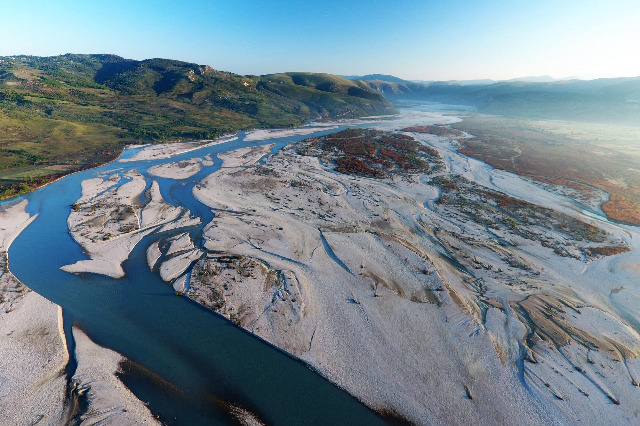
According to environmental activists, certain sections of the Neretva, a river crossing Bosnia and Croatia, are candidates for preservation.
On their journey to the Adriatic Sea, the turquoise waters of the Vjosa, threatened for decades by dams and mining, sparkle as they wind through the dramatic mountainous landscape of southern Albania. The river, recently protected by its status as a unique “national river park”, is fueling a movement whose goal is to save other crystal clear waterways by ensuring that they receive this designation.
The question of how best to protect streams and rivers has long been of concern to conservationists. While waterways are traditionally considered in land protection policies, studies show that this approach does not benefit them, in part because they can enter and leave protected areas and sometimes even cross borders. What happens at the unprotected end of a stream can have serious consequences on that same stream hundreds of kilometers away.
“To protect a river, you must first and foremost focus on the river itself”, explains Ulrich Eichelmann, ecologist, environmental defender of the Austrian organization Riverwatch and director of Save the Blue Heart of Europe, the international coalition behind Vjosa’s success.The Vjosa, an Albanian river, recently became the world’s first “river national park”, a status which prevents the construction of dams or mining, but which allows tourism. Defenders of the environmental cause are now turning to other waterways around the world that could be granted the same status.
Helped by other activists, he is now exporting this river-centred approach to other countries in the Balkans, a region in southeastern Europe comprising eleven countries, including Bosnia and Herzegovina and Montenegro, where the fight to protect ‘other pristine streams of environmental stress is intensifying.
“We want river protections of this type to be the rule rather than the exception,” says Ulrich Eichelmann.
According to several studies, although fresh water nourishes a large part of life, rivers, lakes and wetlands are on average more degraded than marine and terrestrial ecosystems, often due to dams that modify the course of rivers and interrupt migration. fishes.
Although there are more dams on European rivers than on any other continent, many Balkan rivers remain relatively pure, although thousands of hydropower projects are under consideration. At one point, there were up to eight proposed dams on the main arm of the Vjosa and dozens more on its tributaries.
The campaign to protect the Vjosa, which has enjoyed overwhelming public support, has taken years of protests, lawsuits and international pressure on Albania to drop plans for the dams. The government, which has fought to improve the economic conditions of one of the poorest countries in Europe, has resisted for a long time, especially since Albania depends almost exclusively on hydropower for generate electricity.
Patagonia, a US outdoor equipment supplier that has spent nearly $1 million campaigning for the Vjosa, is said to have been instrumental in convincing the government that a national park would boost the country’s tourism industry. ” That [montre] what civil society, government and industry can do when we work around a set of shared goals,” said Ryan Gellert, CEO of Patagonia, a Ventura, California-based company.
According to the International Union for Conservation of Nature (IUCN), Vjosa’s status as a Category II National Park protects it from harmful activities such as dam construction and gravel extraction, while allowing human traffic.
In addition to the main watershed, which is home to more than 1,100 animal species, the new park includes three major tributaries and will cover more than 400 kilometers of waterways and the land immediately adjacent.
Among conservationists, there has been some hesitation in calling Vjosa the world’s first national river park, as other rivers might fit that definition. But according to James Hardcastle, manager of the IUCN protected areas program in Gland, Switzerland, with the Vjosa it is “the first time that a watershed has been the subject of a national park creation”.
According to environmentalists, most Balkan rivers are so ecologically important that hydropower projects should be banned altogether. There are already two rivers that could become national river parks: the Una, a river which flows mainly in Bosnia, and the Morača, a river in Montenegro.
While the Una is home to one of the only healthy populations of Danube salmon (hucho hucho), the largest species of salmon in Europe, the Morača waters Lake Shkodra, the largest lake in the Balkans and an essential ornithological sanctuary. Despite planned hydroelectric projects, the basins of these two rivers remain largely undammed, and their water systems can stretch for hundreds of kilometers through breathtaking scenery.The Una, a river in Bosnia, would be a good candidate to become a national river park, in particular because it is home to Danube salmon (Hucho hucho), the largest species of salmon in Europe.According to Vladimir Topić of the Center for the Environment in Banja Luka, Bosnia, the new status of the Vjosa “should mark the inauguration of similar protections for other Balkan rivers”.
According to Beth Thoren, European director of environmental action at Patagonia, her company plans to invest 4.2 million euros to help create new such parks in the region.
According to conservationists, many rivers in need of urgent protection do not necessarily meet the criteria for obtaining the status of national river park. One of them is the Neretva, a river that crosses Bosnia and Croatia. Although the central sections of the Neretva already have dams and the construction of new buildings is already well underway in other parts of the watershed, the upper part of the river, which is dotted with spectacular waterfalls and bordered by pristine forests , still flows unimpeded.
“A river national park wouldn’t work in the case of the Neretva, but that doesn’t mean there shouldn’t be protection,” observes Ulrich Eichelmann. “There are sections of the river that must be protected, even as a simple national park. »
Some hope that the change in status of the Vjosa, decreed on March 15 by Edi Rama, Albanian Prime Minister, will inspire protection efforts for other crystal clear waterways around the world. James Hardcastle thinks in particular of Patuca as a potential candidate. This river in Honduras is the second largest in Central America and is to this day still devoid of dams.
View of the Morača River from the Morača Bridge on the Bar-Boljare highway in Smokovac, Montenegro, May 27, 2021. A Chinese loan to build the first stretch of a road connecting the Adriatic port of Bar to the Serbian border caused Montenegro’s debt to soar and forced the country to seek aid from the European Union. Photo taken on May 27, 2021.
Michele Thieme, science director for freshwater at WWF, Washington, would like to see more protections given to some of the world’s largest undammed rivers (which her organization focuses on) like the Salouen in South Asia. -East, and several African rivers. “We still have the opportunity to preserve these systems in a relatively intact state,” she explains.
In his words, terrestrial national parks do not always protect the rivers which cross them from the construction of dams. A 2020 study she authored identified at least 1,249 towering dams built within protected areas around the world, and more than 500 dams planned or under construction in protected areas, many of them in the Balkans.
According to activists, this is why the status of the Vjosa is important, as it protects the river specifically. But, they warn, the task remains daunting before the park becomes operational, from managing land use and land titles to building a visitor center to training rangers. to walk around the park. The aim is to extend protection across the border to Greece, where the river is called Aóos, and to encompass more of the watershed.
According to Besjana Guri, a member of an association in Tirana, EcoAlbania, who played an important role in the campaign, the Vjosa can “be an inspiration for all the communities that are fighting to save their waterways. Our message to them is that it is possible to win this fight even if it may seem particularly difficult”.
Të ngjashme



Latest News









Most read










 RTI