
 English
 Français
 Deutsch
 Italiano
 Turkish
 Greek
 Serbian
National Geographic: Take a journey through Albania’s wild, blue heart — a triumphant symbol of habitat protection




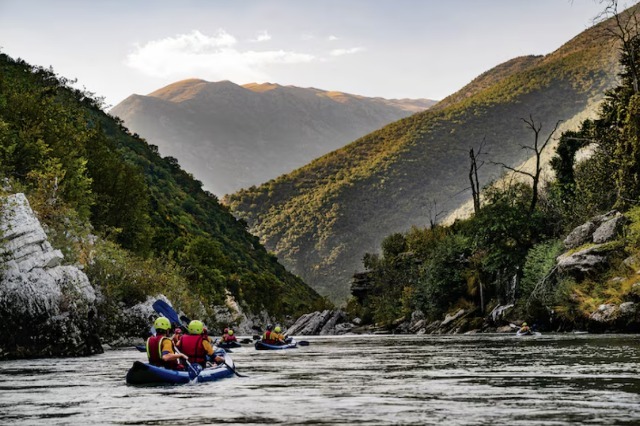
“At the end of a long, dry summer, presided over by cloudless skies, the rapids of the mighty Vjosa have calmed and quietened. Which suits me just fine, sitting as I am in a kayak navigating the ancient sweep of Këlcyrë Gorge,” writes ByAmelia Duggan for National Geographic.
The corridor of gushing waterfalls that earned it the moniker ‘Paradise of a Thousand Springs’ is equally languorous: rivulets rake the stone walls, trickling down to the water basin through gravity-defying profusions of vegetation and resolute, twisted trees.
This is one of Europe’s last wild rivers — practically the only major waterway on the continent unsullied by dams — and a long battle to preserve its natural rhythm and important ecosystems from developers has finally been won. I dip my paddle into the Vjosa’s turquoise meltwaters, part of an unbroken rush from Greece’s Pindus Mountains to the Albanian coastal city of Vlorë. And as I steer the nose of my kayak through picturesque channels, I start to understand why this virgin river, eulogised in poetry and songs over centuries, matters so much to locals, and why a multi-year campaign to preserve it resonated with the likes of clothing brand Patagonia and even actor Leonardo DiCaprio. The 168-mile Vjosa was declared Europe’s first wild river national park in March 2023. Today, the forward-looking travel guides who rallied to help save the country’s ‘blue heart’ wear this victory like a badge of honour.
“A politician once challenged me: ‘Who do you think you are, the father of the river?’” rafting guide Zamo Spathara says earnestly the next day, recounting his part in the fight. “I replied truthfully: ‘No, rivers aren’t mine or yours. They’re for everyone.’” I’m back on the Vjosa, part of a five-night active adventure itinerary in southern Albania organised by Much Better Adventures, and this time the fierce campaigner — and the father of Albanian white-water rafting — is at the rear of an inflatable craft.
Suntanned and stocky, he’s throwing his weight into steering, and shouting directions as our crew of eight clumsily attempt to paddle in-sync. One of hundreds of thousands to leave Albania after the fall of the communist regime in 1991, Zamo found he couldn’t stay away. In the late 1990s, he returned from running rafting tours in Italy to introduce the sport to his home country.
He established routes through unexplored waterways, founded an adventure company, opened a hotel and eventually created the Albanian Rafting Federation. “People thought I was mad, but I didn’t listen,” Zamo admits. “I knew my country was beautiful; I wanted to build something here. I wanted to convince foreigners we were more than the dark things people talked about.” As our raft ricochets down a grade three rapid and scuttles into a shaft of glorious sunshine, we all whoop and raise our oars to the middle in a clunky high-five. His work seems to be paying off.
It may be the tail end of a busy high season, but Zamo and his team of young rafting experts exude energy on our small-group tour of Albania’s mountainous backcountry, which kicked off and will end in the capital, Tirana. The guides have a lot to be happy about, too: visitor arrivals to Albania are soaring. Figures for the first half of 2023 show a 30% increase in travellers from the same period a year before. Outdated stereotypes of criminality and blood feuds are being replaced with viral social media posts showing pristine Adriatic beaches, gorgeous Ottoman relics and fresh Mediterranean food. If Albania was once Europe’s best-kept travel secret, word is now spreading.
Travelling between little-known beauty spots in the country’s south is one of the joys of the itinerary. While Albania has invested heavily in new infrastructure over recent years, my guides prefer tackling the old back roads in hardy, open-sided Land Rovers. Ali Spathara, a relative of Zamo’s in his early 20s — and a member of Albania’s national rafting team — is at the wheel later that day as we careen north along a dirt road, one of many built by Italian occupiers during the Second World War. “I’ve been rafting since I was four, and driving since I was 12. I sometimes don’t know which I’m better at,” he says with trademark swagger as he expertly brings us round a sharp, precipitous bend, sending a spray of dust and gravel into the warm, pine-scented air.
The valleys out here are lush, vast and unspoiled, with rows of serrated peaks misty on the horizon. Small, flowering villages punctuate the hours spent bumping through the mountains. It’s only when we pass the ruins of a communist-era labour camp that I understand the isolation I’m currently enjoying would once have sealed in prisoners, prohibiting any thought of escape. The reign of dictator Enver Hoxha — who ruled the country from 1944 until his death in 1985 — still casts a long shadow over modern Albania. The guides are happy to explain his paranoia-induced construction of up to 750,000 military bunkers, which still litter the landscape, and his bizarre criminalisation of men’s beards. But the human cost is skirted around more gingerly: the execution of over 25,000 people, the confiscation of all property, the banning of religious worship, the mass surveillance, the torture.
As dusk falls, we pile out of the 4WD convoy, stretch, and take in our surroundings. Ali’s forded a low tributary of the Vjosa to park in the shadow of the high-arched Ottoman-era Kadiut Bridge. We’re in the town of Bënja, close to the sleepy holiday resort of Përmet where we’ll stay the night — it’s known as the ‘City of Roses’ for being Albania’s cleanest and greenest community. There’s a faint smell of sulphur on the breeze.
We use the glow of the headlights to shuffle into our swimwear and grab local Korça beers from the car before sinking into the silky waters of a geothermal pool, backed by forest. Steam rises into the night, bats swoop overhead and a group of a dozen disparate travellers, who just a few days ago were strangers, together watch the moon rise from the dark tree line, moving through twinkling constellations towards the banner of the Milky Way.
https://www.nationalgeographic.com/travel/article/explore-albania-wild-river-national-park
Të ngjashme




Latest News










Most read










 RTI