
 English
 Français
  Deutsch
 Italiano
 Turkish
 Greek
Greek Serbian
National Historical Museum Commemorates Pope Clement XI




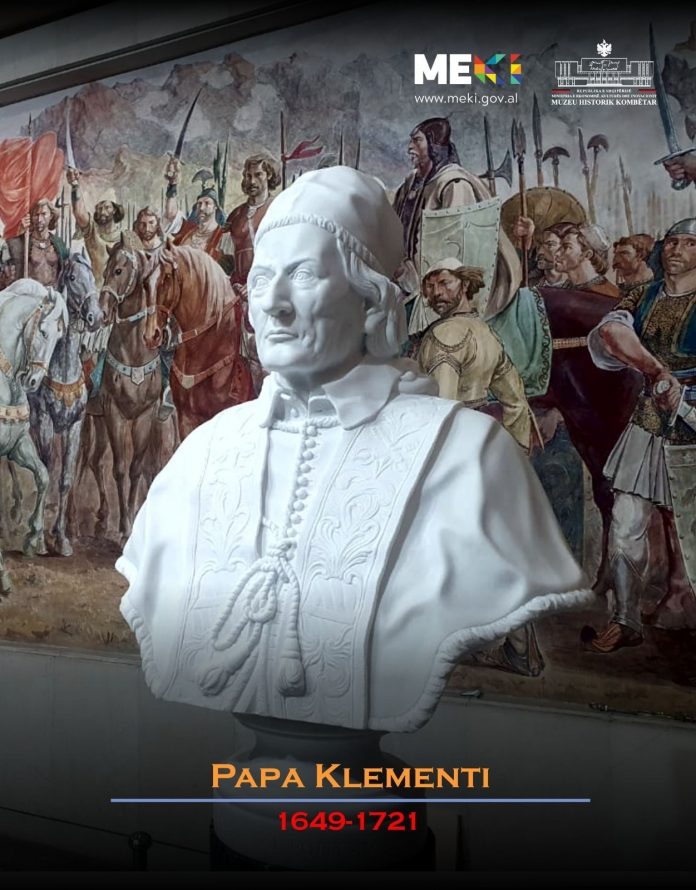
The National Historical Museum commemorated Pope Clement XI (1649–1721) today, marking the 376th anniversary of his birth. The museum honored him as a symbol of wisdom, faith, European culture, and diplomacy.
Pope Clement XI was born on 23 July 1649 in Urbino, Italy. He came from a noble family of Albanian origin, tracing its roots to Laç, Kurbin. His baptismal name was Giovanni Francesco Albani.
In 1690, Pope Innocent XI appointed him cardinal. Ten years later, on 23 November 1700, he was elected pope—two months after the death of Innocent XII.
During his pontificate, Clement XI took a strong stance against nepotism within the Catholic Church. From 1715 to 1718, he supported the Republic of Venice and Emperor Charles VI in their military campaign against the Ottoman Empire.
He also initiated and supported the monumental historical project Illyricum Sacrum. This work aimed to document the full ecclesiastical history of the Illyrian territories, including Albania and the broader Balkans.
Notably, under his guidance, Archbishop Vincenc Zmajević of Bar convened the Assembly of Arbër in 1703. Its proceedings were published in 1706 in both Albanian and Latin.
This document holds double significance. It serves as a key source for Albanian church history and offers early evidence of efforts to preserve the native language, promote education, and strengthen national awareness.
Known as “the Albanian Pope,” Clement XI proudly acknowledged his roots, often stating, “By blood, I am Albanian.”
He died on 19 March 1721 in Rome.
/a.c/
Të ngjashme

Latest News




Most read









 RTI
RTI