
 English
 Français
 Deutsch
 Italiano
 Turkish
 Greek
 Serbian
National Iconographic Museum Onufri




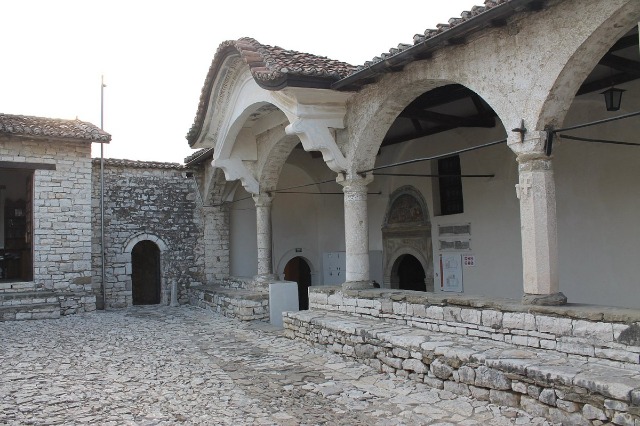
The Museum houses a collection of 200 artwork objects, including icons and liturgical items dating from the 14th to the 20th century, brought from various churches and monasteries in the region. Among the notable pieces are icons painted by renowned Albanian icon painters such as Onufri, his son Nikolla, Onufër the Cypriot, David Selenica, Kostandin Shpataraku, and the Çetiri kinsfolk, including Gjergji, Johani, Nikolla, Naumi, and his son Gjergji, alongside works by anonymous painters. Additionally, the liturgical items feature the craftsmanship of Albanian silversmiths from different periods, while the Cathedral woodcarvings were crafted by masters Stefan Barka and Naum Ngjela from Misrasi and Lavdari, in Opari, during the early 19th century.

The iconostasis of the Cathedral of the Dormition of St. Mary, created in 1807, stands out as a masterpiece of Albanian woodcarving, featuring decorative elements with Baroque-style influences—a prevalent trend in churches constructed in the Balkans during the 18th and 19th centuries. These motifs are interwoven with Byzantine traditions.
Preserved within a wooden arch near the Iconostasis are the remains or relics of two Saints, Gorazdi and Angjellari, believed to have carried out their mission in the 9th century AD as disciples of Saints Methodius and Cyril.
On August 12th, 1968, beneath the apse floor, the Purple Codex of Berat and the Golden Codex of Anthimos were discovered inside a small metal box hidden in the crypt. Also known as the “Codex Purpureus Beratinus” from the 6th century A.D. and the “Codex Aureus Anthimi” from the 9th century A.D., or simply as the Codices of Berat, they represent significant cultural and civilizational monuments, serving as genuine encyclopedias of Christian thought.
Recognized as important works of humanity, the two Berat Codices are included in UNESCO’s “Memory of the World” list, symbolizing their significance in preserving and showcasing human heritage.

/k.s/
Të ngjashme




Latest News










Most read










 RTI