
 English
 Français
  Deutsch
 Italiano
 Turkish
 Greek
Greek Serbian
Ndre Mjeda, the theologian who was a writer, linguist and ardent patriot




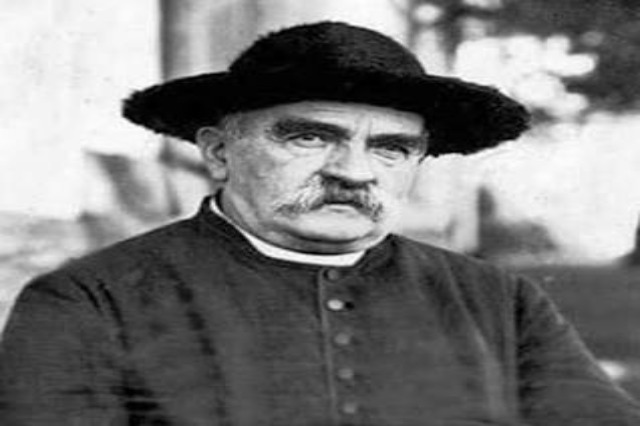
Ndre Mjeda, who signed himself ‘Mjedja’, was the prominent poet and patriotic activist. He was born in Shkodër in 1866 to Jakë Zefi (Kryeziu) and Luçije (Dominika) Thaçi, originally from Mirdita from his father, and from highlands of Puka from his mother. As a young man with his developed intellect, talented and will to study, he attracted the attention of the Jesuits, who thought of making him a priest. His education was influenced by the Jesuit writer Anton Xanoni (1863-1915) and the Franciscan poet Leonardo de Martino. He then continued his religious studies in Spain, Italy and Poland.
In 1883 we find him in Croatia, where he studies rhetoric, Latin and Italian in the Jesuit Institute in Kraljevica on the Dalmatian coast. From 1884 to the beginning of 1887 he trained at a college run there by the Gregorian University of Rome, and in 1887 he transferred to another Gregorian college in Chieri (Chieri), southeast of Turin, where he stayed until the end of that year.
At first he taught in a religious high school in Croatia. In these years, Ndre Mjeda began to write Albanian poetry, among them the well-read melancholic poem “Vaji i bylbylit” Nightingale’s Lament/ , published in 1887, where he conveys the longing for his country. The poem “Vorri i Skanderbegut” /Skanderbeg’s Tomb/ belongs to this period.
The theme of the Albanian in exile, who misses the homeland under the Ottoman Conquest, was more than usual in Renaissance literature, especially in the decade after the surpress of of the League of Prizren enterprise. Many other poems from his pen are devoted to such national themes.
From 1887 to 1891 Mjeda taught music at the Marco Girolamo Vida College in Cremona, Italy on the River Po.
Starting from 1891 Mjeda studied for several years at the theological faculty of the Gregorian college in Krakow in Catholic Poland, where he got acquainted with the philology works of albanologists Gustav Meyer (Gustav Meyer, 1850-1900) and Holger Pedersen (1867-1953).
Mjeda’s poem “Gjuha Shqipe” /The Albanian Language/, written in December 1892, was dedicated to the Austrian linguist Meyer, whose monumental work Etymologisches Wörterbuch der albanesischen Sprache (Etymological Dictionary of the Albanian Language) had been published a year earlier. The works of Meyer and Pedersen awakened Mjeda’s interest in the history and development of the Albanian language, which would continue in later years andwould turn into an aid to the issue of the alphabet itself, through his work with textbooks and studies of old Catholic authors Pjetër Budi (1566-1622) and Pjetër Bogdani (1630-1689). In 1893 we find the poet in Gorizia on the Italian-Slovenian border, and after a year again in Kraljevica again, where he taught philosophy and theology and served as librarian at the Gregorian college.
He also participated at the beginning in the activity of the Literary Society Union, which was founded that year in Shkodër from Preng Doçi, Ndoc Nikaj and Gjergj Fishta, with Austro-Hungarian support.
For patriotic activity, Ottoman authorities arrested him. Mjeda’s ardent interest in the issue of the Albanian alphabet led him, despite the problems with the Ottoman authorities, to participate in Congress of Letters in Manastir in 1908, where together with Father Gjergj Fishta, Luigj Gurakuqi, Hilë Mosin and Mati Logoreci, as representatives of Shkodër, was elected a member of the Commission for the drafting of the unified alphabet of Albanian.
Ndre Mjeda started his poetic activity early. The well-known romantic poem Nightingale’s Lament in 1887 notes his patriotic spirit and longing for homeland, which stood out. The poem ends with a call to the Albanians to stand up to win their freedom.
From this time until 1917 when he the light of publication, the volume of poems Juvenilia, Ndre Mjeda wrote, but published almost nothing.
Thematic of his pen are longing for the homeland, for the people and the nature of the country with its beauties, the traveler, Albanian language, need to unify, evoking of the glorious past and social themes too.
Ndre Mjeda is one of the greatest poets of Albanian literature. With a first romantic and boyish inspiration, he created the poem of longing and personal pain. With the recognition of the authentic life of the Albanian world, he has created the poem of the Albanian world (Dream of Life). With research in the recognition of the cultural roots of historical he created the herds of sounds (Lissus, Scodra). With his personal rebellion and national rebellion, he created the poem of revolt and the anthem of freedom (Liberty). Mjeda remains an unparalleled master of form and poetic language in Albanian and the greatest master of sound in Albanian poetry.
From the poem “Albanian Language”
Above the nightingale’s sound;
Albanian Language trembles me soul;
More than the lilies’ fragrance;
By no doubt it sets my heart appease;
……………….
Geghs and Tosks, highlanders and plain dwellers;
Are one Nation that no split can afford;
From North to South, there is only one single Albania;
And one language unites us all;
/a.p./
Të ngjashme
Latest News
Most read








 RTI
RTI