
 English
 Français
  Deutsch
 Italiano
 Turkish
 Greek
Greek Serbian
Nearly 25 years after, NATO is considering permanent reinforcements in Kosova




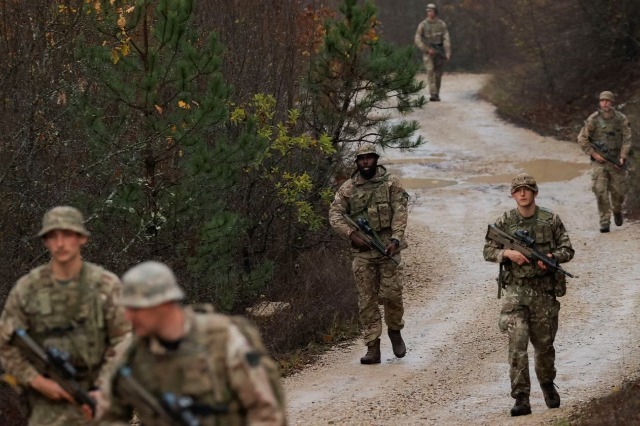
In 1999, NATO intervened to end the war in Kosova. For 78 successive days, NATO bombed the targets of the then Serbian army. After Serbian withdrawal from Kosova, in June 1999, NATO entered with its KFOR peacekeeping mission, consisting of more than 50,000 soldiers.
“We will create a military presence, which will guarantee a safe environment for the return of all refugees and for all those who are homeless within Kosova itself… We will deal directly and decisively with anyone who tries prevent us from achieving this,” said the NATO commander in Kosova, at that time, Sir Michael Jackson.
Since then, KFOR was reduced to just over 3,700 soldiers last year. Today it counts over 4,600. The number of troops have been increased this year, due to the increase of tensions in the farthest north of Kosova, inhabited by a majority of Serbs.
The alliance has sent hundreds of additional forces after the riots caused by the installation of Albanian mayors in four municipalities in the north, in which dozens of KFOR soldiers were injured, and after the incident in Banjska, where armed groups of Serbs attacked the Kosova Police, killing an officer.
The event of September 24 in Banjska has been described as the worst since Kosova declared its independence in 2008 and has fueled international concern about stability in the country. Kosova has blamed the Serbian state apparatus for the attack, while Serbia has blamed the Serbs in Kosova. Milan Radoicic, who has taken responsibility, continues to be free in Belgrade.
The NATO Secretary General, Jens Stoltenberg, first warned in Prishtina, during a visit on November 20, that NATO will consider the permanent increase of forces in Kosova, to keep the situation under control.
This week, on the sidelines of a NATO meeting in Brussels, Stoltenberg has reiterated that the alliance will do whatever is necessary to maintain stability in the Western Balkans and that it will therefore discuss the permanent increase of the military presence in region.
“Now we are considering whether this increase [of troops] should be more long-term, whether there is a need for new capacities, yet so far we have taken important steps, increasing the number of our troops,” Stoltenberg said.
These concerns have been echoed this week by the United States too. The US Assistant Secretary of State for European and Eurasian Affairs, James O’Brien has warned both Kosova and Serbia that causing unrest in the north of Kosova would mean confrontation with NATO.
The US Secretary of State, Antony Blinken, has said that the US does not want the return of the conflicts in the Balkans.
“NATO has responded decisively to the actors who aim to destabilize the north of Kosova. We have deployed additional troops to KFOR. Also, we have deepened the cooperation with the force led by the European Union in Bosnia and Herzegovina,” said Blinken.
In light of these developments, Western diplomacy is exercising pressure on Kosova and Serbia to speed up the process of the relations normalization. It demands to Prishtina the establishment of the Association of municipalities with a Serbian majority, while to Belgrade, it demands the de facto recognition of Kosova.
In this line, Charles Kupchan, from the American Council on Foreign Relations, comments on NATO’s warning for a permanent increase of forces in Kosova.
“I don’t think this ‘permanent’ means a few hundred years. The idea is to buy time to help Kosova and Serbia make progress towards the formation of the Association of municipalities with a Serbian majority, towards the agreement that the EU has put on the table for the normalization of relations between them. I think NATO will stay as long as it needs to. It will provide a sense of security between Albanians and Serbs, that it will help maintain peace while diplomats do the hard work,” Kupchan says on Radio Free Europe’s Expose program.
Jasmin Mujanovic, an expert on Southeast European politics, says that the permanent increase of NATO forces in Kosova would help stabilize the region significantly and send a signal that NATO takes seriously the threats visible in the Western Balkans.
“This is not enough. I think that NATO, eventually, should work towards further expansion in the Western Balkans, considering Bosnia and Kosova as more urgent priorities. But, for the moment, this is a good intermediate step,” says Mujanovic, while adding that the two persons who benefit from these tensions are the president of Serbia, Aleksandar Vucic, who still has territorial claims over Kosova, and the president of Republika Srpska in Bosnia and Herzegovina, Milorad Dodik, who has secessionist tendencies. Refering to the situation created several decades after the end of the wars in the Balkans, Mujanovic puts part of the blame on the international community itself.
“Western governments have stopped paying attention to the Balkans and have believed that the process of reconstruction and democratization after the war can be achieved with minimal contribution and minimal involvement on their part. This has not been the case before. “When we think about post-war reconstruction in Germany and Japan, the involvement of the Allies was on a much, much greater scale,” says Mujanovic.
Mujanovic adds that the “soft approach” of the West towards the president of Serbia, Aleksandar Vucic, has endangered Kosova, but also Bosnia and Montenegro, where Serbian nationalist militancy, according to him, is the main threat to internal security.
Mujanovic does not believe that there can be conflicts in the Balkans similar to those of the 1990s, though adding that low-intensity violence is possible.
Kupchan expresses himself in similar lines. He says that the attack in Banjska was an “alarming event”, as was the then mobilization of the Serbian army near the border with Kosova. The threat of violence is not immediate, but it cannot be ruled out, Kupchan says.
“The last thing the European Union and the United States want right now is another hotbed. We have a major war in Ukraine and a raging war in the Middle East. I think the goal [of the international community] is to keep the Western Balkans stable and push it towards lasting peace,” says Kupchan.
But does the Russian influence also endanger the peace in the Balkans? The discussion about this has intensified towards the middle of last month, when the president of Ukraine, Volodymyr Zelensky, has said that Russia “will make sure that one Balkan country goes to war with another”.
His claims were also supported by the head of NATO, Jens Stoltenberg, during a visit to Sarajevo on November 20.
“We are worried by the secessionist and divisive rhetoric [in Bosnia] as well as by malignant foreign interventions, including Russia,” Stoltenberg said.
The authorities of Kosova repeatedly say that Russia, through its ally, Serbia, tries to destabilize Kosova and other states of the Western Balkans.
In a post on November 19, the Prime Minister of Kosova, Albin Kurti, wrote, among other things, that “the threat from Russia and Serbia to stability, peace and regional security is being noticed more and more. Russia aims to put on a fire of crisis in the yard of the EU, to defocus NATO, and Serbia to fulfill its territorial ambitions towards its neighbors”.
Kupchan says there is no doubt that Russia is trying to exploit internal divisions in the region to increase its influence, but, according to him, its role is fading.
“Is [Russia] interested in stirring up tensions between Serbia and Kosova and then exploiting those tensions? Of course yes. But I think the bigger picture here is that Russia is gradually losing ground in the region. Be it Serbs, Kosovans or Montenegrins, you look at the invasion of Ukraine by Russia and say that this is not a country we want as a partner. I think this is probably one of the reasons why the US, the EU and NATO are improving their game,” says Kupchan.
/a.p./
Të ngjashme

Latest News








 RTI
RTI