
 English
 Français
 Deutsch
 Italiano
 Turkish
 Greek
 Serbian
New York Times: Albania is a country that amazes with its natural beauty and hospitality




Stunning beaches, untouched nature, unusual historical sites and low prices have turned this former hermit state into one of Europe’s newest destinations, writes Valeriya Safronova for the prestigious American “New York Times”.
In southern Albania, practically a stone’s throw from the Greek island of Corfu, the city of Butrint has stood for thousands of years. Its ruins are a history buff’s dream. An open-air theater, a Byzantine baptistery and a Roman aqueduct. Foxes, hawks and eagles roam the 93-square-kilometer national park that includes Butrint’s archaeological treasures.
Ten minutes by bus from Butrint, in the modern seaside resort of Ksamil, tourists lie on sun loungers, dance to electronic music and jet ski around a picturesque bay, made famous by social media influencers, who compare its lush appearance to the Maldives.
Albania is the kind of destination where a traveler can start the day with a stroll through antiquities and end it with a jump on the sand.
This could be a major reason why so many people are coming here.
Last year, 11,7 million visitors entered the country up from 10 million the year before, and they not only went to beaches and historical sites, but also explored the mountains and lakes in the north, as well as the Wild Vjosa River National Park, one of the 52 places to visit in 2023.
“Albania is still an exotic place for many people,” said Frenkli Prengaj, who runs tours for Discover Albania and spent two days touring me.
The country, which lies between Greece and Montenegro along the Adriatic and Ionian seas, declared independence from Ottoman rule in 1912 and, starting in the 1940s, spent decades under a Stalinist dictatorship, isolated from the rest of the world until 1990.
In the late 90s, Albania experienced an economic crisis followed by a period of unrest, but in recent years the political situation has improved and tourism, driven in part by low prices, has flourished.
New Albania
The vibrant resort of Ksamil is a clear example of the new Albania.
“During the decades of dictatorship, a small number of volunteers were sent to Ksamil to establish agricultural communities,” explains Dorina Dhima, an independent guide.
“The area, however, remained restricted, because people could escape by swimming to Corfu. There were no more than four palaces,” she adds.
That era is long gone. I enjoyed a leisurely octopus lunch (1 lekë, about $800) overlooking crystal clear water and green islands at a beach bar called Freskia e Jonit.
But visitors who prefer a quieter vacation can choose coastal destinations such as Jala, Borshi or Dhërmi, one to two hours further north.
When I traveled to Dhërmi in 2023 for the “Kala” music and wellness festival, I was amazed by the natural beauty of the landscape and the local hospitality.
About 20 minutes from Ksamil or a 30-minute ferry ride from Corfu (one-way tickets from $14 to $33), the coastal town of Saranda offers a similarly laid-back atmosphere, public beaches, a lively promenade that fills up in the evenings with well-dressed locals on a stroll, and plenty of opportunities to eat and drink with excellent seafood, such as at “Haxhi” and “Marini.”
I stayed at the “LaFe Boutique Hotel” in the city center and spent a lovely evening seeing family and friends.
Red roofs and juicy tomatoes
Albania has long been a bridge between East and West, the Balkans and the Mediterranean world. Due to centuries of Ottoman rule and despite decades of official atheism, nearly half the population identifies as Muslim. The country’s historical sites reflect this historical heterogeneity.
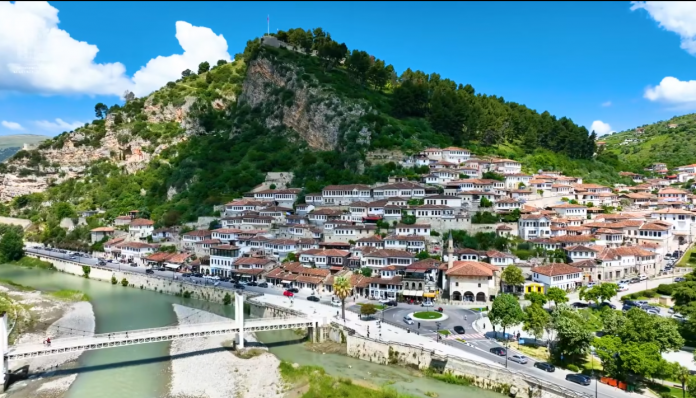
Berat, a UNESCO World Heritage Site about two hours south of Tirana, lies along the banks of the Osum River, with the red-tiled roofs of houses climbing the gentle slopes of the valley, with hundreds of windows looking out like watchful eyes.
Berat Castle (free admission), a complex overlooking the city, includes a Byzantine church, the ruins of one of the first mosques in Albania, and a neighborhood of still-inhabited houses from the 18th-19th centuries, some of which are guesthouses.
Also located there is the Onufri iconographic museum, which exhibits religious objects dating back to the 1300s, including an ornate wooden carved iconostasis (ticket with audio guide 500 lek).
When I visited Berat in late June, the city was silent until sunset, when the streets suddenly filled with children on bicycles, men playing dominoes, and vendors offering plastic cups filled with grapes and cherries for about 100 lek.
The abundance of fresh ingredients made food in Albania a pleasure.
At “Amalia Homemade Food” in Berat, I took a dozen photos of the table, simple and beautiful. The tomato salad was so juicy and vibrant, I felt like I had discovered a long-lost knowledge about the true taste of tomatoes.
The rest of the menu included cheese and vegetables baked in clay pots; peppers stuffed with rice and herbs; eggplant with garlic, peppers and tomatoes; spinach and cheese pie; and Viennese steak, meat stuffed with cheese (11-course menu for two, 28 euros or $32).
As is typical in Albania, the meal ended with a glass of raki, a strong alcoholic drink made from fermented fruit, versions of which are common throughout the Balkans.
“Those over 40 drink it almost every day,” said Andi Kallanxhi, an employee of Pupa Winery, a 20-minute drive southeast of Berat.
“Two large glasses at 5 or 6 in the morning, accompanied by a cigarette and Turkish coffee, two singles around 10 or 11, another after work with coffee, and then three or four more after work with sour cream and garlic,” he adds.
The “Amalia” brandy, sweetened with cinnamon, was a warm and strong concoction for the throat and a perfect end to my dinner.
Would I drink it for breakfast? Ask me when I turn 40.
Visit to a Cold War bunker
Ismail Kadare, winner of the Booker International Prize, describes the city of Gjirokastra, about two and a half hours south of Berat, as a “prehistoric creature clinging to the mountainside like a hook.”
Gjirokastra seemed more like something out of a storybook, its stone houses adorned with intricate wood carvings and clustered around cobblestone streets. But it’s a picture book with a dark side, as in the city center lies a Cold War tunnel, one of thousands of bunkers that dictator Enver Hoxha built across the country during his reign from 1944 to 1985, fearing foreign attack.
To join a 200 lek tour, go to the “Experience Gjirokastra” tourist agency in “Çerçiz Topulli” square.
If you climb beyond the historic center of Gjirokastra, you can visit a centuries-old castle (entry 400 lek), parts of which were used as a prison, most recently during Hoxha’s regime.
The prison cells and torture chambers have been left largely untouched and are a fascinating museum (200 lek).
The additional entrance fee includes entry to the Weapons Museum as well as the Gjirokastra Museum, which offers a compact but comprehensive history of the region.
Some of the most unexpected and interesting museums in Gjirokastra are Ottoman-era houses.
At the Skendulaj House, Edlira Skenduli, a descendant of the wealthy merchant family that built the house more than 300 years ago, led us on a tour (300 lekë).
“There are 64 windows, 44 doors, six bathrooms and four hammams,” she explains.
“The house’s safe room,” she said, “functioned as a shelter for 70 people during World Wars I and II. Other highlights included a natural refrigerator, an underground space cooled by an adjacent cistern, and the wedding room, decorated with pomegranate wood, painted and carved, with a sheltered balcony designated for single women who wanted to watch the ceremony.”
As I descended the slope from the castle towards the Rose Garden Hotel, where I was staying, I could see the sun slowly beginning to set behind the mountains, leaving dusty orange and pink streaks over the stone city.
Të ngjashme




Latest News










Most read










 RTI