
 English
 Français
 Deutsch
 Italiano
 Turkish
 Greek
 Serbian
New York Times:‘This is Albania; it’s a bit crazy’: Outsiders making Group B rivals sweat




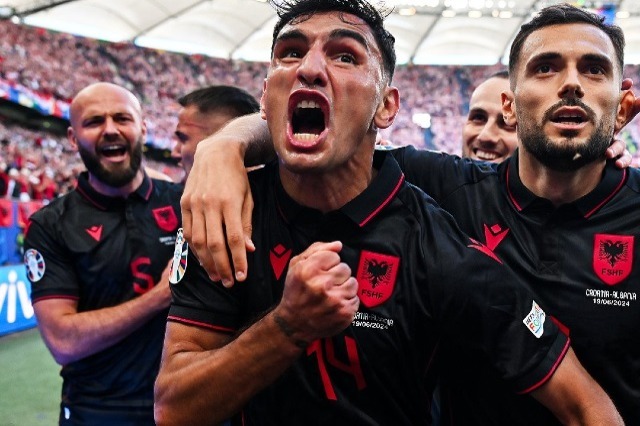
Before a ball was even kicked in Group B, Croatia’s Luka Modric had warned that it was “the most difficult in the tournament”.
He may not have been focusing purely on his side’s tussles with Italy and Spain but, when many others spoke pre-tournament of a ‘Group of Death’, it was probably not really with Albania in mind.
Few will have expected them to be the group’s most combative element, yet Albania — ranked 66th in the world — have become the fun variable in the quartet. With a game to play, they still have a chance of progression.
Managed by former Arsenal, Barcelona and Brazil full-back Sylvinho, Albania are a physical counter-attacking side that look to make up any perceived talent gap between themselves and their opponents through hard running.
It took 23 seconds for this side to make a mark at Euro 2024 as Nedim Bajrami set a new record for the fastest goal scored in European Championship history when opening the scoring against Italy. While Albania eventually lost that match 2-1, their early goal served as a warning; underestimate this team at your peril.
It was a warning that Croatia struggled to heed. Today’s (Wednesday) encounter between the two sides was an unexpected and entertaining romp. It again saw Albania go ahead early – Qazim Laci nodding in a superb cross from Jasir Asani in the 11th minute – before stubbornly battling to protect their lead. At half-time, Croatia had registered 69 per cent possession, but Albania had the game’s better chances.
Kristjan Asllani went off-target following a quick attacking move sparked by Modric losing the ball.
Albanian striker Rey Manaj also looked forlorn after failing to get a proper connection on a header. This has been a running theme for Sylvinho’s side, who have lacked attacking fluency at points throughout his 18-month spell in charge.
Injuries to Manaj and Armando Broja throughout the qualifying games meant neither striker built the sort of playing chemistry a team needs to be a potent counter-attacking side.
The manager’s decision to leave regulars Myrto Uzuni, Keidi Bare and Sokol Cikalleshi out of the 26-man squad for the tournament also caused a stir. Cikalleshi — a striker for Turkish club Konyaspor — was not the most prolific goalscorer, but his hold-up play gave Albania a valuable foothold in qualifying matches.
Yet this side finds a way to forge its own path through the tournament; one that frequently sees it roughing up bigger and more established football players. Mario Mandzukic — now an assistant coach with Croatia — could be seen leaping from the dugout to demand his players match Albania’s intensity in the first half.
It took a handful of second-half changes for Croatia to swing the game’s momentum in their favour. Marcelo Brozovic and Lovro Majer were replaced by Mario Pasalic and Luka Sucic at half-time. Twenty minutes later, striker Ante Budimir was introduced to give his team a better target for their crosses.
Croatia grew in confidence. Their full-backs crept further and further up the field while the build-up patterns of Modric and Mateo Kovacic became more dangerous. Budimir teed up Andrej Kramaric for their equaliser in the 74th minute. Two minutes later, the duo teamed up for another.
A cross intended for Luka Sucic pinballed in the penalty area before being turned in by Albania’s defensive midfielder Klaus Gjasula.
Albania could have collapsed, but they somehow found a second wind. In Asllani, they have a midfielder who is composed when in possession, and nicely combative when out of it. The 22-year-old is fast emerging as Brozovic’s eventual successor for the defensive midfield role at Inter Milan and was the heartbeat of his side.
“We have to fight for every point,” was Sylvinho’s post-match assessment of the game. “For our country and for our federation.”
The Brazilian often makes mention of sweat and respect in press conferences. Hard work is the bare minimum and the most important ingredient for this Albania side.
They can be iffy in front of goal (Mirlind Daku was booked late in stoppage time when an attempted volley missed the ball and hit Josko Gvardiol in the side of the head), but what is most important to the manager, and the thousands of fans who travelled to Hamburg on Wednesday, is their ability to keep trying. That hard work eventually paid off deep in stoppage time, when Mitaj pulled back a wonderful low cross for Gjasula.
The time read 94 minutes and 23 seconds when Albania got their equaliser (the latest goal to be scored at a Euros outside of extra time). It was an equalising goal that felt like a last-minute winner.
The noise in the Volksparkstadion was deafening. Gjasula — only the second player to score an own goal and a goal within the same game at the Euros — had given his side a slender chance of making it to the round of 16.
“This is Albania; it’s a bit crazy,” said Asllani after the 2-2 draw.
“We started off on the right foot, and then I can say I missed a big chance, but I thought Modric would get on the ball before me. I think we conceded two avoidable goals. We’ll review them, surely. The game was crazy in the last 15 minutes.”
Sylvinho’s scrappers will need to be at their very best to get a result against Spain in their final group game, but they are a team that has never been afraid of hard work. Albania doesn’t quit, and that makes them a difficult opponent at this tournament.
–
Të ngjashme



Latest News







Most read










 RTI