
 English
 Français
  Deutsch
 Italiano
 Turkish
 Greek
Greek Serbian
Pal Engjëlli, the clergyman who laid the cornerstone of Albanian diplomacy




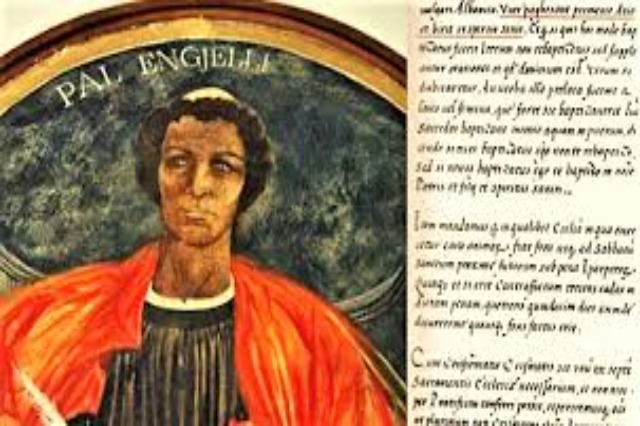
The Encyclopedic Dictionary of the Academy of Sciences of Albania (page 601) has defined the year 1417 as the birthday of this personality. Likewise, Rexhep Smajli, in the book “Old Texts”, reiterates (on page 69) this same year. The same conclusion is reached by Dhimitër Shuteriqi, but also by the authors of the text “Historia e Letërsië Shqipe” /History of Albanian Literature/, 1983, published by the Academy of Sciences, which underlines the year 1417 as the year of birth of Pal Engjëlli. Kristo Frashëri further reinforces the date of the birthday, when he says: “According to Flavio Comenius, Pal Engjëlli, the son of Andrea Engjëlli, who held the title of duke and count of Drishti, was born in 1417. After passing through the steps of the church hierarchy, he became Archbishop of Durrës and, during the pontificate of Pius II (1459-1464)…”
Son of Andrea, Pal Engjëlli from an important family of medieval Drisht. According to the Croatian Albanologist, Milan Suffly, he was born in Durrës and only then the connections with the Angels of Drishti were established by his brother, Pjetër, officer serving at Scanderbeg’s Guard. Not much is known about his youth, it is thought that he was born in 1417 Farlati says that during his youth he stayed in Constantinople. Then he returned to Drisht, where he is documented as a priest (presbyter). According to the Statutes of Drisht, he was also a judge, commissar and conservator.
On March 19, 1460, he was ordained Archbishop of Durrës by Pope Pius II, and until then held the title of baccalaureate in church laws (Lat. baccalaureus in decretorum). During the same year, he donated an amount of 60 florins to the Assembly of St. John of Strilal (in today’s Shtoj, the surroundings of Shkodër).
He was also Skanderbeg’s diplomat and accompanied him to Ragusa and Italy in 1461.
In 1464 in June he was sent by Skanderbeg to Milan together with Alessio Albanese to meet Francesco Sforza. That same year, by order from Pope Pius II and his own mediation, Skanderbeg’s reconciliation with Lekë Dukagjini was achieved. After 1465 he was the ambassador of Skanderbeg in Venice, while after the death of the leader in 1468, Venice returned him to Arbëria (Albania) with 220 ducats with the belief that thanks to the authority he enjoyed in the country’s primacy, he would be able to turn for better the state of affairs with the Ottomans pushing to invade the country.
Baptismal Formula
Pal Engjëlli on November 8, 1462 was among the conveners of the Assembly of Arbër, held in the church of Saint Trinity in Emathia – in today’s village of Tresh, according to Kasem Biçoku. The assembly held rectors and priests from the bishops of Durrës and Lezha, in the presence of countless nobles and minors, dealt with the ecclesiastical issues of the time in accordance with the needs of the country and believers. The conclusions that were drawn from the discussion of the issues in this assembly were listed in the summary entitled Constitutions, orders and statutes (lat. Constitutiones, Ordinationes et Statuta) and in this summary there is also the Baptism Formula in Albanian language with the content “Un te’ paghesont premeni Atit et Birit et Spertit Senit». The phrase was coined to be used by parents if the newborns were in danger of death and there was no time and no clergyman could be found to perform the sacrament of baptism.
These lines are written on page 4 (at the top) of this Latin manuscript. The formula was found in an exchange of letters between priests addressed to the Church of the Holy Trinity in Matt. In the Laurentian Library of Florence, this report written by the hand of Paul Angel on 37 pages, bears the inventory number 1167 and is preserved as one of the precious documents of this library since the European Renaissance. It was discovered in 1915 by the Romanian researcher Nikolae Jorga.
/a.p./
Të ngjashme
Latest News
Most read






 RTI
RTI