
 English
 Français
  Deutsch
 Italiano
 Turkish
 Greek
Greek Serbian
Pavlov: Corridor VIII acts as a catalyst for investment in logistics





Bulgaria’s Deputy Minister of Foreign Affairs, Nikolay Pavlov, said today that in the current geopolitical environment, countries must actively connect and develop transport links. He emphasized that these are not just economic tools but carry strategic importance for the region.
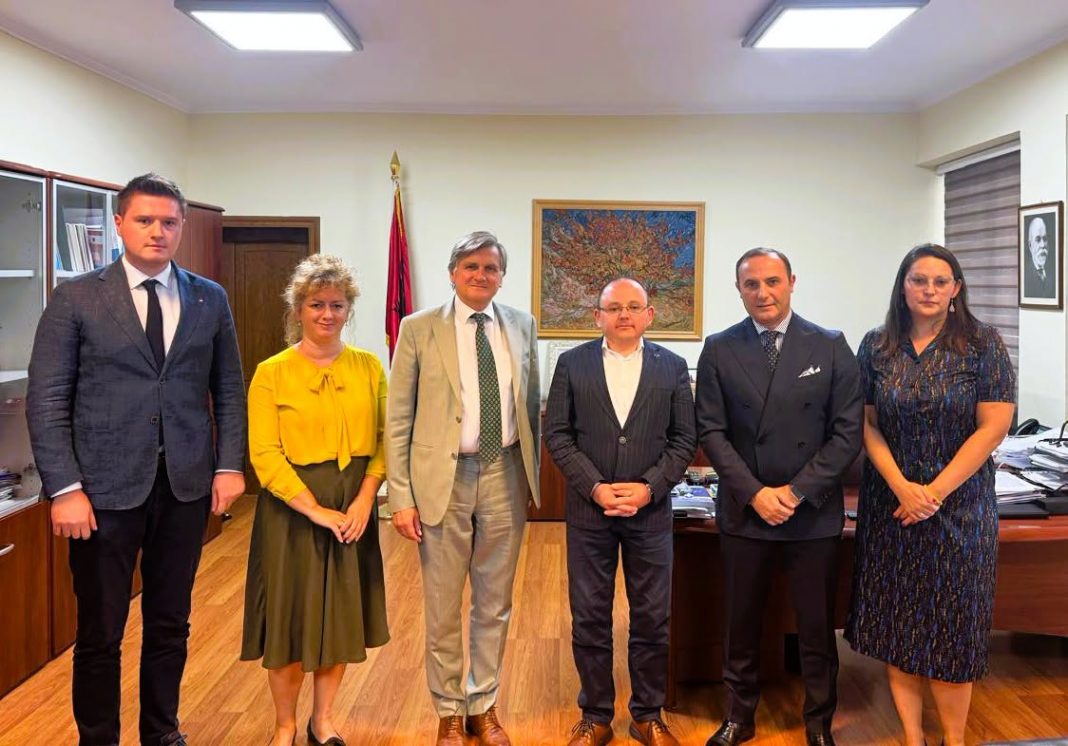
At the Corridor VIII ministerial in Tirana, Pavlov addressed a gathering that included Europe and Foreign Affairs Minister Elisa Spiropali, Italian Foreign Minister Antonio Tajani, North Macedonia’s Foreign Minister Timčho Mucunski, and Romanian Ambassador to Albania Octavian Şerban. He stressed that the EU considers trans-European transport development one of its most strategic projects.
“Railways, roads, ports, airports, energy networks, and digital infrastructure do not function as mere technical systems. Instead, they form the backbone of economic power. Therefore, we must evaluate Corridor VIII for its political-strategic significance, regional economic impact, and defense value,” Pavlov said.
He pointed out that Corridor VIII shortens the distance between the Adriatic and Black Seas. In addition, it creates a multimodal link connecting the Western Balkans, the wider region, and Europe.
“Europe recognized Corridor VIII as strategically important. When authorities adopted Regulation 179 in 2024, they included the Durrës-Bari-Skopje segment in the Eastern Mediterranean corridor. Although it posed challenges, this decision confirmed the corridor’s continental significance,” he added.
Pavlov underlined that Europe acts as a key partner to boost autonomy, mobility, and capacity through 2034. It also supports strategic projects across the European space and in countries aspiring to join the EU.
Furthermore, he stated that the next programming period must address cross-border transport connectivity in a broader context. This approach will increase regional competitiveness and help implement critical infrastructure projects like Corridor VIII.
“We welcome the inclusion of the Skopje-Sofia segment in the 2025 Transport Ministers’ Council funding. This step places Corridor VIII firmly on the European strategic agenda. Last year, Bulgaria and North Macedonia signed a bilateral agreement to link two railway systems technically. This agreement brings us closer to completing the Skopje-Sofia railway, a cornerstone for Corridor VIII,” he explained.
Pavlov added that authorities are modernizing the segment toward North Macedonia. Meanwhile, tender procedures for the remaining 2.4 kilometers at the border station have concluded.
“Corridor VIII carries critical importance. It reduces transport and transit costs while boosting the region’s economic competitiveness. Moreover, it catalyzes investments in logistics, transport, industrial zones, energy networks, and digital infrastructure. Consequently, it will attract investors, strengthen public-private partnerships, and facilitate the use of European funding,” Pavlov concluded.
Të ngjashme

Latest News






Most read






 RTI
RTI