
 English
 Français
 Deutsch
 Italiano
 Turkish
 Greek
 Serbian
Peleshi: Proud of the contribution of the Air Force in these 72 years




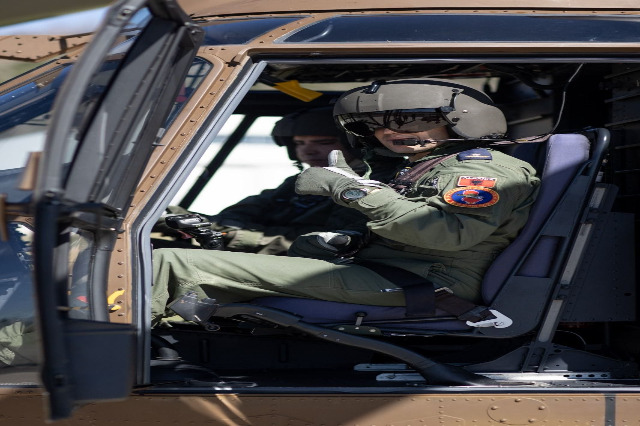
The Minister of Defense, Niko Peleshi, congratulated today the Air Force for their contribution, in the context of the 72nd anniversary of this Force.
“The protection of our airspace, the response to emergency situations, in difficult and critical times, in disaster and need, in helping and saving lives, throughout 72 years, have made our military aviation and its pilots, the most beloved people and honorable”, wrote Peleshi, in his post on social networks.
Peleshi emphasized that, “the contribution of every Air Force soldier is immeasurable and an irreplaceable part of our national history”.
The Albanian Air Force was officially established on April 24, 1951. The first aircraft were Soviet Yak-18 aircraft produced after World War II and were initially stationed in Laprakë on the outskirts of Albania’s capital, Tirana.
A few years later, the Albanian Air Force would also be equipped with jet fighters. The first squadron with MiG-15Bis fighter jets, NATO code ‘Fagot’ titled “Peza” was created in 1955. This squadron was deployed at the airport of Kucova.
In later years, in the framework of military aid from the Soviet Union, the Albanian Air Force was also equipped with MiG-17, NATO code ‘Fresco’ and MiG-19, NATO code ‘Farmer’ types , and in the early 70s with Chinese-made MiG-21 fighter jets. The fighter jets that came from China had different make brands than the Soviet ones, but in the Albanian Air Force, they were always identified with the Soviet brand.
In June 1957, the first transport regiment was created, equipped with Mi-1 helicopters (3 pieces), new Mi-4 helicopters (3 pieces) as well as some Yak-18 and PO-2 propeller-driven aircraft. In 1967 this regiment was expanded in capacity with the arrival of 30 Mi-4 helicopters.
In 1962, the Rinas Regiment was established with MiG-17 fighter jets and MiG-19 jet fighters. MiG-19 fighter jets were the ‘pillar’ of this force due to their large number (over 70 aircraft). At the same airport, the newly arrived warplanes from China were deployed for a short time; the F-7A ‘Fishbed C’ fighter jets which were the Chinese version of the Soviet MiG-21F-13 fighter jet (the first mass-produced model). But after a while these planes (12 in number) were transferred to the newest air base of the Albanian Air Force; that of Gjadri, otherwise known as Lezha-Zadrima.
F-7A (MiG-21F-13) aircraft were grouped into a squadron. Also, the Gjadri airbase had 2 squadrons of F-6S (MiG-19) and one squadron of F-5 (MiG-17) aircraft as well as several two-seater MiG-15UTI training aircraft. The Gjadri air base was distinguished from the other two bases by an underground tunnel built under the Gjadri mountain.
In the period 1950-1975, the Albanian Air Force was one of the most modern air forces in the region, but also in the world, both in terms of logistical equipment and the high training of its personnel.
Albanian pilots were distinguished from other pilots in foreign fighter pilot training schools such as those of Yugoslavia, the Soviet Union and China for the high professional skills they showed.
In 1962, the Soviet Union supplied the Albanian Air Force with 12 MiG-19PM fighter jets, NATO code ‘Farmer E’ equipped with radars. After the breakdown of relations with the Soviet Union, Albania became friends with China. The Chinese government made a proposal to the Albanian government to exchange MiG-19PM fighter jets with a larger number of Chinese-made MiG-19S.
This proposal was accepted by the Albanian government and all 12 MiG-19PMs were exchanged for less sophisticated aircraft of the MiG-19S variant. These aircraft were not equipped with radars and could only fly during the day in optimal weather conditions.
In 1962, the Aviation Academy was established in Vlora, an academy which had the status of a high school. This academy had at its disposal CJ-6 (Yak-18) basic training trainers, MiG-15bis jet fighters and MiG-15UTI two-seat trainers.
/k.s/
Të ngjashme



Latest News




Most read










 RTI