
 English
 Français
  Deutsch
 Italiano
 Turkish
 Greek
Greek Serbian
Pjetër Bogdani, one of the greatest personalities of early Albanian literature




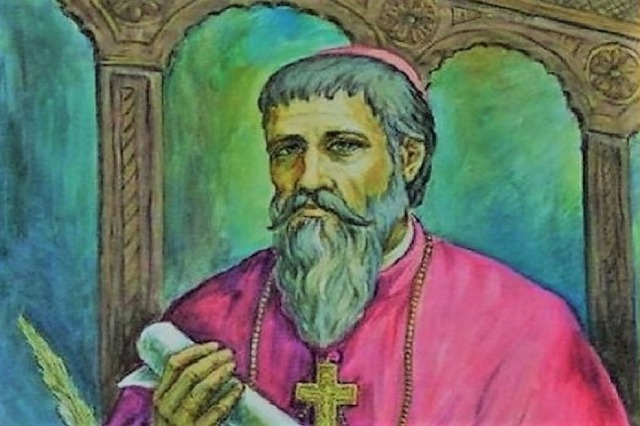
Pjetër Bogdani ( 1627 – 5 December 1689) was one the most original writers of early Albanian literature. He was author of the Çeta e Profet’ve /The Troop of the Prophets/ (1685) one of the first prose works of substance written originally in Albanian. He organized a resistance against the Ottomans in Kosova in 1689 that included Albanians of both religions.
Pjetër Bogdani was born in the village of Gur in the area of Has, near Prizren in 1627. He was educated in the traditions of the Catholic Church. His uncle Andrea Bogdani (1600–1683) was Archbishop of Skopje and author of a Latin-Albanian grammar, now lost. Bogdani is said to have received his initial schooling from the Franciscans at Chiprovtsi in modern northwestern Bulgaria and then studied at the Illyrian College of Loreto near Ancona, as had his predecessors Pjetër Budi and Frang Bardhi. From 1651 to 1654 he served as a parish priest in Pult and from 1654 to 1656 studied at the College of the Propaganda Fide in Rome where he graduated as a doctor of philosophy and theology. In 1656, he was named Bishop of Shkodër, a post he held for twenty-one years, and was also appointed Administrator of the Archdiocese of Tivar (Bar) until 1671.
During the most troubled years of the Ottoman – Austrian war, 1664–1669, he took refuge in the villages of Barbullush and Rjoll near Shkodër. A cave near Rjoll, in which he took refuge, still bears his name. Eventually, he was captured by the Ottomans and imprisoned in the fort of Shkodër. The bishop of Durrës, Shtjëfen Gaspëri later reported to the Propaganda Fide that he was rescued. In 1677, he succeeded his uncle as Archbishop of Skopje. The Gashi and Krasniqja clans were in frequent conflicts with one another until 1680, when Pjetër Bogdani managed to reconcile 24 blood feuds between the two clans.
His religious zeal and patriotic fervor kept him at odds with Ottoman forces, and in the atmosphere of war and confusion which reigned, he was obliged to flee to Ragusa, from where he continued on to Venice and Padua, taking his manuscripts with him. In Padua he was cordially received by Cardinal Gregorio Barbarigo, Bishop of Padua at that time, whom he had served in Rome. Cardinal Barbarigo was responsible for the church affairs in the East and as such he had a keen interest in the culture of Albania. The cardinal had also founded a printing press in Padua, the Tipographia del Seminario. Barbarigo was thus well disposed, willing and able to assist Bogdani in the latter’s historic undertaking, the book ‘Çeta e Provet’ve’ /The Troop of the Prophets/.
After arranging for the publication the ‘The Troop of the Prophets’, Bogdani returned to the Balkans in March 1686 and spent the next years promoting resistance to the armies of the Ottoman Empire, in particular in Kosova. He and his vice Tomë Raspasani played a leading role in the movement in Kosova against the Ottoman rule. He contributed with a force of 6,000 Albanian soldiers to the Austrian army which had arrived in Prishtina and accompanied it to capture Prizren. There, however, he and much of his army were met by another equally formidable adversary, the plague. Bogdani returned to Prishtina but succumbed to the disease there in 5 December 1689.
That’s how ended one of the greatest personalities of early Albanian literature, the writer often referred to as the father of Albanian prose.
The Troop of the Prophets is considered to be the masterpiece of early Albanian literature and is the first work in Albanian of full artistic and literary quality. With its poetry and literary prose, it touches on questions of aesthetic and literary theory. It is a humanist work that steeped in the philosophical traditions of Plato, Aristotle, St Augustine, and St Thomas Aquinas. Bogdani’s fundamental philosophical aim is the knowledge of God, an unraveling of the existence, for which he strives with both reason and intellect.
/a.p./
Të ngjashme
Latest News

Most read







 RTI
RTI