
 English
 Français
 Deutsch
 Italiano
 Turkish
 Greek
 Serbian
Portuguese media “Zerozero”: The hero of Albania and the citizen of Porto




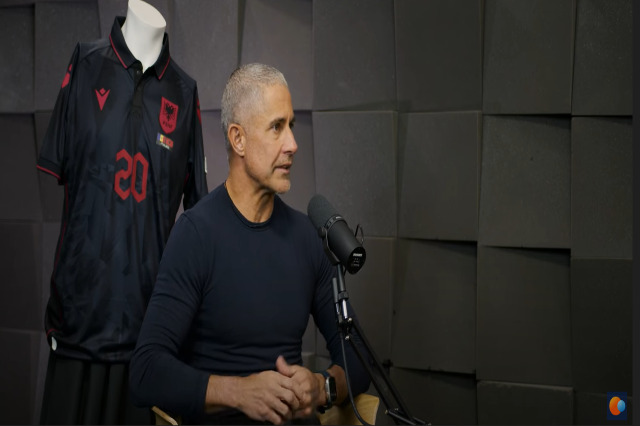
The coach of the Albanian National Team, Sylvinho Mendes Campos Júnior, conducted a very interesting interview for the Portuguese media ‘ZeroZero,’ discussing everything from his journey with the Red and Black team to life in Tirana, working with the staff and players, the conditions offered by the Albanian Football Federation (AFF), and his opinion about the two Albanian footballers who play in Portugal, Adrian Bajrami and Enea Mihaj.
The coach of the Red and Black National Team highlighted the progress of the AFF and the significant research work conducted to discover new talents. He also commented on Albania’s chances in the European Championship.
Furthermore, he expressed the opinion that Albania should learn to play in the European Championship, and he added that in the future, qualification for the World Cup will also be a target.
Exactly one year after it was officially announced in Tirana, Sylvinho visits zerozero. In the midst of this coincidence, what is the assessment of your work as Albania’s coach?
Sylvinho – It’s a pleasure to be here, and I was taken by surprise by this coincidence. The year with Albania was very intense, fabulous, and it’s great to be here talking to you and celebrating it.
I had never been a head coach before. How did the opportunity to coach the Albanian national team come about?
Sylvinho – The invitation came from someone very close to the president of the federation. I was living in Porto at the time and was invited to a dinner in Milan. The president, Armand Duka, was conducting some business in Italy, and during our conversation, there was a good connection and harmony between the federation’s intentions and what we believed we could deliver. Soon after, the invitation was formalized, and we accepted. I conducted extensive research, wanting to understand the complete scenario, and the conclusion was very positive. We proposed to the president to live in Tirana, which came as a big surprise to him. None of my predecessors had done this, but my assistants and I wanted to be present there.
What reality did you find in Tirana?
Sylvinho – I found a very advanced federation, housed in a completely new building with over 100 employees spread across four exclusive floors dedicated to our work. The president occupies the fourth floor, while our team is on the second. We follow a regular schedule, starting work at nine in the morning and concluding at five in the afternoon. Upon our arrival in January, we had our first game scheduled in March against Poland, and we were greeted with a state-of-the-art training center, ready for use. Despite some initial concerns about the training complex’s central location in Tirana – I invite you to visit it – we experienced total respect from the fans and the people. I found a very well-structured federation.
And what group of footballers did you meet? A group already of good quality?
Sylvinho – We quickly realized that almost all the athletes play in very significant scenarios. Whether it’s the Italian Serie A, Bundesliga, Premier League, Spanish league, or Portugal, all these countries have Albanian players.
How was the prospecting work? We questioned why many players of Albanian origin, holding other nationalities, were outside the national team’s radar. Was there a need to convince them to represent Albania?
Sylvinho – It was a very different job from anything I had done previously. Albania’s history is very rich. There are three million Albanians living in the country and another 15 million residing in other territories. We have athletes with Italian, Swiss, or German nationality but of absolute Albanian origin. The federation is conducting this identification work, and it is crucial. We had eight qualifying games; some players have already been called up, and more could come in the future.
Sylvinho is living in Porto, almost an intermediate point between Brazil and Albania. When did he come to our country and why?
Sylvinho – Blame it on the magician Deco (laughs). I have a very good relationship with him; I’ve known him since we both played at Corinthians in 1996 – it doesn’t seem like it, but he’s younger than me. Years later, when I played for Celta de Vigo, Brazilians often visited Porto on Mondays. We walked, shopped, and the truth is, our cultures are closer. One of those times, I met Deco here, and later we were teammates at Barcelona for four years. Life went on, my children grew up, and Deco asked me if I would like to live in Porto since he already lived here. My daughter was studying in Madrid, I had already visited other parts of Europe, and we came to get to know Porto better. It wasn’t love at first sight; it grew. The city has developed a lot, it’s beautiful, with a huge offering, and it gives me peace of mind. I am very energetic, and I need it. The river, the sea, an evening in a quiet restaurant with a friend, family, my wife. That gives me peace of mind. I fell in love with Porto, and we came here. We’ve been here for three years now. My son is now 18 years old and has gone to study in the USA. It’s a bit of our family history.
Was living in Portugal, in Europe, decisive for joining the Albanian national team?
Sylvinho – I believe so. I have lived with many cultures and methodologies – Brazil, Spain, three years in the English Premier League, five years working in Italy, where I also took my coaching courses. In other words, there is a great mix of knowledge. Our trajectory, the trajectory of my technical team, was another help. We have Pablo Zabaleta, Doriva, people more than accustomed to working in the biggest clubs in Europe.
Albania has footballers in the biggest championships, who are always under pressure to win. Did this expectation make your job easier, at least from the mentality side?
Sylvinho – Very correct. On the night we qualified for Euro24, I made a point of mentioning two coaches who were with the national team before us and who left very positive contributions. People need to understand the process, and this process is not always quick. Before our arrival, the federative structure was already aiding the growth of our footballers and facilitating their entry into top leagues. They became accustomed to playing against big clubs, formidable opponents, and handling the responsibility of winning. All of this shapes an athlete. While we brought in our method and ideas, we also took advantage of the legacy left behind.
You told us, while still offline, that this number 20 jersey, worn by captain Ylber Ramadani, symbolizes what you tried to bring to Albania.
Sylvinho – We analyzed the group we were in, and it’s true, there wasn’t a world champion there – France, England, Spain… there was no guaranteed place for a superpower. However, Czechia and Poland were considered favorites. Qualification would depend more on us, and we managed to instill in the footballers’ minds that we had a good chance. Ramadani is a figure of pure heart and soul. We organized the team, provided tactical concepts, everything that football demands. But the most important thing was to be together and move in the same direction. There were exchanges, changes, athletes who played less and others who played more, and the athletes’ acceptance of all of this was fundamental.
The results couldn’t have been better. Does this emotional side help explain the success?
Sylvinho – Our move to Tirana was extraordinary. The athletes realized that we would take care of them down to the smallest detail. We traveled extensively in January and February, arriving at the March meeting already very prepared. We sensed their eagerness for the call, with a lot of desire. The technical team, comprised of individuals from various nationalities, was very close to the group, and this closeness was decisive.
In Portugal, there are two Albanians in the first division: Enea Mihaj plays for Famalicão, and Adrian Bajrami was recently called up to Benfica’s first team. They are both international; do you know them well?
Sylvinho – Yes, I came to meet them in person on a trip to Portugal, and the experience with Adrian Bajrami was actually funny. It’s almost like a joke. I didn’t know if he spoke Portuguese well. When we exchanged written messages, it was always in English. ‘Shall we meet in Lisbon?’ and he always replied ‘yes, mister, yes.’ I arrived in Lisbon, went to see him, and Bajrami looked more like a Portuguese person. ‘Hello, mister, how are you? Everything okay, man?’ (laughter). He’s a young athlete, his eyes were shining. Football has changed; we have to talk and then make decisions. If things are explained, they understand. Adrian is younger, he’s at Benfica B, and I was curious about him. Left-handed center, with good speed, room for growth. Enea Mihaj was already part of our plans; I came to watch two Famalicão games, we spoke in English. He has been called up, he is absolutely professional, and he takes great care of all the physical aspects. Adrian too, but he’s younger. He has rare qualities, namely his quickness and his left foot.
Do you want to give Roberto Martínez any tips about the Czech national team? It will be Portugal’s opponent in the European Championship.
Sylvinho – No, no (laughs). I’m the one who needs tips to stop Italy, Spain, and Croatia. Czechia is a well-assembled team; they were one of the strongest in our group. And there is a curious aspect. When we went to observe Czechia, we ended up watching several local football games, particularly in Prague, and we realized that the teams were ‘the face’ of the national team. They played the same way. What athletes did in clubs, they did in the national team. Very similar concepts. Czechia changed coach; they are physically strong, with tall and powerful athletes. They play a more direct game, have a good defensive process, and are very competent.
What can we expect from Albania in their second appearance at the European Championship? Is the objective to be ambitious, to play good football?
Sylvinho – Let me just go back a little; I can’t forget to talk about Roberto Martínez. We were together at the draw, and he is an extremely competent coach.
It was made official in Portugal on the day Sylvinho was presented in Albania: January 9, 2023.
Sylvinho – Incredible (laughs). We had a confrontation at the 2018 World Cup, although I was only Tite’s assistant. [Belgium eliminated Brazil in the “quarters”] In fact, I met him back in England when he played for Wigan. He is an excellent coach, an extraordinary person, and I would like to publicly express my gratitude to him. We had a great conversation at the time of the draw, and I have great admiration for Roberto. He is very polite. I’m the one who has to ask him for advice, not him me (laughs).
He achieved ten wins in ten games in Portugal’s qualifying campaign.
Sylvinho – Fantastic work. Now, let’s go back to the 2024 European Championship.
What can Albania do?
Sylvinho – We know that the group is very difficult. We must test our strength. There are two very clear situations for us in the Albanian federation: the first is the European Championship, and we have to hold an honest, firm European Championship with the characteristics of our team. We cannot change them; our ideas are non-negotiable. Are our possibilities small? Yes, minimal, but in 2018 with Brazil, we also carried out analyses. The second part involves trying to get Albania to compete in more European Championships and start thinking about being in the World Cup – play major national team competitions more frequently. Both points are difficult, but we are perfectly aligned with the federation.
The euphoria of the fans in Albania is evident. How can they manage this popular enthusiasm in a group with Italy, Spain, and Croatia?
Sylvinho – We started working on this management even before the end of the qualification. It’s true, there is an atmosphere of enormous euphoria. When the game against Czechia at home ended 3-0, I couldn’t sleep. ‘How are we going to manage all this?’. People called us, asked what was happening, said they had never seen such a thing, and that the city of Tirana was setting off fireworks. Well, everything was very good, but the coach wasn’t sleeping (laughs). We had meetings with the captains, and we cannot lose reality. We have to set attainable goals; we cannot say that we are going to this group, and it is mandatory to pass. We want continuity, to be at the European Championship frequently, but it is important to control this euphoria. The fan has no limits; he has every right to dream about the national team, but internally we have to create a conscious line of work.
«The 2009 Champions League final is the only one comparable to the qualification against Albania»
The night of qualifying for the European Championship is historic. Coaches live for these moments. As a footballer, did you experience something similar?
Sylvinho – I had never thought about that question… the answer will come from the heart. My Champions League final in 2009 [Barcelona-Manchester United, 2-0] is different. In fact, the difference is immediately marked in function: achieving perfection when playing on the pitch is inexplicable. However, being a coach has advantages and peculiarities. The only night that comes close to qualifying with Albania is the 2009 Champions League final. I was already a veteran, I knew I wouldn’t repeat that; it was a treble, and my celebration was the celebration of the end of a career. It was different, but the emotion is very close. I was very emotional that night in Moldova, which was still recent. The group was great, the management of this group was great too, everything was in line with what we thought and wanted. So I let myself be carried away by emotion; the images show that. Anyone who knows me knows this well. ‘That’s the real Sílvio, the other one is contained the whole time’ (laughs). It’s part of the profession.
What does the Albania coach do during this period when there are no games?
Sylvinho – Now we have three clear rivals in the European Championship. There is a group of 50 footballers being constantly monitored by my technical team. It’s not just the technical, tactical, or physical performance of the athletes but also the clinical. For example, if an athlete who is not normally called up by us but who is part of this group of 50 gets injured, we must have the information immediately. It’s a way for him to know that he is followed and is important to the coach. It’s part of our plans. There is a lot of work to do. Our medical department is great too. The March friendlies are giving us some headaches because we still don’t have any final opponents. We want two opponents who prove our real strength. Great selections to test us.
In a national team, there are no extended periods to train. Still, is it possible to have a strong game idea?
Sylvinho – Yes. The application of the methodology is different from that of a club; there is no day-to-day work to apply corrections. Since we don’t have that, the alternative is to resort to images, video. For example, if I have a full-back, I will show him everything he should or shouldn’t do at different times. In this case, we send videos to the athlete; we even invade his coach’s work at the club a little, to show him what we want from him – even if it is a little different from what he is used to. Two minutes of the image is ideal; the current generation cannot listen to us for more than that time (laughs). With this compact, our athlete has to know what we want from him and what is on the opponent’s side. It’s hard work, compiling images, and my technical team is essential. This is done individually, with all our footballers. There is a lot of wear and tear, but it is the possible way to mitigate this lack of daily contact.
Was that how you showed Jasir Asani what you wanted from him playing as a right-winger? He normally played as a left-back before that.
Sylvinho – The left-hander who plays in Korea. It is an example. Jasir Asani was not in the team’s plans, curiously. I like a lefty playing on the opposite side. That’s not unanimous among the technical team (laughs), but I’m trying to convince them. It’s very difficult to mark him. He has start, speed, he is very strong. Asani played in another position, but we saw previous images of him – when he played in Hungary – and my eyes ‘hit’ him. ‘Which athlete is this?’. This is very challenging. Doriva even used to say this to me: ‘Sylvinho, you find left-handed people more easily’ (laughs). And truth. This also happened to Mario Mitaj, a left-footed player who was with the Albanian under-21s. He played as a center on the left, sometimes as a winger, a lot of quality. I saw their games and felt that I was already ahead of the game in his category. We decided to promote it, and this is also a source of pride for the technical staff. Anyway, I always say the same thing: I was an athlete for 15 years, and I know that the fundamental answer has to be that of a footballer. In the case of Mitaj, the federation spent years working on it, and we gave it the final touch by putting him on the sidelines.
Was that how you communicated to Jasir Asani what you wanted from him playing as a right winger? He typically played as a left-back before that.
Sylvinho – The left-hander who plays in Korea. This is an example. Interestingly, Jasir Asani was not initially in the team’s plans. I like having a lefty playing on the opposite side. That’s not unanimous among the technical team (laughs), but I’m trying to convince them. It’s very difficult to mark him. He has the start, speed, and is very strong. Asani played in another position, but we saw previous images of him—when he played in Hungary—and my eyes ‘caught’ him. ‘Who is this athlete?’. This is very challenging. Doriva even used to say this to me: ‘Sylvinho, you find left-handed people more easily’ (laughs). And it’s true. This also happened with Mario Mitaj, a left-footed player who was with the Albanian under-21s. He played as a center on the left, sometimes as a winger, with a lot of quality. I watched his games and felt that I was already ahead of the game in his category. We decided to promote him, and this is also a source of pride for the technical staff. Anyway, I always say the same thing: I was an athlete for 15 years, and I know that the fundamental answer has to be that of a footballer. In the case of Mitaj, the federation spent years working on it, and we gave it the final touch by putting him on the sidelines.
Are you closed in your idea of the game, or are you a more flexible coach?
Sylvinho – Being in charge of a national team allows a coach to be less orthodox and more flexibile. It would be impractical for me to insist that there’s only one fixed system with no room for discussion. We initially started with a simple 4-3-3 formation in the first game, still not entirely aligned with my ideas. As we progressed, we realized the need for adjustments, and we brought in Nedim Bajrami, a midfielder from Sassuolo. It turned out to be a very interesting move, and the team improved as a result. Sometimes, certain players emerge and ‘force’ us to change the system.
/m.ll/
Të ngjashme



Latest News







Most read










 RTI