
 English
 Français
 Deutsch
 Italiano
 Turkish
 Greek
 Serbian
President of Slovenia, Natasha Pirc Musar: Slovenia, a staunch supporter of Albania and Western Balkans’ accession into EU




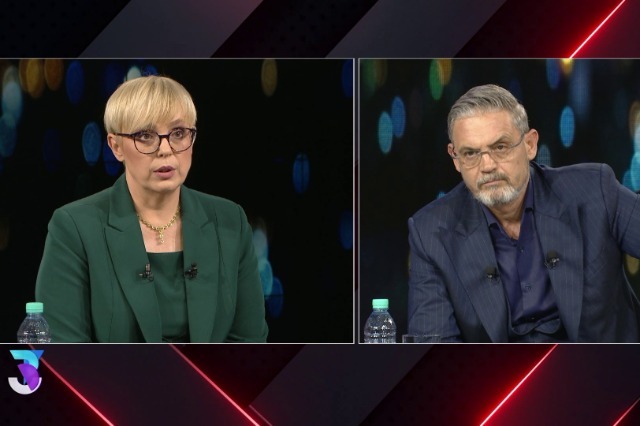
Interview of the President of Slovenia, Natasha Pirc Musar, for the show “3D” hosted by Alban Dudushi.
Alban Dudushi: It’s a pleasure to have you in the studio for a conversation about the potential for closer cooperation between Slovenia and Albania, the situation in the Balkans, and the unresolved issues between Kosovo and Serbia.
Welcome, Madam President.
I’ve read that in one of your “previous lives,” you also worked as a journalist and served as a commissioner from 2004-2014 for public information rights in your country. Now you are the first female president of Slovenia, elected through a direct and independent candidacy, transcending political parties.
Alban Dudushi: Is this your first time in Albania? If so, could you share your initial impressions from this visit?
Natasha Pirc Musar: This isn’t my first time in Albania. Many years ago, I came here as a tourist, and last year I participated in the Berlin Process Summit here. I can say that I’ve noticed enormous progress, and I’m surprised by how much Albania has developed since my last visit. You know me, and if you look at my CV, or if you’ve followed me as the president of the Republic of Slovenia, you’d know I’m a supporter of the European Union. I’m a European, and I truly believe that Western Balkan countries should integrate into the EU. Therefore, I feel good being here to discuss with parliamentarians, with my friend Edi Rama.
Alban Dudushi: Slovenia and Albania are two countries with geographical proximity, but they don’t seem as close in terms of political and economic cooperation. Or is my impression wrong? What do you think are the areas for improvement and greater rapprochement between our two countries?
Natasha Pirc Musar: There’s a reason why we don’t have the same level of cooperation with Western Balkan countries and other countries like those of the former Yugoslavia, where Slovenia was a part, but Albania wasn’t, and that’s the history of dissolution. I believe that our economic relations are at modest levels, but there are many areas for progress in bilateral relations. Bilateral trade exchanges are at low levels: 100 million euros is a really low figure compared to Serbia. With them, we have exchanges of 2.2 billion euros, and I see opportunities for increased cooperation in the field of energy, Artificial Intelligence (AI), a field where Slovenia is currently working a lot, and we have the best AI experts. In Slovenia, we have the highest number of AI experts per capita. For every 7,000 inhabitants, we have an AI expert, so we have many experts to offer Albania. Likewise, Albania has much to offer us, and whenever we talk about economic cooperation, there’s always a joint effort to achieve it.
Alban Dudushi: Of course, Slovenia is an EU member with a more developed economy. You mentioned some elements where Slovenia could be attractive to Albania, but recently we’ve been focusing a lot on tourism. Is Albania attractive to Slovenia only for tourism, or are there other elements?
Natasha Pirc Musar: When I was flying to Albania, it was a beautiful sunny day, and I saw a very beautiful panorama, beautiful beaches, a place with greenery, which we also have in Slovenia.
Slovenia is developing elite tourism, and my country has greenery covering 62% of its territory. Let me tell you another figure: last year, 22,000 Slovenes visited your country, so there’s potential. I know that last year Albania was visited by 8 million tourists, and the numbers are increasing significantly, with estimates for this year suggesting you might have 14 million, 16 million, so seize the opportunity. I’d say focus on sustainable development, on green tourism… that’s the future of Albania.
Alban Dudushi: One of the important points of our visit to your country is the revitalization of the continuation of the Bled-Brijuni process, as it’s known. Why is the revitalization, the reactivation of this process important?
Natasha Pirc Musar: Let me briefly explain the difference. Brdo-Brijuni is the gathering of presidents of the Western Balkans, Slovenia, and Croatia, while the Berlin Process is executive power, with projects on infrastructure, the presidents of the region, and in many European countries, presidents don’t have executive power, but they have the power of speech, and I do believe that presidents in the region can do a lot to calm down the situation in some Western Balkan countries, where in some cases, dialogue hasn’t been fruitful.
The last time I participated in the Brdo-Brijuni Process, I felt good that after two years, when no declaration had been drafted and there were heated discussions, last year in North Macedonia, all the presidents came. We had interesting discussions, even Presidents Vucic and Vjosa Osmani, who didn’t have good relations, but this is an added value, and I decided with the President of Croatia, Zoran Milanovic, to step outside of these problems that the Western Balkans face every day. We discussed these problems and the future of the Western Balkans.
Alban Dudushi: In fact, Brdo-Brijuni started as an initiative of presidents, but later there were some meetings on an executive basis of the prime ministers of that period. Now you think this is just a communication table of the presidents of the region, including Slovenia and Croatia?
Natasha Pirc Musar: In fact, the Brdo-Brijuni Process was initiated by the presidents of Croatia and Slovenia, not by the prime ministers, so it was raised to the presidential level. Yes, they gather, it was the beginning when Borut Pahor was prime minister, but when he became president, it moved to the presidential level.
Alban Dudushi: But then there were meetings at the level of prime ministers after the initiative of the presidents. Do you think it was just a table for the presidents of the region, including Slovenia and Croatia?
Natasha Pirc Musar: Yes, they convene at this level. The Brdo-Brijuni Process holds meetings with the participation of Ministers of Interior, Foreign Affairs, which is good for the region. I think Slovenia and Croatia understand the region. We are in the EU, we can offer knowledge, help in the integration process, and all Western Balkan countries deserve integration into the EU, and I hope in the pledge given by Charles Michel last year that Western Balkan countries should integrate into the EU, but not only that. Western Balkan countries need to be prepared, but EU members themselves need to be prepared too. So, it’s our task, our obligation to have you as part of our family in the future. It takes effort from both sides. Slovenia celebrated the 20th anniversary of its EU accession on May 1. When we joined the EU, the GDP per capita was 17,000 euros, today it’s 33,000 euros. So, the European Union means a lot for the economy, for the youth, for Erasmus+ projects, where every student in the European Union can join, study in other countries, learn other languages. This is the European Union.
Alban Dudushi: It’s been 20 years since Slovenia joined the European Union, and Slovenia is the first country from the former Yugoslavia to become a member. Meanwhile, other countries in the region except Croatia, which followed several years later in its EU accession, other countries of the former Yugoslavia, but not only them, other countries in the region are striving and are on a challenging path to become EU members… and this is 34 years after the fall of communism. In your opinion, why did this process take so long for the rest of us, and what would be your advice for our countries, but especially for Albania?
Natasha Pirc Musar: It’s true. You’re right. It’s taking a long time, but both sides need to look in the mirror, not just EU countries, but also Western Balkan countries. The greatest effort must come from Western Balkan countries.
You need to be aware of this. When Slovenia joined the EU, we had to adopt the “acquis communautaire,” transfer 80,000 pages. And you ask me why the process is moving so slowly. I see only one reason: there’s not enough political will. Maybe policies and politicians are one of the reasons, maybe people are not so interested in integration because of fatigue. It’s hard to negotiate, but it’s not impossible. All Western Balkan countries need to work harder, and the biggest problem in the region is the fight against corruption. No country in the world is immune to corruption, not even my country, but if legislation to fight corruption at the highest levels is adopted in Western Balkan countries, you will make a big step forward. This is a problem in Albania, in North Macedonia, in Serbia, so it’s a matter of political will, and I’ve heard that in Albania you have a strong judiciary, fighting corruption. People trust this judiciary, and this is really a step forward.
Alban Dudushi: It’s true. For years now, there has been an escalation in the fight against corruption. In Albania, the headline has become a Special Prosecutor, what we call SPAK, and there is a very high percentage of trust from the population, from Albanian society towards this mechanism in the fight against corruption. On the other hand, there are reforms, which have been undertaken during this time, but above all, during this period, Albania has begun to be seen in this region as the clearest and most stable country in terms of orientation, alliances with the US and the EU. So, it’s seen as a reliable partner. In this approach, considering these reforms, this will in the fight against corruption, this positioning that gives Albania prestige in its relations with our partners, do you see Albania more advantaged in the integration direction than Serbia, Montenegro with its recent problems, or North Macedonia with the return of VMRO-DPMNE and immediate concerns it created with relations with Greece?
Natasha Pirc Musar: You need to be aware that Montenegro has opened almost all negotiation chapters, and Albania is ready to open the last chapters. I think Albania should be a role model for other Western Balkan countries, and Slovenia is very supportive of this. When I was in Montenegro on an official visit, the Prime Minister of Montenegro informed me about what they did to fight corruption and told me that they drafted a law according to which no one could buy any product that cost 1,000 euros in cash, so everything was done through bank transfer. So, a way to fight corruption… that’s going in the right direction. I really think Albania is ready to fight corruption. Maybe the problem is that you are with North Macedonia. North Macedonia needs to change its constitution at the request of Bulgaria, and this seems to have slowed down the process for your country, and it’s not fair. You need to push the process forward, and I hope the process will be faster for Albania.
Alban Dudushi: The conflict in Ukraine raised many concerns about security and stability in this region. Concerns that are still significant. On the other hand, from the Balkans, this was seen as an opportunity to accelerate accession as a key element of Europe’s security after a long period of skepticism about enlargement. Do you see this viewpoint as realistic? Is the context of war really an opportunity for the Balkans?
Natasha Pirc Musar: Competition is good. The Western Balkans has been a “Sleeping Beauty” for a long time. Moldova and Ukraine got the green light to start negotiations. Maybe some Western Balkan countries say, “Moldova and Ukraine are speeding up the process, so should we.” Moldova and Ukraine need to meet all the conditions. There are no shortcuts for Albania and other Western Balkan countries. Let me tell you something: when we were entering the European Union, we had to adopt, as I said, 80,000 pages of “acquis communautaire.” Today, countries negotiating to join the EU have to adopt 95,000 pages of “acquis communautaire,” so the process needs to be accelerated because it’s getting harder every year, and I hope Charles Michel’s pledge will be fulfilled. I would like to see Albania in the EU by 2030.
Alban Dudushi: This part has indeed become more difficult. Mr. Rama recently threw the idea of using AI to adapt this legal body to the EU as quickly as possible. Besides, it seems that enthusiasm sometimes rises, sometimes falls regarding enlargement. If the situation in Ukraine worsens, then attention turns away from the Balkans again, but sometimes bureaucracies are left out when there is increased will. In 2004, there was a political will for you to join, otherwise, you would have gone through a long ordeal to become part of the EU if there was skepticism?
Natasha Pirc Musar: The process of European integration is the essence of a legal process, but in itself, it is a political process, and we must be aware of this fact. This is why the 27 EU countries must be prepared for enlargement. We have had discussions about the Treaty of the European Union, agreements with countries before they integrate. In my opinion, there is no need to change the Treaty of the European Union, but simply to determine how many parliamentarians there should be, how many committees we should have, so this is feasible and doable without changing the Treaty of the European Union. Sometimes we encounter political obstacles, and the process slows down, so I mentioned at the beginning the reason why we should turn our eyes inward in EU countries, reflect on our policies and decisions, and show our political will in realizing this process.
Alban Dudushi: Today, Kosovo is an independent and free state, but all the problems with Serbia are still there. What is your view on this difficult relationship, and how can these two countries normalize their relations?
Natasha Pirc Musar: As a legal professional and advocate for human rights, and as a politician not affiliated with any political party, I strongly believe that only through dialogue can problems be solved. When I say dialogue, I mean a culture of dialogue. It’s never too late to sit at the same table, like solving this “puzzle”, the problems between Belgrade and Pristina. Politicians from both sides need to take a step back, to look from the perspective of ordinary people, not politics. I have told my colleague Vjosa Osmani that as a lawyer, I do not appreciate the fact that the association agreement has not been respected, the agreement was signed many years ago, and this non-compliance has caused provocation in northern Kosovo by Serbs. This does not help the situation. I read an article emphasizing that the negotiation process is always led by men, at a time when there are women involved in these negotiations and decision-making. So, my suggestion would be more women in negotiation groups.
That’s right. She and Vjosa Osmani, but Ana Brnabić doesn’t do anything without President Vučić and my colleague Vjosa Osmani needs to consult with Prime Minister Kurti.
Alban Dudushi: Meanwhile, there is frustration in Kosovo and the Albanian-speaking region because of the association you mentioned, and that the EU is showing more favor towards Mr. Vučić, who seems to have one foot in Moscow and one in Brussels, than with a country like Kosovo, which is clearly oriented towards Euro-Atlantic structures. It seems like Kosovo is taking the unfair blows in this story, just because the West needs to favor Serbia.
Natasha Pirc Musar: I can’t say this could be the reason. There is only one ethnically pure country in the world, and that is Somalia. Regardless of the democratic form, all countries in the world are not ethnically pure, and it is very important to respect the rights of minorities. And there is a basic rule in every country in the world: the rights of minorities must be respected in the countries where these minorities live, not from their country of origin. This marks the beginning. We can discuss disagreements in Russia. The focus should be on minorities. Minorities in Eastern Ukraine have not been respected; their language was taken away, their municipalities. I cannot justify Mr. Putin. He is a violator of the Charter of Human Rights, an aggressor, but as a human rights advocate, I must emphasize that minorities must have rights, which must be respected by the countries where they live and not only by their countries of origin. If all politicians think this way, we will not say that Russians should stay where they are, Albanians also in their country, Serbs, Slovenes in their countries. So, this is not the right way to address political problems.
It was a pleasure talking to you, sir!
/k.s/
Të ngjashme
Latest News
Most read










 RTI