
 English
 Français
 Deutsch
 Italiano
 Turkish
 Greek
 Serbian
Pyramid in the focus of the German public broadcaster: It has become the center of high technology




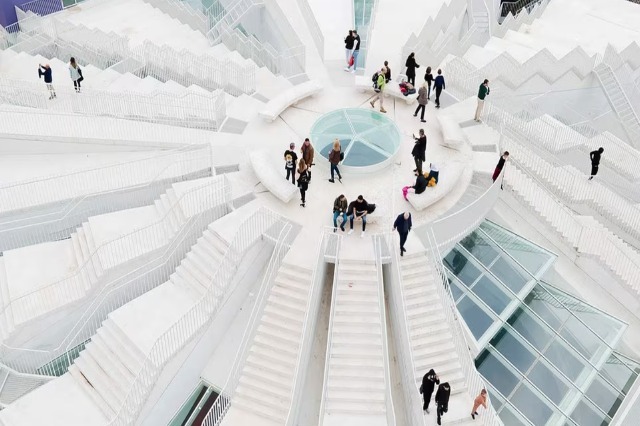
The German public broadcaster, MDR published an article on the transformation of the Pyramid of Tirana, turned into the largest technology center in the region.
In a special article about Tirana, the German public broadcaster writes that the “pyramid” built in memory of the dictator in the center of the capital Tirana, is now a high-tech center. MDR underscores that the Pyramid is seen by its citizens as a symbol of Tirana and that the former dictator’s building now aims to convey the message of freedom.
Full article below:
For decades in Albania, everything that reminded of the communist past was removed. From all of them, the “pyramid” built in memory of the dictator in the center of the capital Tirana has survived. Now it is becoming a high-tech center. A change, even ecountering the painful past?
It is an autumn Monday evening in the center of the capital Tirana. The sun had already set when the mayor Erion Veliaj took to the microphone. Behind it rises a cone-shaped building made of concrete and glass.
Curious visitors crowd the stairs leading to the top. The pyramid was hidden behind a construction fence for a long time, but now the new cultural and high-tech center is being inaugurated.
The monumental building was actually meant to commemorate the former dictator of Albania forever. In 1988, the museum of Enver Hoxha’s life was opened, which would later be labeled as “mausoleum”. For four decades, until his death in 1985, he ruled the country ruthlessly and isolated it from the outside world. Albania was considered the most restrictive regime among the former communist dictatorships of Europe.
From the outside, the building already resembled the glass pyramid in the inner courtyard of the Louvre. It is not known whether the architects were inspired by this. In any case, the dictator had an ambivalent relationship with France.
During his studies there he came into contact with communist ideas. Later he declared the country an enemy of imperialism, but continued to have suits supplied by a Parisian tailor, while he banned the Albanian people from “decadent” clothing from the West.
Now, thirty-three years after reunification, the renewal was inaugurated as part of the Berlin Process summit, which aims to bring the countries of the Western Balkans closer to the EU. Federal Chancellor Olaf Scholz and EU Commission President Ursula von der Leyen also arrived. The flags of the countries involved in the process decorated the entrance to the pyramid. Albania has been an official candidate for membership since 2014 and the EU opened the process in July 2022. “Enver Hoxha would turn into his grave”, said the mayor of Tirana, commenting on Albania’s approach to political Europe.
“At that time there were many power cuts. Everything was dark. Only the pyramid shone, the white marble reflected the light.”
Historian Gentiana Kera on memories of the socialist era
After the end of the dictatorship, the pyramid was used for various purposes – as a convention center, an amusement park and a night club. During the Kosovo War in 1999, it also served as a NATO base.
It is remarkable that the pyramid survived. During the difficult years of transformation, almost everything reminiscent of the socialist past was eliminated. Statues were toppled from their pedestals and political symbols were removed from the cityscape. In 2012, the ruling party at the time wanted to seal its triumph over the dictatorship by tearing down the pyramid. The residents protested and since then the monument has remained untouched but also unused.
The renovation is a success because it stops the pyramid from decay and gives it new life. In the future, the building will house studios and restaurants, as well as work offices where young people can learn programming and robotics. The new uses are housed in 34 colorful boxes that are stacked in and around the building like Lego blocks.
The former tyrant’s monument now aims to convey the message of freedom. It claims to distance itself from the ideology of the previous regime. During the redesign, all symbols glorifying the socialist past were removed, explained Winy Maas, a partner at Rotterdam architecture firm MVRDV, which designed the renovation. The new pyramid has become a “monument to the people and the ability to overcome dictators”. Just think of the outside stairs. The project has also attracted international attention. In the German press, for example, the polished concrete beams between some stairs provoked a creative interpretation: citizens could now “slip off the hump of the dictatorship”.
Young people from Tirana: “We often played here as children”
On a windy autumn day, four students spend their lunch break at the top of the pyramid. “We like the architecture and the look”, say Martin Taka and Rexhina Papa. Asked what the pyramid reminded him of, the student shrugged. And Rexhina adds: “If I’m not mistaken, the building dates back to the time of communism. But today it is much more beautiful!”
At the foot of the monument, a young woman asks for a photo. She poses on the stairs, turning her head in profile before looking directly into the camera. Then 33-year-old Anxhela Malko remembers: “When I was a child, we often played here, climbing and sliding down the pyramid when there were no stairs.”
Both the students and Angela were all born after the fall of communism and do not know the dictatorship. And they don’t seem to connect the pyramid with Enver Hoxha or the socialist past. A 2015 survey also found that the pyramid is not even recognized as a memorial landscape. Young people see them as a symbol of Tirana.
Historian: “The revaluation fails because of political will”
The communist dictatorship in Albania has hardly been addressed – so far progress has been slow. No one has been held accountable for the crimes of the dictatorship until today, and thousands of victims are still missing.
“It fails because of political will,” explains historian Gentiana Kera. Many of those who benefited from the socialist regime would hold political office today.
“Of course it’s not easy to face your past.” So far, more artistic than historical elaboration has been observed. The former nuclear shelter of the party elite on the outskirts of Tirana is now used as an exhibition space. And artists from all over the world will soon be able to live in the dictator’s former villa.
When the mayor steps down from the podium at the inauguration, the pyramid darkens for the last time before shining in a new glow. Bright colors flow along the exterior walls. The lasers cause glowing green lines to circle the steps. It vibrates and glows, first hypnotically, then ecstatically. The light show is accompanied by music that you would expect in a Berlin techno club. The government presents itself as cosmopolitan and future-oriented.
Although historian Kera generally welcomes a renovation, she would have liked a museum for political prisoners or everyday history. “Such a museum about the dictatorship would be brought to a building that was built for the dictator. That would reconcile the past.”
/k.s/
Të ngjashme




Latest News










Most read










 RTI