
 English
 Français
 Deutsch
 Italiano
 Turkish
 Greek
 Serbian
Rama: “Enofama” winery invests to boost Albanian wine exports




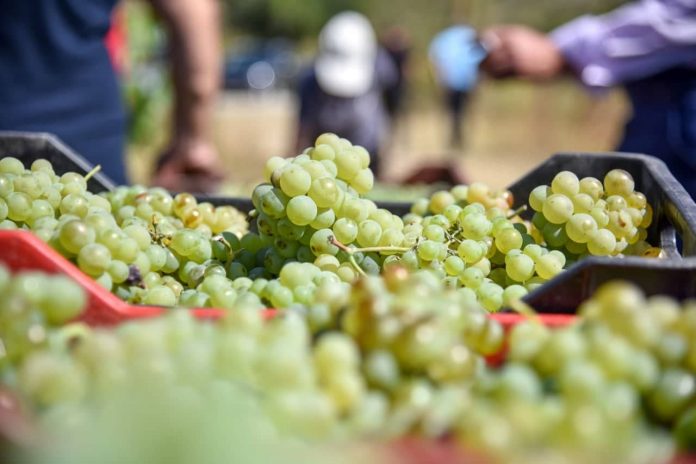
Albania has entered the grape harvest season, while government programs continue to support vineyards and wineries across the country.
The Agency for Agricultural and Rural Development (AZHBR) provides financial support to farmers and wine producers. Through these schemes, businesses can modernize their farms, improve production and introduce new technologies.
Prime Minister Edi Rama recently shared images from the grape harvest at a plantation in Toshkëz, Lushnjë. Farmers there have started collecting grapes for the market.
Rama highlighted “Enofama” winery as a successful example of Albanian wine production. The winery has received support through the IPARD Programme, the Soft Loan with Sovereign Guarantee and the National Investment Scheme.
Marko Malia, a young entrepreneur at the winery, said his family started the business in 1998. At first, they planted vineyards across around 3,000 square meters.
Today, the family cultivates 45 hectares of vineyards. Moreover, a significant part of its production comes from indigenous Albanian grape varieties.
In recent years, the business has focused on protecting its vineyards from hail. Through government subsidies, farmers can now install anti-hail nets at a lower cost.
Malia said the company now aims to improve the quality of its products and expand exports.
Meanwhile, the farm has already attracted demand from international markets. The company plans to increase exports to Belgium, Japan, China and Brazil.
“Demand for grapes from our farm has increased in foreign markets,” Malia said. “We applied to AZHBR and signed a contract to receive subsidies for new fermentation tanks and modern processing technology.”
In addition, “Enofama” continues to modernize its wine-processing facilities. The winery has used financial support from the IPARD Programme, the Soft Loan with Sovereign Guarantee and the National Investment Scheme to expand its production capacity.
These investments aim to help farmers and agri-processing businesses increase productivity and improve production technologies.
At the same time, they help Albanian producers raise the quality of their products and compete more effectively in international markets.
As a result, Albania’s wine industry is gradually expanding beyond the domestic market. Growing foreign demand, investment in technology and support for local producers are creating new opportunities for Albanian wine.
Ultimately, the sector aims to strengthen its international presence while promoting Albania’s indigenous grape varieties and wine production.
/a.c/
Të ngjashme









Most read










 RTI