
 English
 Français
 Deutsch
 Italiano
 Turkish
 Greek
 Serbian
Rama for The Washington Post: Why Iran picked up Albania and failure to destroy state cyber-structure




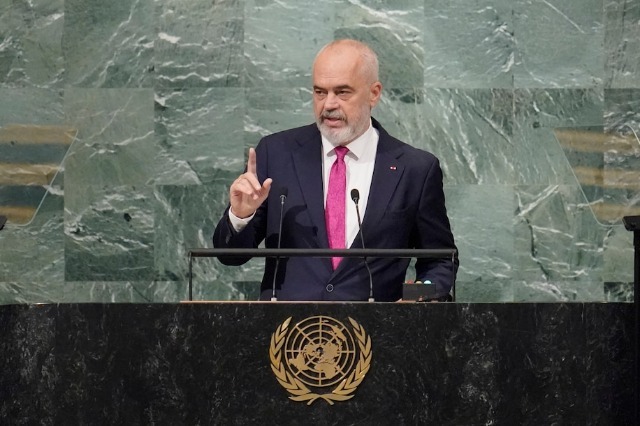
Albania’s landmark decision this month to sever diplomatic ties with Iran over a massive summer cyberattack began with a top-notch investigation, said Prime Minister Rama during an interview for The Washington Post, taken by analyst Tim Starks.
The FBI and a team from Microsoft worked with Albanian experts and experts from elsewhere to pinpoint four separate hacking groups that the Iranian government is known to sponsor, particularly out of its Ministry of Intelligence. One of them, Prime Minister Edi Rama said this weekend in an interview, was “among the top-10 cyber-terror groups, [whose] prints have been also detected behind the attacks on Saudi Arabia, Israel and so on.”
The July hackers, he said, were bent on destruction of government services, 95 percent of which Albania has shifted to online availability after long lines previously forced some people to wait months for licenses and certificates.
“Based on the investigation, the scale of the attack was such that the aim behind it was to completely destroy our infrastructure back to the full paper age, and at the same time, wipe out all our data,” Rama told me. “Our sense now is first, that they didn’t succeed to destroy infrastructure. Services are back. Second, data. Yes, they took some but practically not of any particular relevance.”
A group calling itself Home Land Justice took credit for the attack, apparently inspired by Albania hosting members of the Iranian dissident group Mujahedeen-e-Khalq, or MEK. Rama did not name the four groups that the investigation deemed responsible.
When Albania ordered the eviction of Iranian diplomats and the complete cessation of diplomatic ties, some hailed it as perhaps the strongest action a nation had ever taken in response to a cyber-attack. But some also questioned whether the model would work for other countries, given that some of the biggest players in cyberspace, such as China, would be harder to freeze out. Albania didn’t have a meaningful relationship with Iran, Rama said, so the severance wasn’t a big loss. Other countries might be able to use the approach Albania did, depending first on the thoroughness of any investigation so as to feel confident in expelling diplomats, and next on the degree of harm the attacks cause.
“It’s practically bombing the country you know, destroying critical infrastructure,” Rama said of Iran’s attacks. “The bombs are not visible, the wounds are not physical, thank God, but still [it] is an aggression, a bombardment, and it’s direct harm to the national sovereignty. … Would you keep the country that bombards you?”
Iran has denied responsibility for the attack and denounced Albania’s response.
Rama spoke to me Saturday following his speech at the United Nations. There, he criticized Russia’s war in Ukraine and decried a 2011 Council of Europe resolution that cited allegations of Albanian organ harvesting during the 1990-s war in Kosovo, claims Rama said amounted to “one of the worst cases of distorted reality” and for which “not a single shred of evidence or proof was found anywhere.”
He also recommended the United Nations should take further action in cyberspace.
“We urge the United Nations, including the Security Council, to focus more seriously and concretely to address cybersecurity by investing in prevention and help all member states build resilience,” Rama said.
NATO and the United States have provided help on just that for Albania, he told me. Albania had been working to build stronger defenses against cyberattacks before July, but he said it takes time and a lot of money. NATO and the United States have been trying to speed that up since the July attack and a follow-up hack from Iran, he said.
“We were not really under the pressure of time, which is the case now after this horrible attack that was followed by another one,” Rama said.
The hackers had been inside Albanian networks for 14 months before pulling the trigger on their attacks, according to an alert that the FBI and Cybersecurity and Infrastructure Security Agency published last week.
/a.p./
Të ngjashme






Most read










 RTI