
 English
 Français
 Deutsch
 Italiano
 Turkish
 Greek
 Serbian
Rama, speaking to ‘Corriere della Sera’: It’s a brotherhood agreement rather than a trade agreement with Italy




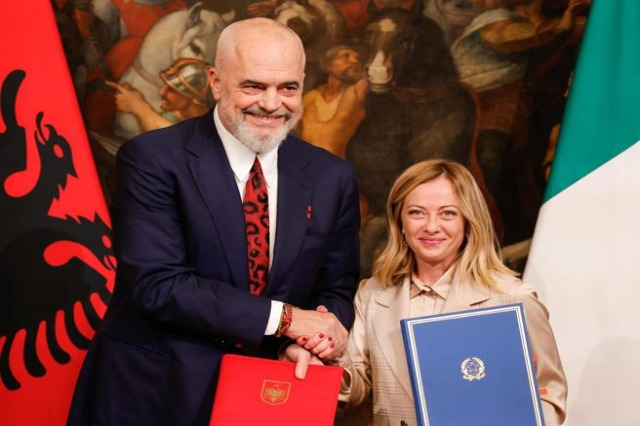
In an interview with ‘Corriere della Sera’ following the signing of the Rome-Tirana agreement, Rama stated, “All expenses are borne by Italy, and Albania will not have to give anything in return.” Regarding immigration, he described it as a “complex phenomenon’ and emphasized the need for a ‘new approach.”
“We have signed a comprehensive agreement with the Italian government, which addresses numerous aspects and allocates responsibilities between Italy and Albania. Most importantly, it adheres to all international regulations with the highest standards and requirements for the reception of migrants,” Edi Rama explained in a telephone interview with Corriere della Sera. The Albanian Prime Minister recently returned to Tirana after jointly announcing the agreement in Rome with Prime Minister Giorgia Meloni. The agreement includes the opening of a center in the Balkan country to welcome asylum seekers.
Can you explain in detail what the agreement was about?
The memorandum of understanding outlines specific provisions for the agreement. According to the agreement, at the port of Shëngjin in northern Albania, Italian authorities will be responsible for the initial identification process of asylum seekers. Following this identification, the asylum seekers will be transferred to the Gjadër reception center in Albania, where they will await the outcome of their asylum applications.
Who will pay for all this?
The costs will be covered by Italy.
And what will you get in return?
Nothing. We didn’t request any quid pro quo, especially not of an economic nature. We have no desire for it. This isn’t a commercial agreement; it’s one based on brotherhood and camaraderie.
I imagine that, in exchange, you might expect greater pressure from Rome on Brussels to expedite your entry into the European Union.
Not at all. The two things are unrelated, and we certainly didn’t approach it from that perspective.
When did you begin working on this agreement with Rome?
Let’s say it had been in the pipeline for some time.
Some say it was last summer when the Italian Prime Minister visited you in southern Albania…
There, we laid the foundations of the protocol that has now been signed.
But how did this initiative come about?
When discussing the issue with Prime Minister Meloni, it became clear that Italy might need logistical support to better handle the landings. We offered our assistance.
Is it true that other EU countries have also requested your assistance on this matter?
Yes, but we declined all of them.
May I inquire about the names of these countries?
Out of respect for them and the confidentiality of our discussions, I would prefer not to disclose that information.
And why did you agree to assist Italy instead?
Because we are indebted, and whenever we can, we strive to repay it. Let’s not forget what the Italians did for us in the welcoming of the 1990s and also during the subsequent crises that affected Albania.
Someone from the Italian opposition mentioned ‘Guantanamo’ when commenting on the agreement with you.
I would like to emphasize that this is an internal matter within their country. I must say that such a comparison appears ungenerous to those who endured suffering at the actual Guantanamo. Anyone coming to Albania for a limited period will be accommodated in the best conditions.
Some grumbling also came from the opposition.
In fact, the memorandum of understanding will be presented to Parliament for approval.
Is there a time limit for this agreement?
We will assess it step by step. The only limitation is numerical: we can accommodate a maximum of three thousand migrants.
When will the reception center open?
I believe it will be in spring 2024. However, the Italians will have the final say on this, as they will be responsible for the implementation and management.
Isn’t there a risk of potential issues in Albania?
No, there isn’t. I recall that we have previously welcomed over four thousand Afghans escaping the Taliban’s brutality. At the conclusion of the bureaucratic process, they have relocated to the USA or Canada. This is a manageable operation, and we have proven our capability.
You are familiar with the migration phenomenon. The EU appears to be facing a deadlock. What is your suggestion?
I am not in a position to dictate to Brussels what they should or should not do. We can observe and offer insights, but it’s one thing to assist from the outside and another to manage the crisis. The EU is undoubtedly in a complex situation when it comes to immigration.
In what sense?”
Over time, certain European countries have maintained an ambiguous stance on reception, saying ‘no’ to those coming from Africa while welcoming those arriving from Ukraine. Meanwhile, other nations, like Sweden, have hosted individuals without distinction. However, today they too are grappling with negative consequences, such as increased crime rates. It’s a notably intricate issue, which underscores the need for a fresh approach from the entire European Union.
/m.ll/
Të ngjashme
Latest News
Kolkondas: Where History, Art and Faith Come Together
The UK iPaper highlights Tirana’s growing cocktail scene
Cosmopolitan UK features Albania in five-day summer trip for women
Most read










 RTI