
 English
 Français
 Deutsch
 Italiano
 Turkish
 Greek
 Serbian
Rama: Transparency and the right to information are the best ways to combat disinformation




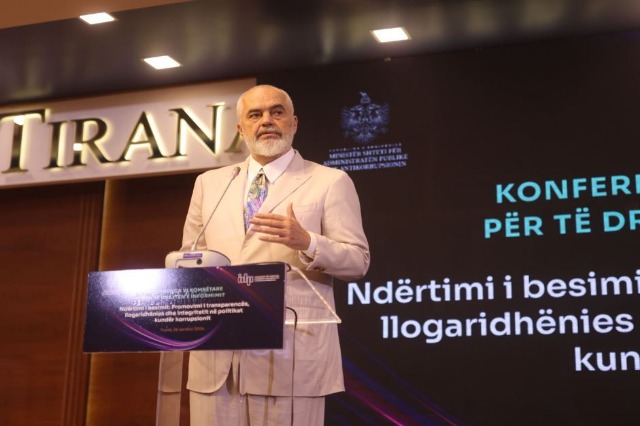
Speaking at the 6th National Conference on the Right to Information, Albanian Prime Minister Edi Rama has criticized institutions that do not uphold citizens’ or interest groups’ right to information, while praising Albania’s legislative framework for the right to information as one of the best.
The problem, according to Rama, lies in the gap between legislation and the implementation of the right to information, creating absurdities that are easily solvable, according to him.
Prime Minister Rama said that transparency and the right to information are the best ways to combat disinformation.
“Transparency and the right to information, overall, saw Albania ranked 86th until 2014 when we took the first serious steps by transforming our legal base. Today, Albania is ranks 7th in terms of legislation. The gap between legislation and its implementation, and when you hear that 70% of complaints about the lack or violation of the right to information are resolved immediately once the Commissioner’s office is activated and requests the relevant institution to inform the citizen, it is mind-boggling. As the Commissioner stated, this is simply due to the non-functioning of a comprehensive mechanism that guarantees the right to information without needing a coordinator to ensure it systematically. I believe this and other aspects preventing us from advancing as a country that is already ranked 7th to an even higher level in guaranteeing the right to information are low-hanging fruits that can be grasped without much effort or requiring a step-by-step climb.
Another striking issue is the persistent mindset in the administration that providing information is an unnecessary exposure. This is about giving information on decision-making processes, which is essential. It is both dramatic and laughable when obtaining and publicly releasing information is seen as a revelation. In fact, such documents are not owned by any institution or government but are public property and should be accessible. Here, we can make rapid progress.
There is no more effective way to confront disinformation than by providing more information. There is no more democratic and confrontational way to counter disinformation than by increasing information. Disinformation grows daily, while information based on what is truly written and documented does not keep pace, showing a lack of will to confront it. This is not just a matter of coordinators but requires a fully mechanized system making it impossible for institutions to withhold information. Fortunately, we live in a time when technology is a blessing for countries like ours to compensate for backwardness with technological advancement. The more technological space we create for public data, the more we can help our public and country reach a new level, and this is possible,” Rama said.
Rama added that a national board should be created to monitor the assurance of the right to information.
“It is time to create a national board with the participation of the government, local authorities, the Public Commissioner, the Ombudsman, and other agencies, such as the Agency for Dialogue and Governance, which can play a role in this part, to have a joint work plan not for anything else but to monitor this process, i.e., the assurance of the right to information. Most of the problem is the lack of awareness about providing real-time information, which erodes citizens’ trust, opening up vast spaces for the spread of disinformation,” said Rama.
Rama emphasized that the right to information is a state-owned property and not an investigative secret, adding that even when investigative secrets are leaked, it is not the journalist’s fault but those who provided it and should have kept it confidential.
“Treating information that belongs to the public, the media, and all interested parties as a legally sanctioned right while treating it as an abused power creates much mystery, gossip, and poison about facts, giving room for speculation when in fact facts are best confronted with those who speak in their name. The right to information is not an investigative secret. Investigative secrets are something else. I take this opportunity to thank the Ombudsman for a case involving a journalist who was accused and mistreated for leaking an investigative secret. This happened even during the pandemic when the prosecution went after some journalists. For me, journalists do not leak investigative secrets. It is the prosecutors who leak them.
When a secret falls into a journalist’s hands, it is no longer their obligation to keep it confidential. The investigation should focus not on the journalist but on those who gave it to him. This is elementary. It is [even] written in black and white in the Canon that the messenger bears no blame; the blame lies with those who produced or handed over the information to someone else. Information about everything public institutions do and all existing documents, stamps, and signatures, not within a narrow scope, is public property, which the state has no right to withhold from citizens. Therefore, a critical stance towards institutions regarding the right to information and the entire obstacle placing us in a significant gap between legislation and its implementation should be nonexistent. We should not be prisoners of the old culture where the state knows things others should not,” said Rama.
/a.p./
Të ngjashme







Most read










 RTI