
 English
 Français
  Deutsch
 Italiano
 Turkish
 Greek
Greek Serbian
Sami Frasheri, Albanian linguist, lexicographer, encyclopedist, novelist, playwright, and fundamental ideologist of National Renaissance




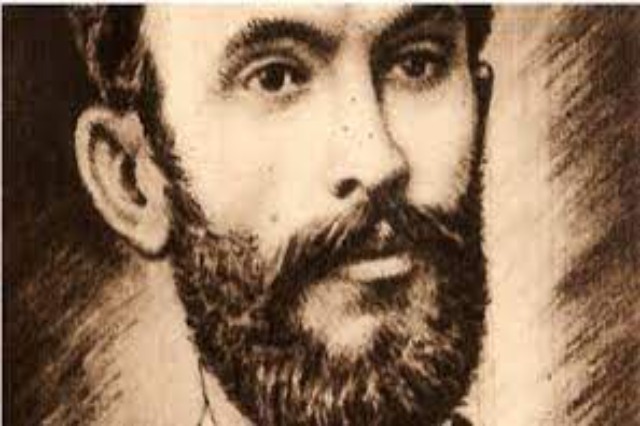
Sami Bey Frashëri, known in his time as Shemseddin Sami Bey was an Albanian official and intellectual of the Ottoman Empire, linguist, lexicographer, encyclopedist , novelist, playwright, translator and fundamental ideologist of the National Renaissance, together with his two brothers Abdyl and Naim. With his activity he became the most prominent thinker of Albanian nationalism and among the pioneers of Turkish nationalism generally known as Samiu. In Turkish opinion, he is known as “the father of encyclopedists”.
Sami Frasheri was born in the village of Frashër in the Vilayet of Ioannina (today in the district of Përmet) in 1797. He received his first lessons in his hometown together with Naim in the tekke of Frashëri. After the death of his parents, in 1865 the family moved to Ioannina, where he attended and graduated from the Greek high school “Zosimea” in 1869. During his school journey, he came into contact with philosophy Western, Ancient and Modern Greek, Latin, French and Italian. Then in a local school, he learned Arabic, Persian and Turkish. As an excellent student, he completed the eight-year school program in seven years; school which later in life he described as “excellent”. Having been educated in different cultural and linguistic environments, he was equipped with the right intellectual and emotional tools to research different cultures.
After finishing school, he started working in the Press Office of the local government in Ioannina. In 1871 he and Naim moved to Istanbul with the same job position already in the Press Office in the capital, where he made friends with progressive journalists and intellectuals Namık Kemal, Ebüzziya Tevfik, etc. but keeping in contact with the Albanian compatriots; as well as, being fond of the culture of the French language, he started to translate from this language into Ottoman.
In 1872, his contribution begins with the first novel in the Turkish language Ta’aşşûk-ı Tal’at ve Fitnât, in 1873 he became a collaborator of the newspapers Sırac (Light) and Hadika (Garden). He returned to Istanbul and continued to work in the press.
In 1878 he became the editor-in-chief of the newspaper (Tercüman of the East). After the decisions of the Berlin Congress, he was appointed secretary of the Military Control Commission established in 1881, a post he held until his death. He stood out as one of the most prominent intellectuals of the Ottoman capital, directing and editing several newspapers, writing over twelve books in Ottoman. He compiled a French-Turkish dictionary in 1882 and another Turkish-French in 1884, an Arabic language dictionary in 1898, a two-volume Ottoman dictionary (1899–1901) together with the six-volume encyclopedia Kamus al Alam. Adding here a pamphlet on the alphabet of the Albanian language, a grammar and the political treatise
His activity in the Albanian language is summarized in several textbooks, the compilation of a grammar and the design of the Istanbul alphabet that was also known by his name, as well as the treatise Albania what was, what is and what will become which became the political manifesto of the National Movement.
In 1874, Sami wrote the play (Besa or Keeping the Word) in Ottoman with the theme of the issue of an Albanian ethnicity, connected to an ethnic territoriality, an ethno-cultural diversity that promotes unity, honor, Ottoman loyalty and self-sacrifice.With this work, Sami tried to present the Albanians in a different light to the Ottoman opinion, informing him about the morals, values, customs and traditions of the Albanians, whom he considered a very important element of the empire; also wanted to lay the foundations of an authentic Ottoman theater, which at the time had many external influences.[8] For the more refined audience the element of allegiance meant the military and political development it could receive.
In 1901, it was translated into Albanian by his friend, Abdyl bey Ypi, and published by Kristo Luarasi in Sofia, while it was part of the school curriculum at the Korça School until it was closed in 1902. The Albanian translation of the drama by the Ottoman authorities was kept as “instigator of the national feelings of the Albanians” and after the Young Turk Revolution in 1908 there were reports that the kachak gangs played parts of the drama around the fire. Sami’s play would not be performed until after the Young Turk Revolution had passed, then it was performed for another three years until 1911-1912.
During the Great Eastern Crisis, he was part of the “Central Committee for the Protection of the Rights of the Albanian Nationality” directed by his brother, Abdyli. He was part of the 10 high functionaries of the Albanians of the imperial capital who signed the memorandum sent to the host of the Congress of Berlin, Chancellor Bismarck and the Austro-Hungarian Count Andrassy, asking for reforms and for the Albanians to stay within the Ottoman Empire while respecting their rights, wishes, interests and traditions.[22] In the same period, in the temporary Tercüman-ı Hakikat, in an article dated December 24, 1878, he reported on the geopolitical situation and events,[23] saying that Albania was his homeland and he felt connected to the vast Ottoman motherland and emphasizing that Albanians were loyal to the empire. It highlighted the military danger of Albanian neighbors and the cultivation of their languages among schools in Albanian villages. The solution for him was to unite the vilayets inhabited by Albanians into a single vilayet, so that he could exercise a greater resistance force,[24] where after the desire to cultivate the native language, they would face it properly Slavism and Hellenism.[25]
From October 1879, Sami led the “Society of Printing with Albanian Letters”, where books and textbooks were drawn up by him and Naim.
Sami directed the first magazines in the Albanian language “Drita” and then “Dituria” (Istanbul, 1884-85) where he wrote a large number of articles. For the needs of the Albanian school, he wrote the books “Primary of the Albanian language” (1886), “Alphabet of the Albanian language” (grammar, 1886) and “Skronjë” (Geography, 1888) in the Albanian language. Among the most prominent works of this outstanding thinker, patriot, democrat and enlightener is , published in 1899 without the author’s name in Bucharest. This treaty became the manifesto of the Albanian National Renaissance, the work that synthesized the program of the movement, its strategy and tactics. The democratic ideals of political and social development of the country, development of education, culture and science were expressed in it. Sami Frashëri also drafted a dictionary of the Albanian language which remained unpublished. He also left a collection of Albanian folk songs in manuscript.
Sami Frashëri also defended the Albanian issue in the various press bodies he led, especially in the Turkish newspaper “Terxhuman-i Shark”. Sami Frashëri is the author of 57 works in Albanian, Turkish and Arabic, including the magazines and newspapers he directed and published in them himself. Sami Frashëri deals with the Albanian issue and the history of the Albanian people in his works in the Turkish language, especially in the articles published in the press of the time, as well as in his literary works with motifs from Albanian life.
As a great scholar, Sami Frashëri made his contribution in several fields of science where he stood out as a representative of advanced materialist thought, not only for Albania, but also for the countries of the East. He is the author of the normative dictionary of the Turkish language (Kamus-i türki, 1901), which maintains its great value even today. The “Kamus-i türki” dictionary contains over 40,000 words and linguistic expressions and is equipped with a long preface written by Sami himself where he presents his principles on the vocabulary of a literary language. Sami is also the author of several French-Turkish bilingual dictionaries 1882); Turkish-French 1885); Arabic-Turkish Sami Frashëri’s major work in the Turkish language is his Encyclopedia “Kamus-ul alâm“.
Të ngjashme
Latest News
Most read



 RTI
RTI