
 English
 Français
 Deutsch
 Italiano
 Turkish
 Greek
 Serbian
Sejko: 3.5% Economic Growth Driven by Investment and Private Consumption




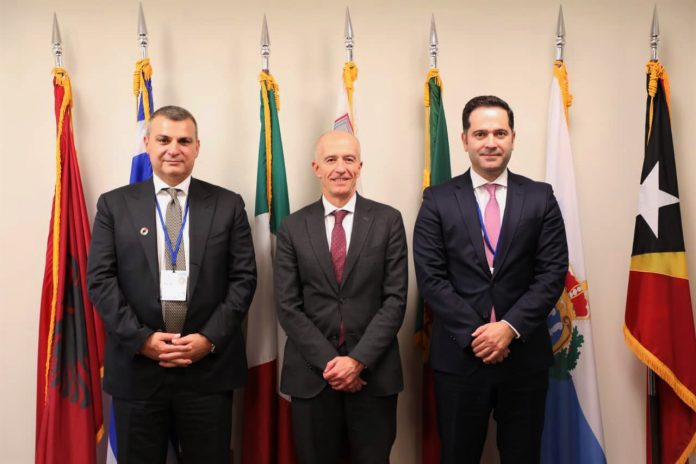
Governor Gent Sejko and Finance Minister Petrit Malaj attended the 2025 IMF and World Bank Annual Meetings in Washington, D.C.
These meetings bring together finance ministers, central bank governors, and policymakers to discuss global economic trends. Meanwhile, Sejko held key meetings with IMF and World Bank leaders, where he updated them on Albania’s economy, monetary policy, and banking sector reforms.
Despite challenges, Albania’s economy remained resilient. GDP grew 3.5% annually over the past two years. Inflation stayed near 3%, while unemployment fell to historic lows and wages rose steadily. In particular, private consumption and investments drove growth, with the services and tourism sectors contributing strongly.
Sejko also highlighted that macro policies were coordinated and cautious. For example, fiscal policy reduced public debt, monetary policy kept inflation expectations anchored, and macroprudential measures limited banking and real estate risks.
Looking ahead, he expects steady growth and inflation reaching the target by 2026. However, external risks remain, including slower growth in trade partners and geopolitical tensions. On the other hand, EU integration and the Western Balkans growth plan offer positive opportunities. Therefore, monetary policy will continue to focus on price stability, and fiscal policy will maintain consolidation.
In addition, innovation in the financial sector is a priority. The Bank of Albania upgraded payment systems, joined SEPA in 2024, and from October 7, 2025, launched its first EU-wide payments covering 40+ countries. These steps strengthen Albania’s financial infrastructure and integration with Europe.
Furthermore, Sejko emphasized the importance of international cooperation. The IMF and World Bank supported reforms and helped manage risks, which reinforced financial stability. Officials praised Albania’s SEPA membership as a milestone for modernization and EU integration. They also acknowledged Albania’s economic progress and the central bank’s key role in maintaining stability.
Moreover, the free-floating exchange rate helps preserve macroeconomic stability and control inflation. Central bank interventions remain tools to maintain price stability and mitigate speculative fluctuations.
Sejko and international partners agreed to continue technical assistance in banking supervision, payment systems, and legal frameworks. During the visit, the delegation also met with international counterparts to expand bilateral cooperation and attract technical support.
In parallel, Sejko participated in IMF plenary sessions and a breakfast briefing with finance ministers and central bank governors. There, he presented Albania’s macroeconomic outlook, key growth sectors, and investment potential.
Overall, Albania combines strong fundamentals, financial stability, and proactive policies to support sustainable growth and attract investors. Consequently, the country is positioning itself as a resilient and investment-friendly economy in the region.
/a.c/
Të ngjashme



Latest News







Most read










 RTI