
 English
 Français
 Deutsch
 Italiano
 Turkish
 Greek
 Serbian
Spiropali: We Are in a New Stage of EU Membership, Further Advancement of Reforms Required




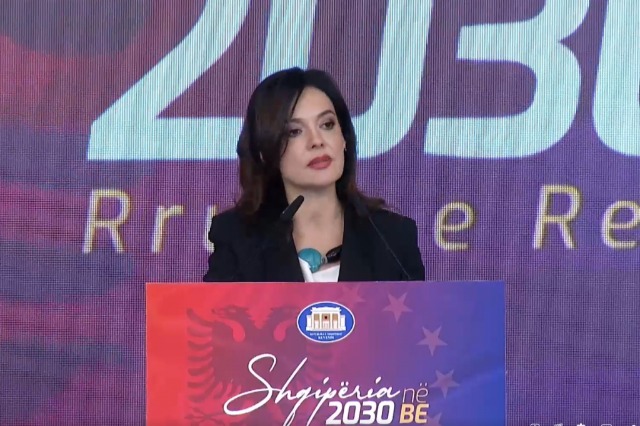
Speaker of Parliament Elisa Spiropali reaffirmed Albania’s resolute ambition to achieve European Union membership by 2030, describing it as a transformative journey. Speaking at the high-level meeting “Albania 2030 in the EU – The Path of Reforms,” which gathered Prime Minister Edi Rama, diplomats, and government officials, Spiropali emphasized the critical need to accelerate developmental and democratic reforms.
Spiropali highlighted Parliament’s pivotal role in steering this process, particularly in identifying priorities, crafting actionable plans, and consolidating efforts. She stressed the significance of this phase following the Second Intergovernmental Conference and the initiation of negotiations on the foundational chapters of EU membership, calling it a decisive moment in realizing Albania’s strategic objective of joining the EU.
She expressed pride in Albania’s progress but stressed that this milestone demands greater responsibility, political action, and inspiration for the future. “Dreams and hope are not just our only solution but also our firm choice. Albania’s path to EU membership is a one-way street to our collective future,” Spiropali stated.
She acknowledged the immense dedication of the negotiating team and thousands of public servants who have contributed to the integration process, describing their efforts as irreplaceable assets. Spiropali also noted the critical role of political will from the government and ruling majority, coupled with at least formal, non-oppositional support from the opposition, emphasizing that no political force opposes Albania’s European ambition.
The focus now, she said, is on refining the approaches and methods for achieving this goal. The successful conclusion of the screening process marked a pivotal moment, leading Albania into the negotiation phase for EU membership.
Spiropali highlighted key challenges for the Parliament, focusing on EU accession, legislative responsibilities, parliamentary oversight, and advancing democratic and integrative reforms.
She emphasized the importance of a new law defining the Parliament’s role in the EU integration process, particularly the March 2023 amendments, which aim to better address negotiation challenges. These changes assign significant responsibilities to the Committee on European Affairs and the National Council for European Integration to drive the European agenda forward.
According to Spiropali, EU membership is a transformative process, requiring not only institutional but societal adaptation. She expressed confidence that Albania’s EU membership by 2030 is an ambitious yet achievable goal, contingent on political and social mobilization.
The Parliament, she noted, will lead decisively, ensuring democratic legitimacy and inclusiveness throughout the accession process. Strengthened oversight, particularly by parliamentary bodies, is vital to monitor and fulfill negotiation criteria, engage stakeholders, and keep the public informed.
Spiropali also highlighted the EU’s Growth Plan for the Western Balkans, offering economic development opportunities, infrastructure improvements, and support for reforms. She mentioned the establishment of a Special Commission to deepen governance, rule of law, and anti-corruption reforms as part of the Albania 2030 EU agenda. This body addresses the need for a permanent parliamentary mechanism to evaluate and advance reform progress across all government branches.
The Parliament’s initiatives, including 11 discussion tables on reforms, were commended as effective steps. Spiropali underlined the fight against corruption as pivotal, describing it as both a critical challenge and a measure of Albania’s reform success. While recognizing achievements acknowledged by international reports, she stressed the ongoing risks of corruption in public services and the importance of intensifying preventive and punitive measures.
Highlighting digitalization efforts, Spiropali credited these initiatives with reducing corruption and simplifying citizen interactions with public services. She also praised the new justice institutions, including the Special Court and SPAK, for demonstrating that impunity is no longer tolerated, emphasizing accountability and justice as cornerstones of Albania’s progress.
Spiropali also reflected on the importance of safeguarding institutions, saying, “Institutions are the guardians of public interest, but who guards the guardians? Parliament, as the only institution elected and delegated by the people, ensures all institutions, including itself, remain accountable to the Constitution, the law, and the citizens.”
She underlined that the political and parliamentary courage required to lead transformative reforms, coupled with the achieved results and ongoing challenges, demonstrates the necessity of synergy between institutions and society. This process, according to Spiropali, demands both political and human sacrifice.
Finally, Spiropali acknowledged the invaluable support of Albania’s international partners, expressing gratitude to the EU delegation, the U.S. Embassy, EU member state embassies, Switzerland’s Embassy, the OSCE Presence, the Council of Europe, and other partners for their excellent cooperation and unwavering support at this pivotal stage of Albania’s journey toward EU integration.
Të ngjashme
Latest News










Most read










 RTI