
 English
 Français
 Deutsch
 Italiano
 Turkish
 Greek
 Serbian
Summer Day Celebration in Albania




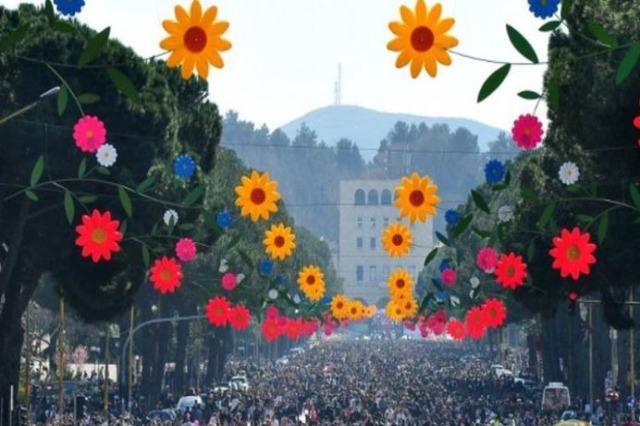
Today, the entire country is immersed in celebrations as part of the symbolism of Summer Day.
“Summer Day” holds ancient roots both in terms of time and celebration style. It is a pagan festival, not tied to any specific religion. Also known as the day of bidding farewell to winter, this festival has established its tradition not only among the residents of the city of Elbasan but also in other cities across the country, particularly in Tirana.
However, the origin of “Summer Day” lies in the sanctuary of the Fairy of Çermenika, situated in the outskirts of Elbasan. This sanctuary was dedicated to the goddess of hunting, forests, and nature as a whole. According to folklore, this fairy would emerge from her sanctuary on March 14th. Passed down through generations, this folk festival has become a defining day for the city of Elbasan, renowned in Albania for its unique cultural traditions.
Many friends from all regions of the country gather in Elbasan to celebrate the arrival of summer and indulge in the traditional dishes of the area, such as ballokume (a traditional sweet), revani (a dessert), sea bass, walnuts, or dried figs. These treats are traditionally gifted to young children, who are the first to make goodwill visits to the homes of relatives and neighbors.
Traditionally, on the eve of Summer Day, people would swiftly gather in their homes to celebrate together with relatives, marking the last phase of this festival. Awakening would occur at dawn, with elders opening their doors early in the morning, taking a branch to fill with fresh water, and bringing into the house a green sprout, while the youth would compost oranges and olives.
As is known, the main center of the holidays is Elbasan, where families gather throughout the day and celebrate together, through good food, wine, and, of course, parties. The city is engulfed in festivities, decorations that evoke spring. If you have never been to Elbasan for this day, you should definitely do so as soon as possible, as the atmosphere of the holiday will naturally involve you, and you will enjoy the excellent cooking that is prepared on all Elbasan tables.
The gate is decorated with flowers and green shoots, which symbolize the arrival of spring. During this night, relatives, but also friends sing old songs accompanied by the rich cuisine of Elbasan.
The first phase is the preparatory phase that starts with the collection of the zahire(stock of eatables) that are necessary for Summer Day. The second phase is the Midsummer night starting March 13 with the bonfire, the third phase Midsummer’s Day morning starting March 14 and finally the Midsummer’s Day picnic at noon on March 14.
On the eve of Midsummer’s Day, every house is filled with a special joy, it is a feeling that overwhelms people without realizing it. Perhaps due to the sun, greenery or the blossom of seeds and buds that are an expression of prosperity and continuity. The house is filled with plenty of good food.
Breakfast is cheerful and festive. The people of Elbasan wake up early on March 14 and with a special dedication, open the door for good to enter and evil to exit.
The eyes are washed with summer flowers, violets and caracafte (a type of flower) and then water is drunk in the “loaf of pork”, which is a tuber found underground in areas with forests and greenery. The water in the “loaf of pork” symbolizes a healthy and prosperous year.
Also, another custom that is preserved on this day is boiling eggs on the night of the 13th, and washing the eyes with boiled egg water on the morning of the summer day. In addition, on the day of summer, a “red and white stiped bracelet” is tied to the hand, which is made of a red and white thread.
The red and white striped bracelet(verore) is removed when you see the first swallow, and it is thrown into the brambles to be taken by the swallow to make a nest. All of these are rituals that are performed to celebrate the arrival of spring, the blooming of flowers, the return of swallows and the revitalization of life. In many cases on Midsummer’s Day wreaths were woven and hung on the doors of the house to bring good luck.
Lunch on this day is a joyous and festive ritual for all Elbasan residents, who typically enjoy it outdoors in nature, where traditional folk games are organized. In Elbasan and Peqin, the night before the arrival of summer is also celebrated with meat, raki (a strong alcoholic beverage), sea bass, ballokume, and sweets. On this day, Elbasan residents extend wishes for long and happy lives to one another.
Everyone knows that this day is associated with ballokume, a delicious traditional sun-shaped dessert, which explains why it is the symbol of the holiday. Ballokume is a large cookie that is made with wheat or corn flour with a significant sugar content.
The preparation is a real challenge for the housewives, who must strictly observe a sequence of mixing the ingredients that in most cases are stirred only with a wooden spoon in a container that tradition requires to be made of copper.
If you know someone from Elbasan, don’t forget to ask them for some ballokume, as this is the only way you can understand how Elbasan housewives have raised the preparation of this dessert to an art.
Summer Day would be incomplete without flowers and songs. For generations, the people of Elbasan have been known for their skilled gardening and soulful singing. The most characteristic flowers in Elbasan include jasmine, cloves, roses, violets, carnations, and more. Gardeners ensure that these flowers bloom on Summer Day.
Throughout the night and day of Summer Day, people sing urban folk songs, such as “A Garden with Roses,” “What Do You Want to See,” “Better in the Forest Than in the City,” “Like the Nightingale in Spring,” and others are sung not only by Elbasan residents but also by people across Albania.
In addition to Summer Day, many cities also celebrate Summer Night, when the entire city seems ablaze with fires. These fires are believed to assist the sun in banishing winter; they are meant to intimidate it. In a sense, people rejoice in the sun and pay homage to it. Children are accompanied by adults as they light the fires.
The participation of children symbolizes the passing down of tradition. Everyone gathers around the fire, adding branches they have gathered beforehand, attempting to make their fire burn higher than those of neighboring areas, symbolizing a friendly competition. Around the fire, songs are sung, and dances are performed. People strive to keep the fire burning for as long as possible. The tradition of lighting fires continues from the beginning of March, with the most important days being March 11th, 12th, and 13th.
Radio Tirana International staff wishes all Albanians ‘Happy Summer Day’!
/k.s/
Të ngjashme

Latest News










Most read










 RTI