
 English
 Français
 Deutsch
 Italiano
 Turkish
 Greek
 Serbian
Symbolism of coffee traditions among Albanians in the past




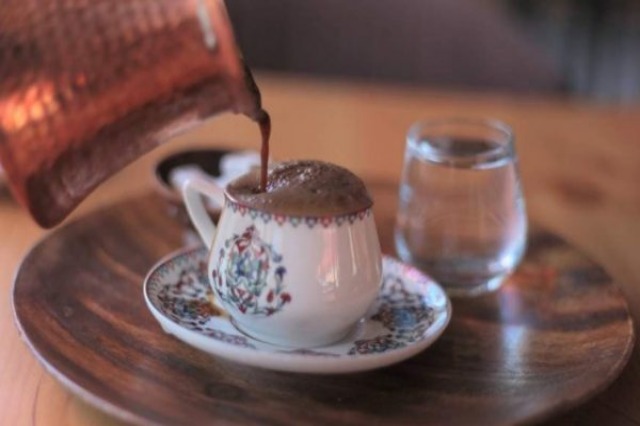
Albanians have had many symbols in the ritual of drinking coffee. They conveyed positive and negative messages when friends had relationships, meetings or different situations. And what are these messages expressed by the coffee service ritual?
When a well dressed mountaineer visited a friend to the house of another fellow villager, be it a relative or a simple acquaintance, the conversation started in a casual session of tobacco exchange than continuing the conversation on an engagement, blood feud reconciliation, or other important matters, the master of the house did not ask the visitor whether he liked his coffee with or without sugar.
Through the degree of sweetness or strength of the coffee, the friend symbolically received the appropriate message about the progress of the reason that stood in the background of such a visit.
If the coffee was served sweet, the friend received the message that the matter was resolved or that on the right track.
To reinforce the meaning of such a positive message, the friend, as a rule, in another form pointed out the excessive sweetness of the coffee, generally using expressions such as: “Honey sweet coffee”, ” you’ve put honey, not sugar in coffee”, “you’ve put a jar of honey in coffee” etc.
The master of the house generally approved such statements, that is, basically nodding or smiling. After such approval, the friend spoke with an optimistic spirit and redeemed me for the solution of the case under consideration.
If he was served medium sweet coffee, he would receive messages that the issue he was interested in remained pending, so the progress of its solution could not be predicted. To confirm that the medium sweet coffee, which meant freezing the matter, the friend almost in a diplomatic tone said: “I don’t know if there was sugar in your coffee or not”. In such situations the men of the host party remained silent.
The friend who had a mission in the conversation received the message that he had to be very careful in reasoning, that he had to wisely use the whole arsenal of arguments, to move the issue in the direction of the best solution.
The hosts could serve the friend coffee without sugar. In such situations, the friend behaved in two ways. Less often, he reinforced this fact with somewhat diplomatic expressions, such as: “The weather was bad and the goods did not arrive from the city”,(meaning we have no sugar at home).
As a rule, the hosts were silent. In most cases the bitterness of the coffee did not need confirmation. The silence of the hosts meant that the negative answer to the matter was indisputable.
In most cases, the friend made sure that in such conversations he cleverly avoided the issue in which he was directly interested.
It is worth noting that the use of coffee symbolism and other symbolic means to convey negative responses, especially for vital issues that had to do with the destinies of individuals, families or members of smarter communities, was of particular importance in many “segments” of the traditional Albanian society, while the negative word had quite a heavy weight, up to the level of disregard or insult for the other party, i.e. not only for the family and the individual directly affected by the shadow of the bad word, but also for his whole tribe.
Also, the degree of sweetness or bitterness of the coffee that was served at the funeral ceremony in many provinces of Albania symbolically expressed the degree of grief for the deceased, expressed the age of the deceased and the severity of family, tribal or wider concerns caused by the departure of the deceased him from this life.
If the deceased person was old and with grown-up children, married and in a stable economic condition, sweet coffee was served; if the deceased was middle-aged and had children partly married and unmarried, medium coffee was served; and, if the dead person was young, with small or unmarried children, very bitter coffee, without sugar, was served.
According to widespread prejudices in pre-modern Albanian society, the cup of coffee also reflected many elements of the personality, lifestyle and state of mind of the people who drank the coffee.
For example, if the man drank hot coffee, according to the superstitions, he was so cowardly that he was afraid even of his wife. Also, according to superstitions, if the person drank sweet coffee, he had a bitter life and the opposite, if he drank bitter coffee, he had a happy life.
As a rule, the serving of coffee symbolically marked the end of almost every kind of joyous ceremony and radiated complex and highly nuanced symbolic messages in funeral ceremonies.
Except in such environments and in coffee bars and restaurants, coffee was probably the only drink, which in a significant part of the Albanian lands was also served in cemeteries.
But what message did the coffee served in the cemetery send after the burial of the deceased?
Such coffee, especially in the northern provinces of Albania, symbolically testified that the deceased had performed important social functions for the members of the big family, the inhabitants of that village or county, so he was an outstanding man.
Serving coffee with the left hand and especially under the knee was considered a very serious insult, especially for men who were delayed in carrying out vengeance.
/k.s/
Të ngjashme

Latest News










Most read










 RTI