
 English
 Français
 Deutsch
 Italiano
 Turkish
 Greek
 Serbian
The 7th of April marks the Italian occupation of Albania in 1939




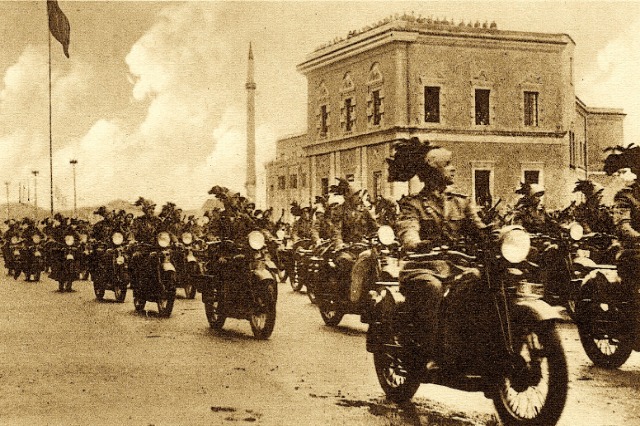
The Italian occupation of Albania lasted from 7 April 1939 (the date of the invasion) to the Italian capitulation to the Allies on 8 September 1943. The original Italian plans for the invasion called for up to 50,000 men supported by 137 naval units and 400 airplanes. Ultimately the invasion force grew to 100,000 men supported by 600 airplanes. On April 7 Mussolini’s troops, led by General Alfredo Guzzoni, invaded Albania, attacking all Albanian ports simultaneously. There were 65 units in Saranda, 40 at Vlorë, 38 in Durrës, 28 at Shëngjin and 8 more at Bishti i Pallës.
On the other side the regular Albanian army had 15,000 poorly equipped troops who had been instructed by Italian officers. King Zog’s plan was to mount a resistance in the mountains, leaving the ports and main cities undefended, but Italian agents placed in Albania as military instructors sabotaged this plan. The Albanians discovered that artillery pieces had been disabled and there was no ammunition. As a consequence, the main resistance was offered by gendarmes and small groups of patriots.
In Durrës, a force of only 360 Albanians, mostly gendarmes and townspeople, led by Abaz Kupi, the commander of the gendarmerie in Durrës, and Mujo Ulqinaku, a marine official, tried to halt the Italian advance. Equipped only with small arms and three machine guns, they succeeded in keeping the Italians at bay for several hours until a large number of small tanks disembarked from the Italian ships. After that, resistance diminished and within five hours Italy had captured the city.
By 1:30 pm on the first day, all Albanian ports were in Italian hands. The same day King Zog, his wife, Queen Geraldine Apponyi, and their infant son Leka fled for Greece, taking with them part of the gold reserves of the Albanian Central Bank. On hearing the news, an angry mob attacked the prisons, liberated the prisoners and sacked the King’s residence. At 9:30 am on April 8, Italian troops entered Tirana and quickly captured all government buildings. Italian columns then marched in the directions of Shkodër, Fier and Elbasan. Shkodër surrendered in the evening after 12 hours of fighting. However, two officers garrisoned at Rozafa castle refused to obey the ceasefire order and continued to fight until they ran out of ammunition. The Italian troops paid homage to the Albanian troops in Shkodër who had halted their advance for an entire day. During the Italian advance in Shkodër the mob besieged the prison and liberated some 200 prisoners.
The number of casualties in these battles is disputed. For example, the Italian military forces maintained that at Durrës 25 Italians were killed and 97 wounded and 160 Albanians were killed and several hundred wounded, while the townspeople of Durrës declared that some 400 Italians had been killed.
On April 12, the Albanian parliament voted to depose Zog and unite the nation with Italy “in personal union” by offering the Albanian crown to Victor Emmanuel III. The parliament elected Albania’s largest landowner, Shefqet Bej Verlaci, as Prime Minister. Verlaci additionally served as head of state for five days until Victor Emmanuel III formally accepted the Albanian crown in a ceremony at the Quirinale palace in Rome. Victor Emmanuel III appointed Francesco Jacomoni di San Savino, a former ambassador to Albania, to represent him in Albania as “Lieutenant-General of the King”
Following the Italian capitulation, the occupation ceased but numerous Italians (perhaps 20,000) remained within the country. These were rounded up by the Germans and taken to Germany (many officers being shot) or else they evaded capture and adopted some disguise, for example, as agricultural laborers. A small number even joined Albanian partisan groups. This aftermath is illustrated in Ismail Kadare’s The General of the Dead Army and in Reginald Hibbert’s Albania’s National Liberation Struggle: The Bitter Victory. The Italians capitulated on 8 Sep 1943.
Të ngjashme







Most read










 RTI