
 English
 Français
  Deutsch
 Italiano
 Turkish
 Greek
Greek Serbian
The Albanian composer and politician, Lec Kurti, is commemorated




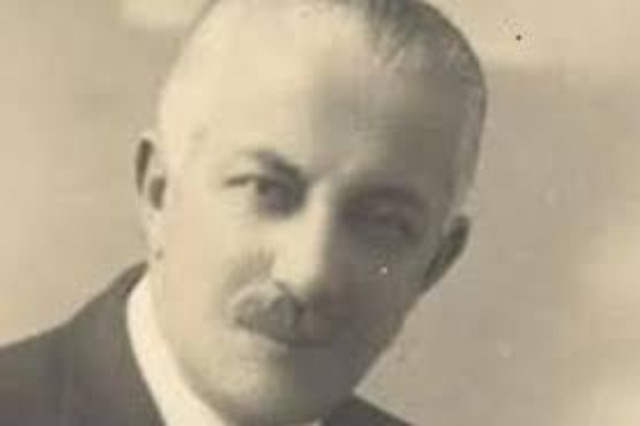
The National Museum “House with leaves” today commemorates the composer, diplomat and politician, Lec Kurti (May 9, 1884 – December 1948).
Lec Kurti was born in the city of Shkodra. He studied composition and diplomacy in Pesaro, Italy until 1916. He would continue his studies in the field of music at the Academy of Fine Arts in Venice and then in Political Science in Rome.
Lec Kurti was engaged in musical creativity until 1916 and then devoted himself entirely to diplomatic and political activity.
From 1918 to 1922, Lec Kurti was Consul in Bari. In his diplomatic career, the task of charge d’affaires in Athens would not be missing, which he held until 1927, where he was decorated by the Greek state for his contribution to the relations between the two countries.
The peak of Lec Kurti’s diplomatic activity is his representation of Albania in the League of Nations 1930-1935. A dignified representation that increased the prestige of Albania in the international arena. “Lec Kurti was intelligent, polyglot, very cultured, well acquainted with the Albanian issue and international law”, says another prominent diplomat, Fuat Asllani.
Lec Kurti was also the vice-president of the Parliament and Minister of Education during the Kingdom. The highest diplomatic task was that of Albania’s representative at the League of Nations in Geneva (1927–1936). After that he would be a Consul of Albania in Rome until 1939. During the Second World War, Lec Kurti was a deputy of the National Front and a few days before November 29, 1944, he finally left Albania.
Lec Kurti composed the works: “Gavotte”, in B major, February 24, 1912; “Scherzo”, in E major, December 17, 1913, “Scherzo”, in A minor, December 12 ..; the romances “Romanza senza parole”, in E major, on December 9, 1913, “Preludio”, in A minor, on March 20, 1913; “Andante”, in A major, “Presto”, in C minor; “Preludio”, in G minor, May 11, 1914.
The works for canto “Le fronde che vedresti rinverdire, romanza, parole di Ada Negri”, December 5, 1913 or “N’amasti mai”, romances that were written in Venice on March 2 1914. Kurti’s other creations are “Fugue for four voices”, “Marsh Weed”, clavier, December 30, 1913, as well as two scores for symphony orchestra, one dated March 10, 1914 and the other April 2, 1914; “Sonata, for violin and piano” in E major; “Adagio, for violin and piano” in F major; “Allegro un po sostenutto, for violin and piano” in A minor; “Non troppo lento, for violin and piano”; “Sonata, for violin and piano” in C major. Also, “Sonata, for violin and piano” in D minor, Venice, dated September 15, 1915, “Romanza for violin and piano”, written on February 3, 1914. Lec Kurti’s creativity continues with other works for chamber ensembles: “Trio for violin, cello and piano”, dated March 6, 1914; “Quartetto”, in G minor for strings, written on April 24, 1914; “Tema con variazioni”, in A minor; “Allegro molto moderato”, in C minor, January 27, 1914, “Preludio”, in D Major, for piano, March 20, 1914; “Prelude”, January 29, 1914; “Berceuse”, in la Mazhor, January 12, 1914; “Minuetto”, in A major, December 6, 1914, “Preludio”, in G minor, December 20, 1914; “Sonata”, in C minor, March 19, 1914.
But the main work is the Opera “Arbëreshtja”, Venice, May 1915, of which only 11 fascicles remain. Even from what remains, it is considered not only as the first Albanian opera (until today it was believed that the first opera was “Mrika” by Preng Jakovo, year 1959), but also as a very professional work with an Albanian theme.
Leci can be considered, without fear, as a classical-romantic composer. It is classical in terms of form, while somewhat romantic, due to the harmonious language used and the avoidance of the regularity of classical formal principles. The last two years of his creativity, 1915-1916, mark the years of his compositional maturity. From the scores of 1915, the form of the sonata (Piano Sonata in C-), which creates the impression of Beethoven’s influence, appears for the first time in his work. Undoubtedly, in the creativity of Lec Kurti, this work also marks his creative maturity to be completed in 1916 with “Luisa di Charpentier, quadro II”. The latter proves the tendency towards romanticism, as well as the good familiarity with Wagner’s creativity.
One of Kurt’s beautiful and impressionistic compositions is “National Anthem”, with text by Gjergj Fishta.
A few days before the end of the National Liberation War, Lec Kurti, like many other Albanian nationalists, escaped the punishment of the communists, who had taken power in Albania after the Second World War. This is because he had held the post of vice president of the National Front Party. Hoxha’s government demanded from the Italian authorities their return to Albania at any cost.
Lec Kurti, being the first Albanian member of the Academy of Sciences of the Kingdom of England, asked to go to London to talk with the authorities about the rather sharp problem of the Italian authorities not returning the escaped Albanian nationalists. Then, it was decided that the Albanians would not return, but also not stay in Italy. Thus, everyone was given the right to emigrate elsewhere.
Lec Kurti passed away in Rome in December 1948. Since that time, his music has remained completely unknown to the general public, even to professionals.
/a.p/
Të ngjashme
Latest News
Most read








 RTI
RTI