
 English
 Français
 Deutsch
 Italiano
 Turkish
 Greek
 Serbian
The Ancient City of Butrint




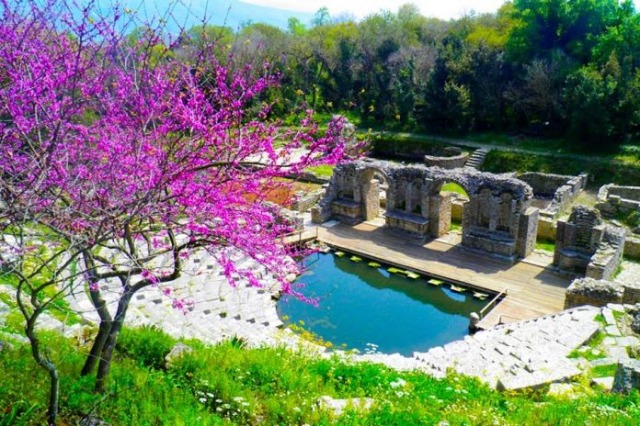
The 2500-year-old ruins of Butrint have always been an attraction not only for tourists but also for numerous media outlets engaged in promoting tourism. The monuments of Butrint reflect its rich history, including ancient ruins dating back to Greek and Roman times, covering the period from the 8th century BC to the 16th century AD, more than two millennia. Among the countless monuments of the site, Butrint is the one that has introduced Albania to the world. The 2500-year-old ruins of Butrint, within a magnificent 30 km² park, are some of the most beautiful and well-preserved in Europe. For this reason, in 1992, Butrint was declared a World Heritage Site by UNESCO and tops every international list of attractions to see in Albania! Due to the interest this place holds in international tourism, it remains an oasis of rare tranquility, where one can endlessly stroll without spending hours in long queues or facing the hassles that would accompany such an experience in similar places.
Monuments in Butrint
The monuments of Butrint reflect its rich history starting from the Hellenistic period and continuing through the Roman, Byzantine, and Venetian periods. Although life within Butrint had begun earlier, the influence of Greek culture in Albania started in the 6th century BC when Greeks from Corfu settled on the hill of today’s Butrint. At that time called Buthrotum, according to mythology, this name comes from the word “buthrotos” (wounded ox), referring to the sacrifice of an ox by the Trojans when they founded the city on the hill. Even the great poet of ancient Rome, Virgil, tells us about Aeneas’ stop in Buthrotum in his epic poem, the Aeneid!

The Amphitheater of Butrint
At the entrance of the ancient city, one of the best-preserved masterpieces of this period stands out: the Amphitheater of the 3rd century BC, where once 2500 people could sit, and where the performances staged still allow one to experience its former glory. Near the theater are the ruins of the Temple of Asclepius (1st – 2nd century), the ancient god of health and protector of the city. When the Romans arrived around the 2nd century BC, the major constructions in the city had been completed. In 44 BC, Butrint became a colony of Rome, initiating a period of a series of constructions that are now evidence of early Christianity in Albania. The numerous columns and mainly the mosaic with 69 medallions are two of the rare beauties of this place. Furthermore, the magnificent walls of the 6th-century basilica and its mosaics, the fortifications on the hillside, which date back to different centuries, and the Lion Gate (5th century AD), which shows the relief of a lion devouring a deer, symbolize the defense of the city.

The Castle
At the top of the hill lies the Castle, from the Venetian period of the city, which was built where the ancient acropolis stood in the 14th century and was reconstructed in the same way in 1930. Today, the Butrint Museum is also located within its premises. The view from the top of the hill is the spectacular final gift of Butrint. Lake Butrint, the Vivari Channel connecting the Butrint Valley with the Ionian Sea, the triangular Castle built nearby, and the dense forests adorning the entire landscape are the frame of this masterpiece, the rare microcosm of the history of the Mediterranean that is Butrint.

Butrint has two things that make it quite unique: various remains indicating a long duration of occupation and lush vegetation. Butrint is part of the large Butrint National Park, located less than 20 kilometers south of the city of Saranda. All the main attractions are on the closest hill to the entrance gate. You should plan a visit that can last about three hours.
/k.s/
Të ngjashme

Latest News










Most read










 RTI