
 English
 Français
 Deutsch
 Italiano
 Turkish
 Greek
 Serbian
The ancient Illyiran city of Apollonia




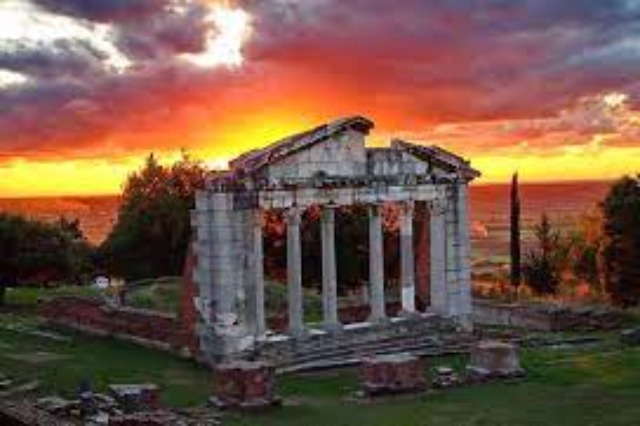
The ancient Illyiran city of Apollonia resides on a windswept hilltop overlooking the plains of southern Albania out to the Adriatic. Founded in 588 BC, much of the city remains unearthed with the only real excavations taking place within the city walls. The undoubted highlight has to be the restored façade of the 2nd century AD administrative centre complete with elegant pillars and the theatre sat opposite.
Housed within the walls of the much later Byzantine Monastery and Church of St Mary is the Apollonia Museum which gives good insight in to the city and showcases some of the incredible and well-preserved artefacts recused from the ruins, including an intricately restored and extremely rare Illyrian shield, various marble busts and statues and exquisite glassware and ceramics.
Apollonia is among the largest cities in the Adriatic basin and the most mentioned among 30 other cities, of the same name, of ancient times. It was founded around the beginning of the IV century p.e.s. The ruins of Apollonia were discovered in the early 19th century. The earliest archeological traces are some objects of the Iron Age, typical of Illyrian culture. From the first centuries of city life are preserved some remnants of the defensive wall and an archaic temple dedicated to Artemis, the most worshiped goddess of the Apollonians.
Apollonia, after Dyrrah, was the most important city in the Adriatic basin and the most mentioned among the 30 other cities that bore the same name in ancient times. It rose on a hill in a position that dominates the whole area and through the Vjosa river valley connected to the Adriatic Sea. Lying on an area of about 140 ha and surrounded by a wall about 4 km long Apollonia was a large commercial and industrial center. Perched on the last ridge of the beautiful and fruitful hills of Mallakastra, Apollonia dominated almost the entire expansive space that stretched at its feet and ended at the Adriatic Sea. This field formed by the alluvium of the river Seman and Vjosa has been one of the most fertile regions of Fushë e Myzeqe.
Unlike other coastal cities which had risen along the coast, Apollonia had risen further inland, a few miles off the coast. However, it was connected to the coast via the Vjosa River, which at that time was navigable.
Of great interest to the visitor in Apollonia are the monument of the Agonites, the Odeon, the Library, the surrounding wall, the Porch, the villas with impluvium, the Roman villas with mosaics, the archeological museum, the Church of St. Mary.
/Klara Ruci/
Të ngjashme










Most read










 RTI