
 English
 Français
  Deutsch
 Italiano
 Turkish
 Greek
Greek Serbian
The Belgrade-Prishtina dialogue, this is what the 11-point Franco-German proposal foresees




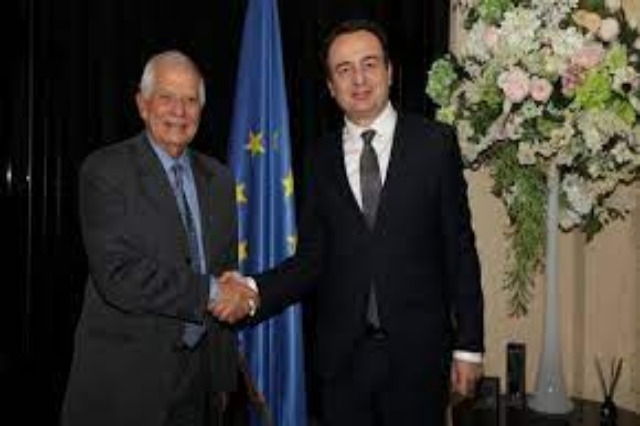
The European Union has published the content of the 11-point Franco-German proposal for the normalization of relations between Kosovo and Serbia. From the first point of this plan, it is required that the two countries mutually recognize their respective documents and national symbols, including passports, diplomas, license plates and customs stamps.
Likewise, Kosovo and Serbia are required to respect their independence, autonomy and territorial integrity and the right to self-determination.
The parties must commit to resolve any disputes between them by peaceful means, while Serbia is requested not to oppose Kosovo’s membership in any international organization.
On Monday (February 27), a high-level meeting was held for the normalization of relations between Kosova and Serbia, mediated by the EU, discussions that lasted over 5 hours. Despite the progress achieved, the parties still did not reach a final agreement.
The head of the European Union’s foreign policy, Josep Borrell, during the press conference after the meeting with Vucic and Kurti, said that the parties pledged to implement what was signed in Brussels and that no further discussions are needed regarding the EU’s proposal on the Franco-German plan.
The Franco-German plan
Article 1
The parties will develop normal, good neighborly relations with each other on the basis of equal rights.
Both Parties shall mutually recognize their respective documents and national symbols, including passports, diplomas, license plates and customs stamps.
Article 2
Both parties will be guided by the goals and principles set forth in the Charter of the United Nations, especially those of the sovereign equality of all states, respect for their independence, autonomy and territorial integrity, the right to self-determination, the protection of the rights of to man , and non-discrimination.
Article 3
In accordance with the Charter of the United Nations, the Parties shall settle any dispute between them exclusively by peaceful means and shall refrain from the threat or use of force.
Article 4
The parties proceed on the assumption that neither can represent the other in the international sphere nor can act on one’s behalf.
Serbia will not oppose Kosovo’s membership in any international organization.
Article 5
Neither party will block, nor encourage the other to block, the other’s progress on their respective EU paths based on their own merits. Both parties will respect the values mentioned in Articles 2 and 21 of the Treaty on European Union.
Article 6
While the current Agreement constitutes an important normalization step, both sides will continue with renewed impetus the EU-led dialogue process, which should lead to a legally binding agreement for the full normalization of their relations. .
The parties agree to deepen future cooperation in the fields of economy, science and technology, transport and communications, judicial and law enforcement relations, posts and telecommunications, health, culture, religion, sports, environmental protection, missing persons, persons displaced and other such fields, through the conclusion of specific agreements.
Details will be agreed in additional agreements brokered by the EU-led Dialogue.
Article 7
Both parties undertake to create specific agreements and guarantees, in accordance with the relevant instruments of the Council of Europe and relying on existing European experiences, to ensure an appropriate level of self-management for the Serbian community in Kosovo and the ability to provide services in specific areas, including the possibility of financial support from Serbia and a direct communication channel for the Serbian community with the Government of Kosovo.
The parties will formalize the status of the Serbian Orthodox Church in Kosova and provide a strong level of protection for Serbian religious and cultural heritage sites, in line with existing European models.
Article 8
The parties will exchange Permanent Missions. They will be placed at the headquarters of the respective Government.
Practical matters related to the establishment of Missions will be dealt with separately.
Article 9
Both sides take into account the commitment of the EU and other donors to create a special package of investment and financial support for the Parties’ joint projects in economic development, connectivity, green transition and other key areas.
Article 10
The parties will establish a joint Committee, chaired by the EU, for monitoring the implementation of this Agreement.
Both parties confirm their obligation to implement all past Dialogue agreements, which remain valid and binding.
Article 11
Both parties undertake to respect the Implementation Guide annexed to this Agreement.
Të ngjashme

Latest News












 RTI
RTI