
 English
 Français
 Deutsch
 Italiano
 Turkish
 Greek
 Serbian
The bridge of Kamara is an important historical and architectural monument




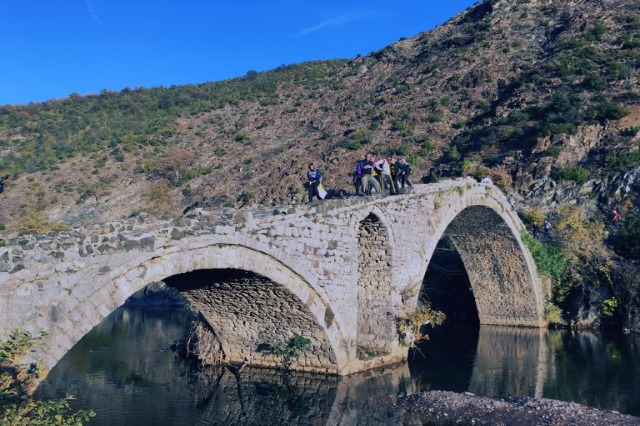
Kamara Bridge is one of the most important historical and architectural monuments in the Librazhd area and is appreciated for its unique features and the strategic position over the River Shkumbin.
Kamara Bridge is located about 5 km from the city of Librazhd, in the Administrative Unit in Miraka and has a significant history and cultural value.
This medieval bridge served as a key element on the ancient Road Egnatia, being positioned at a strategic point at the fork of this road. This makes the bridge particularly important in the context of transport and trade links at the time of its construction.
For the values that it carries, this bridge was declared a Category I Cultural Monument in 1963.
This bridge is asymmetrical and is built on three arches made of gray stones taken from Mount Murrash.
Built around 1714, Kamara Bridge has experienced several reconstructions, one during the Ottoman period.
It is about 40 m long and about 3.5 m wide with boat-shaped discharge windows between. The main arch of the bridge has a span of 23 meters and the right arch is in a circular shape.
The pedestrian plinth is built with a cobblestone from the smooth river stones. She received this name, because of a niche located on her right side. This niche served as an announcement for people who would cross the bridge. When the weather was bad and it was very windy, the bell rang as a kind of warning to cross it carefully and so as not to fall off the bridge.
On the left bank, the bridge rests on the rock formation of Mount Polis, while on the right hand side, the bridge rests on the gravel of the river bed.
At the time of its construction, it connected the medieval caravan route that came from Elbasan and from the bridge of Haxhi Beqari crossed the left of the river, following the route of the ancient Road Egnatia, to continue to Korça and further to Macedonia, Greece up to Istanbul.
The other road that started by the Kamara bridge, the one that connected Elbasan with the province of Dibër, via Klenja and Zerqan, was disconnected.
Today, Kamara Bridge continues to be a point of local history and culture, attracting the attention of visitors and researchers who want to get to know the rich heritage of this area better.
The National Council of Restorations, at the proposal of the Institute of Cultural Monuments, has declared the Kamara Bridge a protected area.
The areas surrounding the heritage objects are protected as public property and as an integral part of the natural landscape, which helps to preserve and highlight the Cultural Heritage.
/a.p./
Të ngjashme




Latest News










Most read










 RTI