
 English
 Français
 Deutsch
 Italiano
 Turkish
 Greek
 Serbian
The Canon of Lek Dukagjini and Bloodfeud




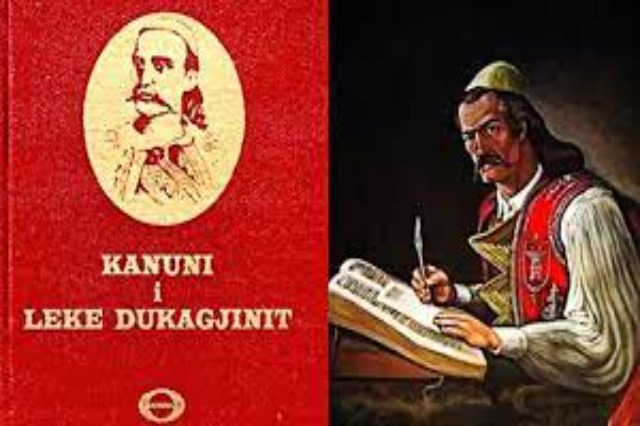
In Albanian, the term Kanun refers to the country’s customary law, which was founded on a set of fundamental ideas that served as its permanent pillars, such as blood equality, personal honor, hospitality, and faith. The corpus juris was built on the foundation of these ideas, which were broken down into various norms.
The Kanun of Lek Dukagjini is a centuries-old rule of conduct that governs both individual and collective behavior. The main element of northern subculture has emblematically influenced the entire area of Albanian ideas, beliefs, and practices, emerging as the fundamental source of the country’s customary law.
The majority of studies on blood feuds are anthropological in character; however, this paper will discuss how blood feuds and mutual honor killings are profoundly rooted in the traditional Albanian social code, the canon, which is especially influential in historically isolated places. The code is far from being abolished; its standards continue to govern many aspects of Albanian daily life to this day. Inequality between men and women, as well as blood feuds, is still prevalent.
The Canon of Lek Dukagjini, which is mostly unknown and misunderstood outside of Albania, is the most representative and unique feature of Albanian society.
Nowadays, the Canon is primarily discussed in terms of blood feuds. To grasp this, we must first grasp certain fundamental concepts from the Canon, such as honor and word of honor (Besa). This Canon collects the laws that govern culture, focusing primarily on the concept of honor. 18 “The cornerstone of all is the notion of personal honor,” writes British political journalist Noel Malcolm. The next step is to ensure that all people are treated equally. The freedom of everyone to act according to his own honor, within the confines of the law, without submitting to the order of the other, is derived from these, as is the fourth principle, the word of honor, promise (besa), which creates an inviolable trust position.” “Word of honor – Besa” is the most sacred thing for Albanians, it is a sacred promise. Man’s “word of honor – besa” is a word of honor that “goes beyond the grave.” “Word of honor – besa” is an untranslatable term in other languages. The word that comes closer to it is promise, but within the Canon it is used with a different meaning and indicates the ceasefire given to someone when trying to kill someone. In order to understand the meaning and importance of this concept in Albanian culture, it is important to know the legend of the Dead Brother.
The legend concludes by explaining the meaning of this important concept. Dishonour is defined as a violation of the word of honor (Besa) or the code. Worldly Honor (Honor), Word of Honor (Besa), and Hospitality (Hospitality) were all inextricably linked in this way. The pillars that comprised the universe of life of the northern Albanian highlanders were honor, word of honor – Besa, and hospitality. Word of Honor (Besa) symbolized their highest moral value; it was their true religion, and Hospitality was their most sublime attribute. Honor is frequently protected and restored through blood feuds. A legal law controlling blood feuds is described in one of the canon’s numerous articles (blood feud). Blood feuds are part of a centuries old Albanian system of honor killings that serve as a type of self-administered justice based on the principle of “blood for blood” (blood for blood), which excuses the loss of individual or family honor. Disputes over marriage, land, and property are the most common sources of complaints that can lead to dishonour.The canon and its idea of honor were formed to acknowledge the role of murdering for revenge and the implementation of a proportionality of killings to prevent out-of-control, unequal outbreaks of violence by establishing sanctions for certain actions.
Taking revenge for a transgression or insult to one’s or one’s family’s honor, a blood feud is a sanctioned killing that cleanses the honor with blood. Customary meanings can forecast the perpetrator’s goal, but in fact, the list of prospective targets has been enlarged to include any male relative of the killer.Blood feud reconciliation has also been codified by the Canon as a choice of human right that can be exercised willingly by the family.
The blood feud reconciliation might take place in one of two ways: with the admittance of witnesses from the murdered’s house and the parish priest, or with the payment of money for the murdered’s house, the amount of which and when it should be paid were established by the area’s elders and men. The presence of the Institute of Reconciliation, it should be underlined, demonstrates the Albanian people’s progress towards a civilized society, as well as the general tradition of settling conflicts and disputes through peaceful ways through mediation.
Të ngjashme




Latest News










Most read










 RTI