
 English
 Français
 Deutsch
 Italiano
 Turkish
 Greek
 Serbian
The findings at the 8,000-year-old settlement of Lin are revolutionizing archaeological understanding of Prehistoric Europe




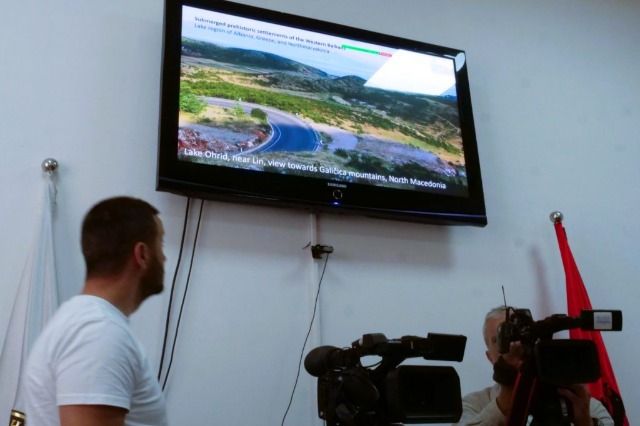
The Albanian Academy of Sciences hosted a scholarly event today in the “Academicians” Hall, featuring a presentation by Professor Albert Hafner in the field of archaeology.
Prof. Hafner delivered an open lecture on the archaeological discoveries at the Lin settlement, a result of the joint Albanian-Swiss expedition, which led to the discovery of the oldest pile dwelling settlement in Europe, dated over 8,000 years old.
These findings were part of the LIN 3 project, in collaboration with the Institute of Archaeology at the Albanian Academy of Sciences and the University of Bern, Switzerland.
The event was attended by the president of the Albanian Academy of Sciences, Acad. Skënder Gjinushi, Vice President Acad. Vasil Tole, Chairman of the Social and Albanological Sciences Section, Acad. Gëzim Hoxha, Director of the Institute of Archaeology, Adem Bunguri, team members, as well as prominent scholars and archaeologists.
Through this open lecture, Prof. Hafner argued that the new findings in Albanian territory could revolutionize archaeological knowledge of Prehistoric Europe and the origins of agriculture. The objects unearthed during the LIN 3 project revealed Europe’s oldest pile dwelling settlement, dating back 8,000 years.
Taking into account the underwater archaeological research initiated by the Institute in 2013 in Lake Ohrid, Prof. Hafner, along with his Albanian colleagues, launched the LIN 3 project, which is believed to be one of the largest archaeological sites of its kind.
The research and discoveries at this site have yielded significant results for the scientific community.
In 2023, dendrochronological and radiocarbon analyses revealed that the pile dwellings at LIN 3 were the oldest in Europe, dating back to 6,000 BC.
These studies draw parallels with other settlements in Dunavec, Dispilio, Maliq, and Plloçë.
Hafner considers this the oldest settlement of its kind in Europe.
Excavations, both on land and underwater, conducted between 2021 and 2024, demonstrate that this site was inhabited for approximately 2,000 years, from 6,000 BC to 4,000 BC.
Prof. Hafner is one of the leading figures in Europe for the study of pile dwellings.
Within the framework of this major European project, he established a successful collaboration with Albania’s Institute of Archaeology.
Following extensive research in Alpine pile dwellings, Prof. Hafner, along with other scholars, has focused on pile dwelling studies in the Western Balkans since 2018 through the European project EXPLO.
The work is ongoing, and the results are highly promising.
The findings from previous years’ research (2021, 2022, and 2023) and the laboratory analyses conducted at the University of Bern in Switzerland, as well as those in collaboration with the University of Oxford in England, confirmed that the pile dwelling settlement “Lin 3” is the oldest of its kind in Europe.
This year’s excavations, led by the Albanian-Swiss expedition, aim to further understand the settlement’s extent, duration, material and spiritual culture of the Neolithic inhabitants, the complexity of these lake dwellings’ structures, as well as the agricultural and pastoral economy and the cultural and chronological relationships with similar settlements in surrounding regions (in the Korça basin, Northern Greece, and North Macedonia).
Meanwhile, the Ministry of Economy, Culture, and Innovation is preparing the necessary archaeological documentation to protect and declare the site an archaeological zone.
/a.c/
Të ngjashme




Latest News










Most read










 RTI