
 English
 Français
 Deutsch
 Italiano
 Turkish
 Greek
 Serbian
The Italian magazine “Domus”: Albania, the land of impressions




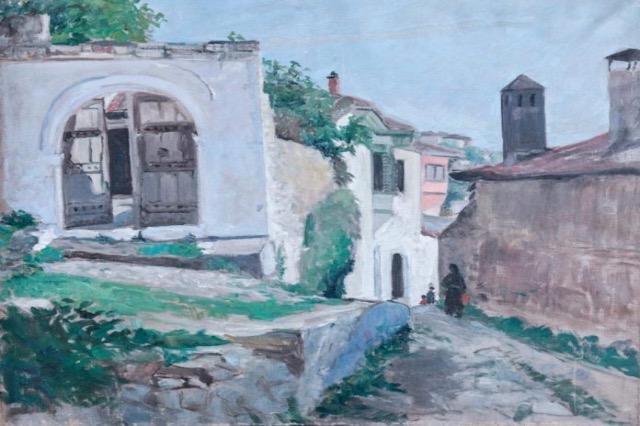
Today, amidst political disputes and often labeled as a country of migrants, Albania remains a land rich in art and history, vividly portrayed in the paintings of the great artist Vangjush Mio.
In European memory, Albania is frequently linked with migration, and the notable arrival of immigrants in Italy on August 8, 1991, at the port of Bari remains unforgettable. This event was regarded as a significant occurrence in the Albanian people’s uprising, as detailed in an article published in the Italian magazine “Domus.”
However, Albania isn’t solely defined by its immigrant narrative; it’s a land abundant in art and history, a facet vividly depicted by the artist Vangjush Mio.
Mio is regarded as the poet of Albanian landscapes, the first and sole Albanian impressionist, and the pioneer of Modern Art in Albania.
Vangjush Mio was born in 1891 in Korça, a town situated on the border with Greece and North Macedonia, recognized as the “Little Paris of Albania,” within a family of modest origins.
At a tender age, he relocated to Bucharest alongside his brother. He commenced his studies at the National University of Arts in Bucharest in 1915 before venturing to Rome in 1920 to pursue further education at the Royal Academy of San Luca.
Deeply captivated by the Italian impressionist painting of Silvestro Lega, Giovanni Fattori, and Telemaco Signorini, known as Macchiaioli, Mio delved into studying their techniques, the Color Code, and their syntax.
However, Mio was compelled to return to Albania. Regrettably, sustaining the life of an artist in the capital necessitates numerous activities, primarily due to financial constraints.
He accepted the role of an art teacher at the French school in Korça, a position that not only provided Mio with financial stability but also bestowed upon him significant prestige due to his influential role.
Among his students was Enver Hoxha, a notable politician within the Communist Party, who subsequently ascended to become the leader of Albania.
Due to this employment and the esteemed position he held, the artist secured the opportunity to return to Italy in 1924 and complete his studies with a state scholarship.
Nevertheless, Albania remained his greatest passion, and after finishing his studies and undertaking various travels, Vangjush Mio chose to return to his homeland.
Vangjush Mio in his studio
The utilization of photography became indispensable for him, and he acquired the techniques from his friend and photographer, Kristaq Sotiri.
This became crucial as it enabled him to meticulously examine every detail of his homeland without overlooking anything, thus facilitating the reproduction of these details on his canvases through his brushstrokes.
The forms, the shadows, the tones; every element held utmost importance, intricately true and profoundly complex in its simplicity.
To Mio, Albania held fundamental significance, not solely for his artistic odyssey but for its history, landscape, distant past, and present—a country adorned with countless beauties, often perhaps too easily overlooked and forgotten.
He painted it with the fervor of a muse, capturing every corner intricately.
The colors, the sea, the churches, the hills, the inhabitants—all portraying a land waiting to be discovered and captured.
Amidst the pristine nature, the Monastery of Saint Naum stands prominently. Exhibiting Byzantine architecture, this monastery overlooks Lake Ohrid.
The Monastery of Saint Naum belonged to Albania until 1925 when King Zog of Albania made the decision to offer it to the Yugoslavs as a gesture of gratitude for their assistance in reclaiming power.
The strong discontent among the Albanian people regarding this decision was palpable. In 1941, Mio deliberately chose it as a subject for his artwork, perhaps as a way to keep it close to himself and his people.
The perspective is captivating. The monastery appears almost like an architectural embellishment, framing the deserted white street where a boy sits, seemingly lost in his reading, immersed in silence.
The dominance of white captivates the scene, creating a fading effect, yet at the apex of the artwork, the subtle shadow of the monastery draws the viewer’s attention toward it.
Mio adeptly employs a light material that seamlessly melds with the forms and illuminations of that cherished landscape, skillfully translating painting techniques into a lifelike portrayal.
His rendition feels immersive, almost as if one can sense the warmth of the sun, hear the chirping of birds, and feel the gentle rustle of the wind. The ‘impression’ becomes uniquely his own, transcending the canvas into an experiential reality.
Mio loved to travel, and his artworks found their way to various exhibitions. Notably, his works were showcased in Italy, particularly in Venice, where he took part in the renowned Biennale in 1923.
His art also reached audiences in the Middle and Far East, Romania, and even featured in the Biennale held in Alexandria, marking the widespread reach of his artistic contributions.
Nonetheless, his true passion lay in exploring his homeland, Albania. He made a stop in Berat, situated in the southern region of the country, and created a painting depicting the town, which has since gained recognition as a UNESCO World Heritage Site.
Vangjush Mio’s artwork titled “Saint Naum Church, 1941,” rendered in oil on canvas, reflects a synthesis of cultural amalgamations between the West and East, divided by the Osum River. In this depiction, Mio opted for the simpler, more ‘Mediterranean’ side of Berat.
The portrayal evokes reminiscences of a small town in Puglia, its shores not far distant, characterized by dense, uneven vegetation, cobbled streets, and a vast expanse of white that provides a sense of depth and perspective.
Mio’s attention to perspective is precise and deliberate; every detail is meticulously studied, leaving nothing to chance. The lightness of the pictorial material adds a poetic depth to the artwork.
In Korça, his birthplace, nestled within a typical Ottoman residence, stands the Vangjush Mio Museum, making a sanctuary dedicated to him. Every detail is meticulously preserved and guarded with utmost care.
Within the museum, his still works grace easels, landscapes and still lifes adorn the walls, alongside portraits and nudes. Wooden floors and planks contribute to the ambiance, encapsulating not just his art but also his home.
Vangjush Mio considered Albania as his paramount wellspring of inspiration, his muse, and the foundation of his artistic endeavors.
Të ngjashme




Most read










 RTI